Volkova Natalia, Berillo Dmitriy
Department of Biotechnology, Lund University, P.O. Box 124, 22 100 Lund, Sweden.
Department of Solid State Physics, Lund University, P.O. Box 118, 22 100 Lund, Sweden.
Gels. 2021 Sep 30;7(4):159. doi: 10.3390/gels7040159.
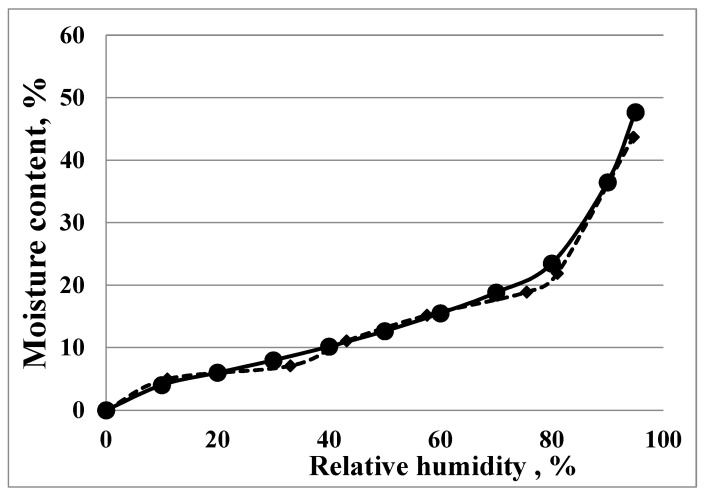
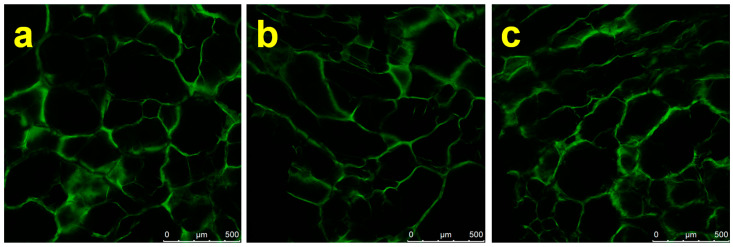
We investigated the water sorption properties of macroporous cryogels of gelatine (Gel) and dextran dialdehyde (DDA) prepared via cryogelation at 260 K and following the freeze drying processes. Water vapour sorption isotherms for aerogels were studied at 293 K by two independent methods: static-gravimetric and dynamic vapour sorption (DVS) over a water activity range of 0.11-1.0. Experimental data were fitted by use of the Brunauer-Emmett-Teller (BET) and Guggenheim-Anderson-de Boer (GAB) models. The BET model (for a water activity range of 0.1 ≤ / ≤ 0.5) was used to calculate the sorption parameters of the studied cryogels (the monolayer capacity, surface area and energy of interaction). In comparison with BET, the GAB model can be applied for the whole range of water activities (0.1 ≤ / ≤ 0.95). This model gave an almost perfect correlation between the experimental and calculated sorption isotherms using nonlinear least squares fitting (NLSF). Confocal Laser Scanning Microscopy (CLSM) was used to confirm the structural differences between various DDA:Gel cryogel compositions. Thermogravimetric analysis and DSC data for aerogels DDA:Gel provided information regarding the bonded water loss, relative remaining water content of the material and the temperature of decomposition. Estimation of the amount of bound water in the cryogels after the freeze drying process as well as after the cycle of treatment of cryogels with high humidity and drying was performed using DSC. The results of the DSC determinations showed that cryogels with higher gelatin content had higher levels of bonded water.
我们研究了通过在260 K下冷冻凝胶化并经过冷冻干燥过程制备的明胶(Gel)和二醛葡聚糖(DDA)大孔冷冻凝胶的吸水性能。通过两种独立方法在293 K下研究了气凝胶的水蒸气吸附等温线:静态重量法和动态蒸汽吸附(DVS),水活度范围为0.11 - 1.0。实验数据采用布鲁诺尔-埃米特-特勒(BET)和古根海姆-安德森-德布尔(GAB)模型进行拟合。BET模型(对于水活度范围0.1≤/≤0.5)用于计算所研究冷冻凝胶的吸附参数(单层容量、表面积和相互作用能)。与BET相比,GAB模型可应用于整个水活度范围(0.1≤/≤0.95)。该模型通过非线性最小二乘法拟合(NLSF)在实验和计算的吸附等温线之间给出了几乎完美的相关性。共聚焦激光扫描显微镜(CLSM)用于确认各种DDA:Gel冷冻凝胶组成之间的结构差异。DDA:Gel气凝胶的热重分析和DSC数据提供了有关结合水损失、材料相对剩余含水量和分解温度的信息。使用DSC对冷冻干燥过程后以及高湿度和干燥处理循环后的冷冻凝胶中的结合水量进行了估计。DSC测定结果表明,明胶含量较高的冷冻凝胶具有较高水平的结合水。