Section on Experimental Radiology, Department of Diagnostic and Interventional Radiology, University of Tuebingen, Tuebingen, Germany.
Institute for Diabetes Research and Metabolic Diseases of the Helmholtz Centre Munich at the University of Tuebingen, Tuebingen, Germany.
MAGMA. 2022 Jun;35(3):401-410. doi: 10.1007/s10334-021-00970-9. Epub 2021 Oct 26.
To provide a basis for the selection of suitable emulsifiers in oil-in-water emulsions used as tissue analogs for MRI experiments. Three different emulsifiers were investigated with regard to their ability to stabilize tissue-like oil-in-water emulsions. Furthermore, MR signal properties of the emulsifiers themselves and influences on relaxation times and ADC values of the aqueous phase were investigated.
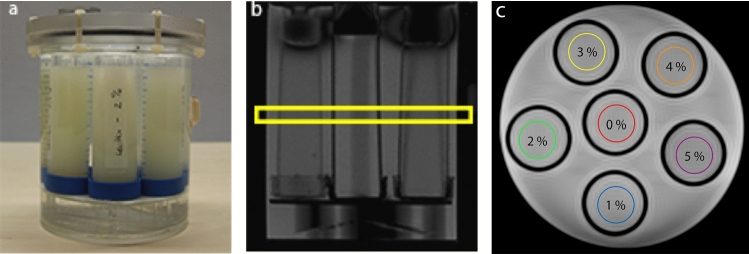
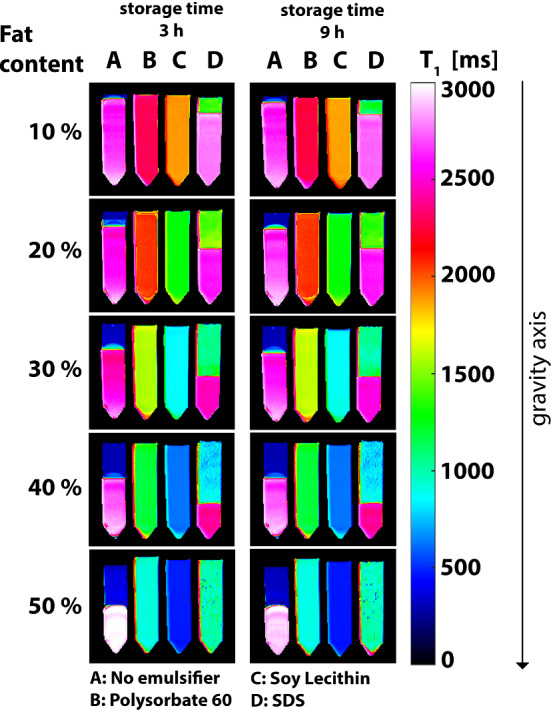
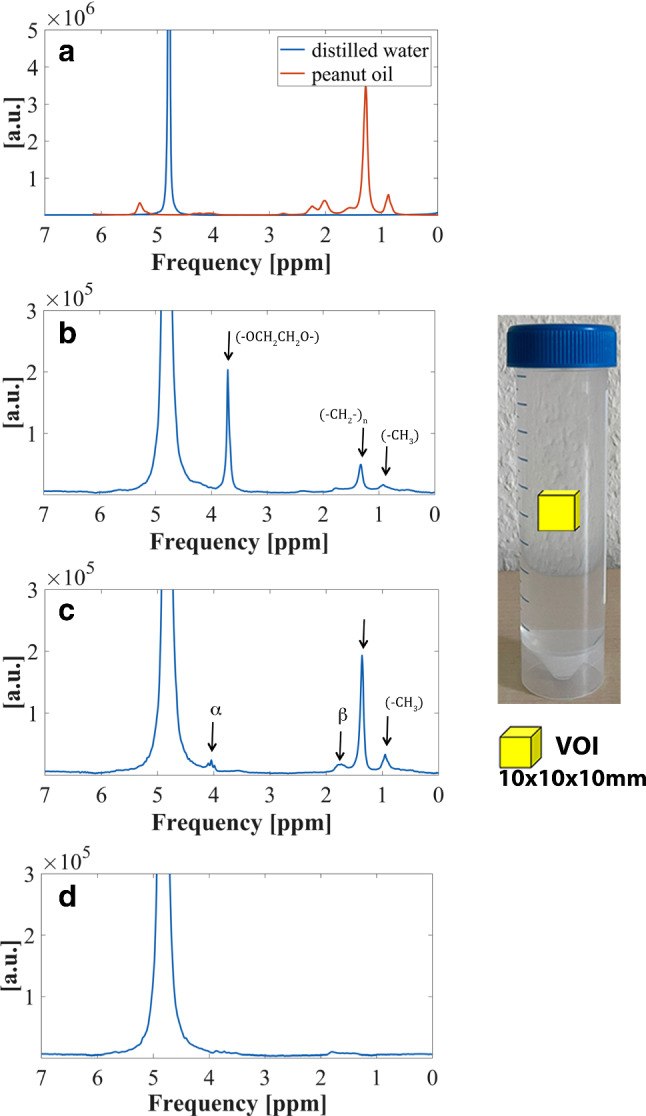
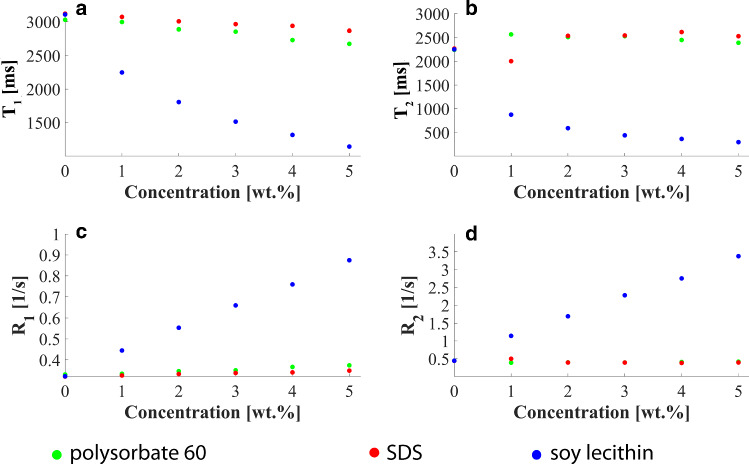
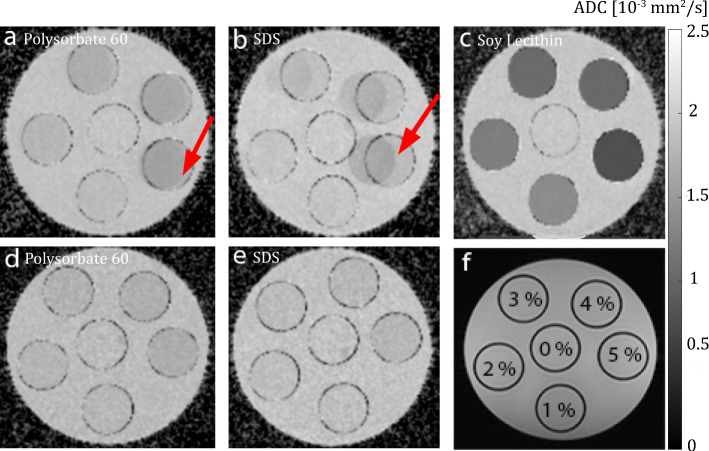
Polysorbate 60, sodium dodecyl sulfate (SDS) and soy lecithin were used as emulsifiers. MR characteristics of emulsifiers were assessed in aqueous solutions and their function as a stabilizer was examined in oil-in-water emulsions of varying fat content (10, 20, 30, 40, 50%). Stability and homogeneity of the oil-in-water emulsions were evaluated with a delay of 3 h and 9 h after preparation using T mapping and visual control. Signal properties of the emulsifiers were investigated by H-MRS in aqueous emulsifier solutions. Relaxometry and diffusion weighted MRI (DWI) were performed to investigate the effect of various emulsifier concentrations on relaxation times (T and T) and ADC values of aqueous solutions.
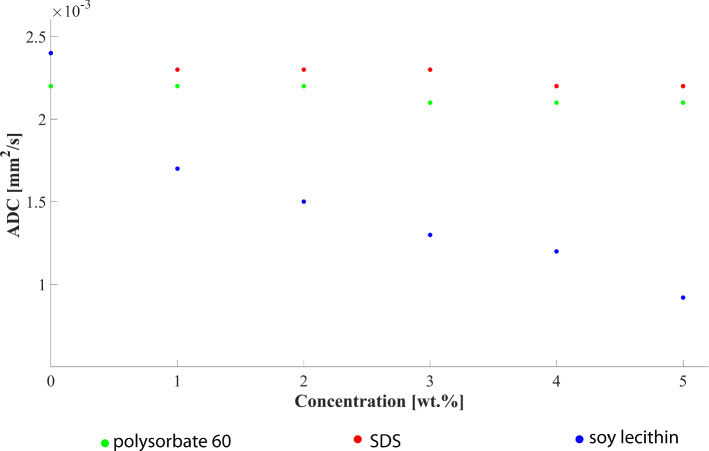
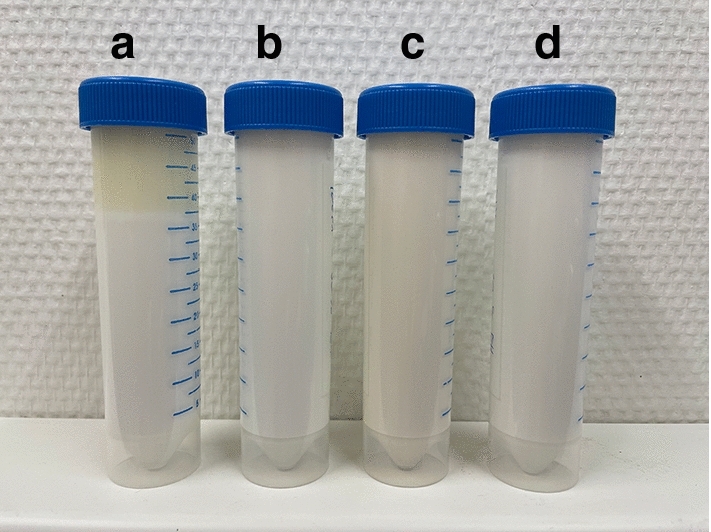
Emulsions stabilized by polysorbate 60 or soy lecithin were stable and homogeneous across all tested fat fractions. In contrast, emulsions with SDS showed a significantly lower stability and homogeneity. Recorded T maps revealed marked creaming of oil droplets in almost all of the emulsions with SDS. The spectral analysis showed several additional signals for polysorbate and SDS. However, lecithin remained invisible in H-MRS. Relaxometry and DWI revealed different influences of the emulsifiers on water: Polysorbate and SDS showed only minor effects on relaxation times and ADC values of aqueous solutions, whereas lecithin showed a strong decrease in both relaxation times (r = 0.11 wt.% s, r = 0.57 wt.% s) and ADC value (Δ(ADC) = - 0.18 × 10 mm/s⋅wt.%) with increasing concentration.
Lecithin is suggested as the preferred emulsifier of oil-in-water emulsions in MRI as it shows a high stabilizing ability and remains invisible in MRI experiments. In addition, lecithin is suitable as an alternative means of adjusting relaxation times and ADC values of water.
为磁共振成像实验中用作组织类似物的水包油型乳液选择合适乳化剂提供依据。研究了三种不同的乳化剂稳定类似组织的水包油型乳液的能力。此外,还研究了乳化剂本身的磁共振信号特性及其对水相弛豫时间和 ADC 值的影响。
聚山梨酯 60、十二烷基硫酸钠(SDS)和大豆卵磷脂用作乳化剂。在水溶液中评估乳化剂的磁共振特性,并在不同脂肪含量(10、20、30、40、50%)的水包油乳液中检查其作为稳定剂的功能。使用 T 映射和目视检查,在制备后 3 h 和 9 h 评估水包油乳液的稳定性和均一性。通过 H-MRS 在水性乳化剂溶液中研究乳化剂的信号特性。弛豫测量和扩散加权 MRI(DWI)用于研究不同乳化剂浓度对水溶液弛豫时间(T1 和 T2)和 ADC 值的影响。
由聚山梨酯 60 或大豆卵磷脂稳定的乳液在所有测试的脂肪分数下均稳定且均匀。相比之下,SDS 稳定的乳液稳定性和均一性明显较低。记录的 T 映射显示,几乎所有 SDS 乳液中均出现明显的油滴增稠。光谱分析显示,聚山梨酯和 SDS 都有几个额外的信号。然而,H-MRS 中仍未检测到卵磷脂。弛豫测量和 DWI 显示乳化剂对水的不同影响:聚山梨酯和 SDS 对水溶液的弛豫时间和 ADC 值仅产生较小影响,而卵磷脂则使弛豫时间(r=0.11wt.%s,r=0.57wt.%s)和 ADC 值(Δ(ADC)=-0.18×10mm/s·wt.%)均显著降低随着浓度的增加。
建议将卵磷脂作为磁共振成像中水包油乳液的首选乳化剂,因为它具有高稳定性且在磁共振实验中不可见。此外,卵磷脂还可作为调整水的弛豫时间和 ADC 值的替代方法。