Laboratory for Chemistry and Life Science, Institute of Innovative Research, Tokyo Institute of Technology, Yokohama, Japan.
School of Life Science and Technology, Tokyo Institute of Technology, Yokohama, Japan.
PLoS One. 2021 Oct 26;16(10):e0259138. doi: 10.1371/journal.pone.0259138. eCollection 2021.
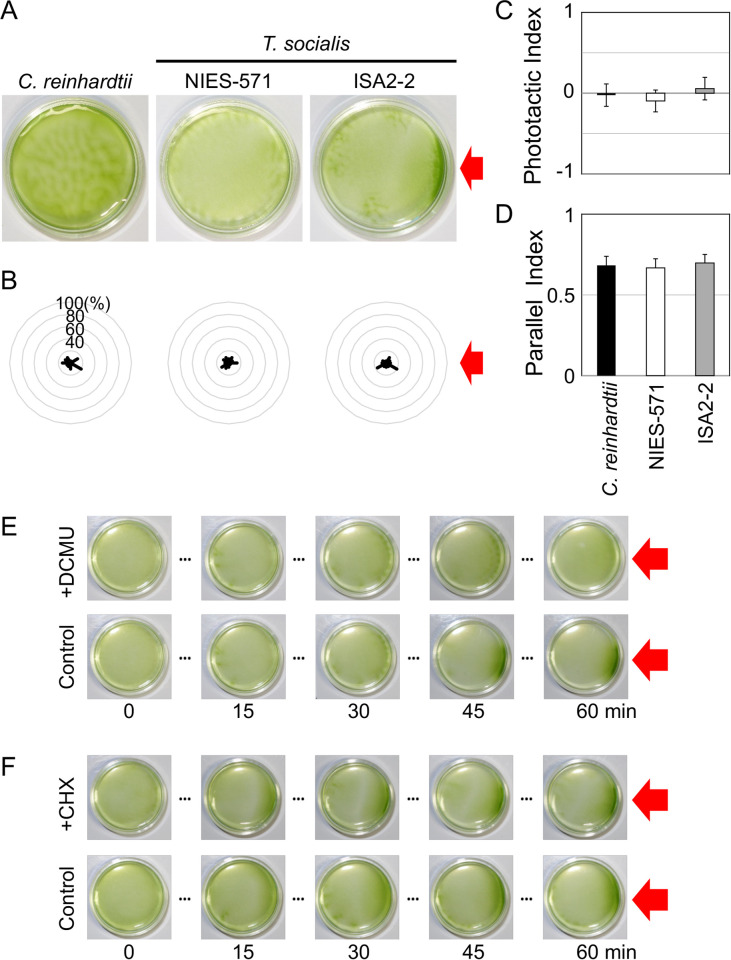
Photo-induced behavioral responses (photobehaviors) are crucial to the survival of motile phototrophic organisms in changing light conditions. Volvocine green algae are excellent model organisms for studying the regulatory mechanisms of photobehavior. We recently reported that unicellular Chlamydomonas reinhardtii and multicellular Volvox rousseletii exhibit similar photobehaviors, such as phototactic and photoshock responses, via different ciliary regulations. To clarify how the regulatory systems have changed during the evolution of multicellularity, we investigated the photobehaviors of four-celled Tetrabaena socialis. Surprisingly, unlike C. reinhardtii and V. rousseletii, T. socialis did not exhibit immediate photobehaviors after light illumination. Electrophysiological analysis revealed that the T. socialis eyespot does not function as a photoreceptor. Instead, T. socialis exhibited slow accumulation toward the light source in a photosynthesis-dependent manner. Our assessment of photosynthetic activities showed that T. socialis chloroplasts possess higher photoprotection abilities against strong light than C. reinhardtii. These data suggest that C. reinhardtii and T. socialis employ different strategies to avoid high-light stress (moving away rapidly and gaining photoprotection, respectively) despite their close phylogenetic relationship.
光诱导行为反应(光行为)对于在光照条件变化的情况下运动的光养生物的生存至关重要。绿色涡鞭毛藻是研究光行为调控机制的理想模式生物。我们最近报道,单细胞衣藻和多细胞水螅绿球藻通过不同的纤毛调节表现出相似的光行为,如趋光性和光休克反应。为了阐明在多细胞生物进化过程中调节系统发生了怎样的变化,我们研究了四细胞四尾栅藻的光行为。令人惊讶的是,与衣藻和水螅绿球藻不同,四尾栅藻在光照后不会立即表现出光行为。电生理分析表明,四尾栅藻眼点不能作为光感受器。相反,四尾栅藻以光合作用依赖的方式缓慢地向光源聚集。我们对光合作用活性的评估表明,四尾栅藻叶绿体比衣藻具有更高的光保护能力,以抵御强光。这些数据表明,尽管衣藻和四尾栅藻具有密切的系统发育关系,但它们采用不同的策略来避免高光胁迫(分别是快速移动和获得光保护)。