Institute of Medical Technology, Peking University Health Science Center, Beijing 100191, China; Department of Clinical Laboratory, Peking University People's Hospital, Beijing 100044, China.
Department of Clinical Laboratory, Peking University People's Hospital, Beijing 100044, China.
EBioMedicine. 2021 Nov;73:103639. doi: 10.1016/j.ebiom.2021.103639. Epub 2021 Oct 23.
Lung biopsy tissue samples can be used for infection detection and cancer diagnosis. Metagenomic next-generation sequencing (mNGS) has the potential to further improve diagnosis.
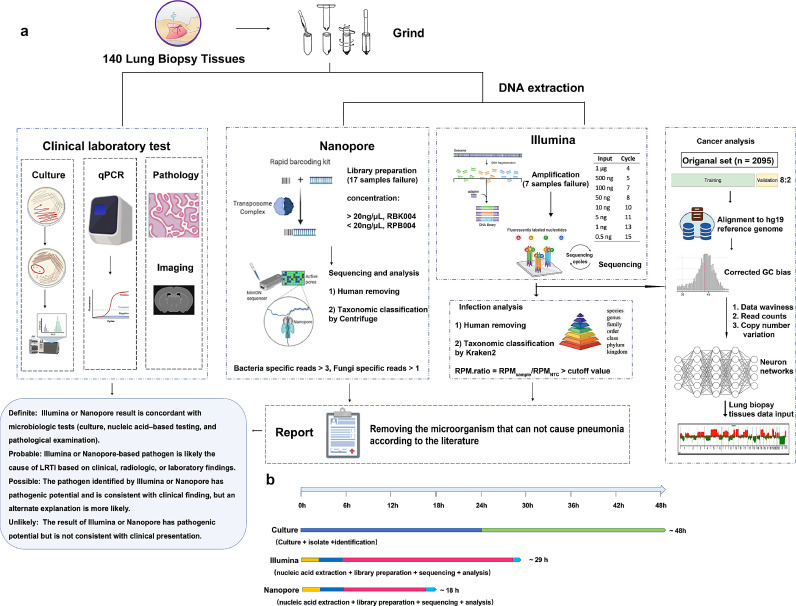
From July 2018 to May 2020, lung biopsy samples of 133 patients with suspected pulmonary infection or abnormal imaging findings were collected and subjected to clinical microbiological testing, Illumina and Nanopore sequencing to identify pathogens. The neural networks were pretrained by extracting features of human reads from 2,095 metagenomic next-generation sequencing results, and the human reads of lung biopsy samples were entered into the validated pipeline to predict the risk of cancer.
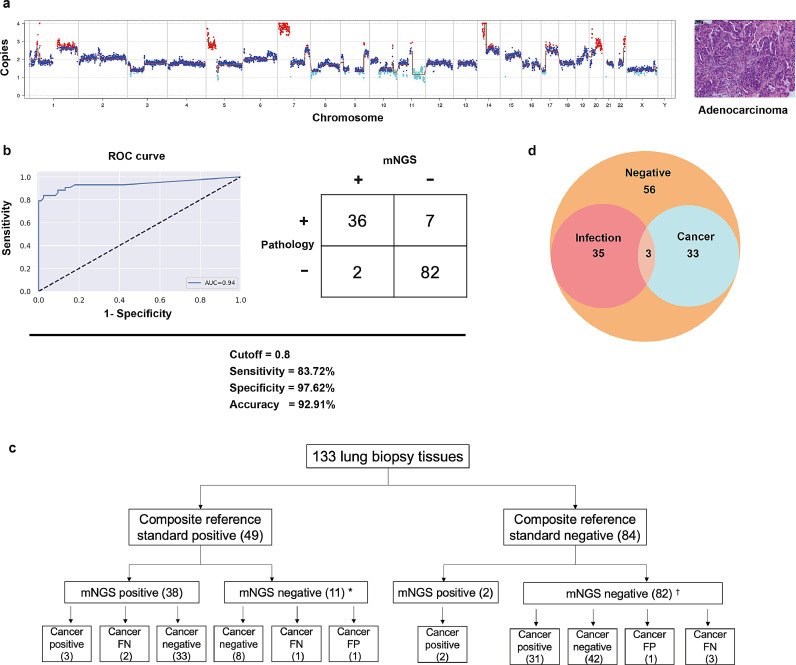
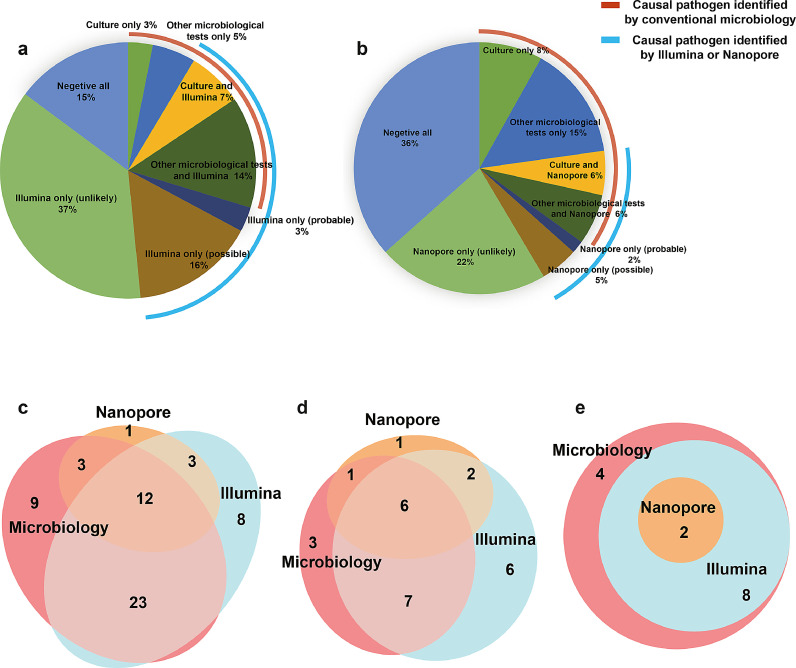
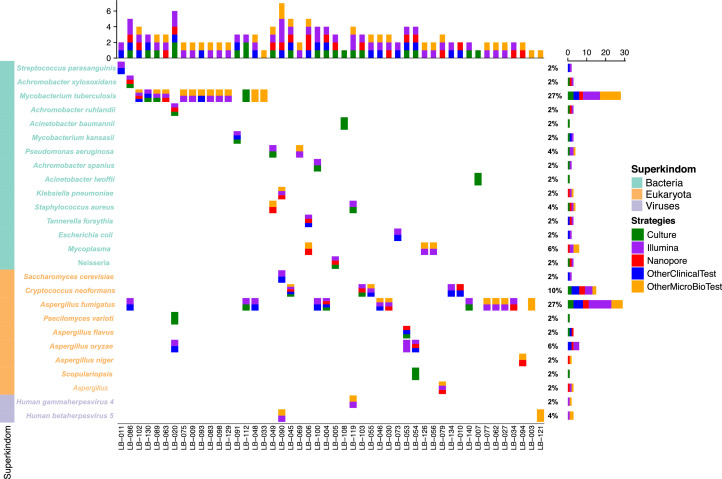
Based on the pathogen-cancer detection pipeline, the Illumina platform showed 77·6% sensitivity and 97·6% specificity compared to the composite reference standard for infection diagnosis. However, the Nanopore platform showed 34·7% sensitivity and 98·7% specificity. mNGS identified more fungi, which was confirmed by subsequent pathological examination. M. tuberculosis complex was weakly detected. For cancer detection, compared with histology, the Illumina platform showed 83·7% sensitivity and 97·6% specificity, diagnosing an additional 36 cancer patients, of whom half had abnormal imaging findings (pulmonary shadow, space-occupying lesions, or nodules).
For the first time, we have established a pipeline to simultaneously detect pathogens and cancer based on Illumina sequencing of lung biopsy tissue. This pipeline efficiently diagnosed cancer in patients with abnormal imaging findings.
This work was supported by the National Key Research and Development Program of China and National Natural Science Foundation of China.
肺活检组织样本可用于感染检测和癌症诊断。宏基因组下一代测序(mNGS)有可能进一步提高诊断效果。
从 2018 年 7 月至 2020 年 5 月,收集了 133 例疑似肺部感染或影像学异常的患者的肺活检样本,进行临床微生物学检测、Illumina 和 Nanopore 测序以鉴定病原体。通过从 2095 项宏基因组下一代测序结果中提取人读特征对神经网络进行预训练,然后将肺活检样本的人读输入到经过验证的管道中,以预测癌症风险。
基于病原体-癌症检测管道,Illumina 平台在感染诊断的综合参考标准下的灵敏度为 77.6%,特异性为 97.6%;而 Nanopore 平台的灵敏度为 34.7%,特异性为 98.7%。mNGS 鉴定出更多的真菌,这在后续的病理检查中得到了证实。结核分枝杆菌复合体的检测较弱。对于癌症检测,与组织学相比,Illumina 平台的灵敏度为 83.7%,特异性为 97.6%,诊断出另外 36 名癌症患者,其中一半有异常的影像学表现(肺部阴影、占位性病变或结节)。
这是首次基于肺活检组织的 Illumina 测序建立了一个同时检测病原体和癌症的管道。该管道有效地诊断了影像学异常的患者的癌症。
这项工作得到了中国国家重点研发计划和国家自然科学基金的支持。