
人工微结构中的栖息地几何形状会影响细菌和真菌的生长、相互作用以及基质降解。
Habitat geometry in artificial microstructure affects bacterial and fungal growth, interactions, and substrate degradation.
机构信息
Department of Biology, Lund University, Lund, Sweden.
Department of Biomedical Engineering, Lund University, Lund, Sweden.
出版信息
Commun Biol. 2021 Oct 26;4(1):1226. doi: 10.1038/s42003-021-02736-4.
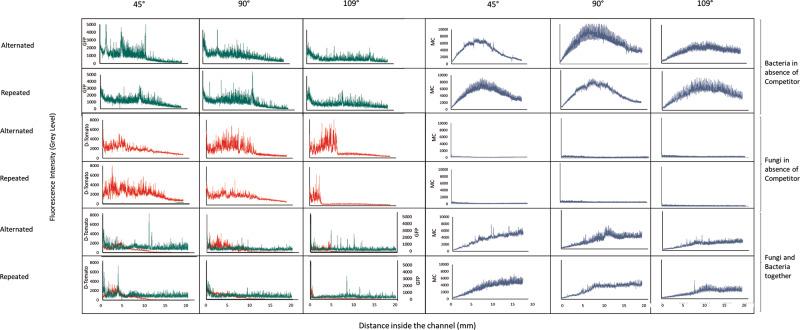
Microhabitat conditions determine the magnitude and speed of microbial processes but have been challenging to investigate. In this study we used microfluidic devices to determine the effect of the spatial distortion of a pore space on fungal and bacterial growth, interactions, and substrate degradation. The devices contained channels differing in bending angles and order. Sharper angles reduced fungal and bacterial biomass, especially when angles were repeated in the same direction. Substrate degradation was only decreased by sharper angles when fungi and bacteria were grown together. Investigation at the cellular scale suggests that this was caused by fungal habitat modification, since hyphae branched in sharp and repeated turns, blocking the dispersal of bacteria and the substrate. Our results demonstrate how the geometry of microstructures can influence microbial activity. This can be transferable to soil pore spaces, where spatial occlusion and microbial feedback on microstructures is thought to explain organic matter stabilization.
微生境条件决定了微生物过程的规模和速度,但一直难以研究。在这项研究中,我们使用微流控装置来确定孔隙空间的空间变形对真菌和细菌生长、相互作用和基质降解的影响。这些装置包含具有不同弯曲角度和顺序的通道。更尖锐的角度会降低真菌和细菌的生物量,尤其是当角度在同一方向重复时。只有当真菌和细菌一起生长时,更尖锐的角度才会降低基质的降解。在细胞尺度上的研究表明,这是由于真菌栖息地的改变,因为菌丝在尖锐和重复的转弯处分枝,阻碍了细菌和基质的扩散。我们的研究结果表明,微结构的几何形状如何影响微生物的活性。这可以转移到土壤孔隙空间,其中空间闭塞和微生物对微结构的反馈被认为可以解释有机质的稳定化。


 Zotero 插件