Ludden Michael D, Taylor Christopher G P, Ward Michael D
Department of Chemistry, University of Warwick Coventry CV4 7AL UK
Chem Sci. 2021 Aug 25;12(38):12640-12650. doi: 10.1039/d1sc04272f. eCollection 2021 Oct 6.
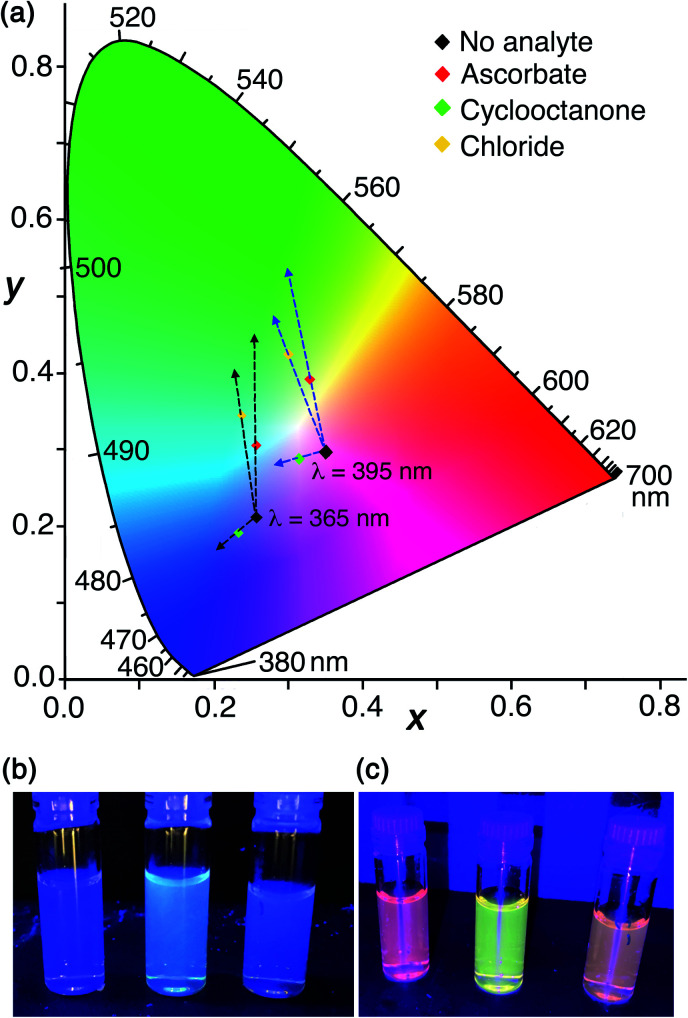
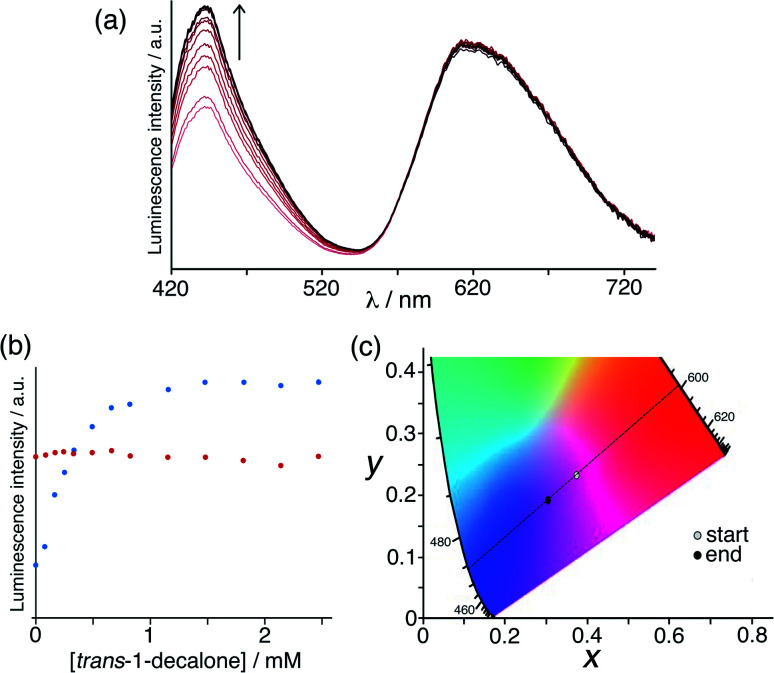
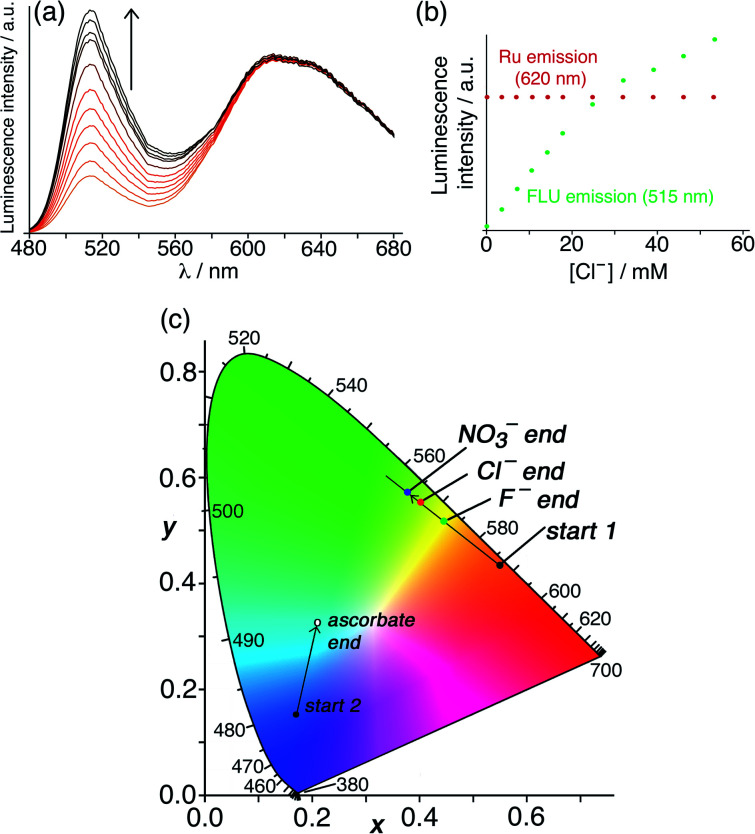
The octanuclear Co(ii) cubic coordination cage system (or if it bears external water-solubilising substituents) has two types of binding site for guests. These are (i) the partially-enclosed central cavity where neutral hydrophobic organic species can bind, and (ii) the six 'portals' in the centres of each of the faces of the cubic cage where anions bind formation of a network of CH⋯X hydrogen bonds between the anion and CH units on the positively-charged cage surface, as demonstrated by a set of crystal structures. The near-orthogonality of these guest binding modes provides the basis for an unusual dual-probe fluorescence displacement assay in which either a cavity-bound fluorophore (4-methyl-7-amino-coumarin, ; = 440 nm), or a surface-bound anionic fluorophore (fluorescein, ; = 515 nm), is displaced and has its emission 'switched on' according to whether the analyte under investigation is cavity-binding, surface binding, or a combination of both. A completely orthogonal system is demonstrated based using a // combination: addition of the anionic analyte ascorbate displaced solely from the cage surface, increasing the 515 nm (green) emission component, whereas addition of a neutral hydrophobic guest such as cyclooctanone displaced solely from the cage central cavity, increasing the 440 nm (blue) emission component. Addition of chloride results in some release of both components, and an intermediate colour change, as chloride is a rare example of a guest that shows both surface-binding and cavity-binding behaviour. Thus we have a colourimetric response based on differing contributions from blue and green emission components in which the specific colour change signals the binding mode of the analyte. Addition of a fixed red emission component from the complex [Ru(bipy)] () provides a baseline colour shift of the overall colour of the luminescence closer to neutral, meaning that different types of guest binding result in different colour changes which are easily distinguishable by eye.
八核钴(II)立方配位笼系统(或者如果它带有外部水溶性取代基)有两种客体结合位点。这些位点是:(i)部分封闭的中心腔,中性疏水有机物种可在此处结合;(ii)立方笼每个面中心的六个“入口”,阴离子在此处结合,通过一组晶体结构表明,阴离子与带正电的笼表面的CH单元之间形成CH⋯X氢键网络。这些客体结合模式近乎正交,为一种不寻常的双探针荧光位移测定提供了基础,在该测定中,要么是腔结合荧光团(4-甲基-7-氨基香豆素,λex = 440 nm),要么是表面结合的阴离子荧光团(荧光素,λex = 515 nm),根据所研究的分析物是腔结合、表面结合还是两者的组合而被取代并使其发射“开启”。使用一种//组合展示了一个完全正交的系统:添加阴离子分析物抗坏血酸盐仅从笼表面取代,增加515 nm(绿色)发射成分,而添加中性疏水客体如环辛酮仅从笼中心腔取代,增加440 nm(蓝色)发射成分。添加氯离子会导致两种成分都有一些释放,并产生中间颜色变化,因为氯离子是显示表面结合和腔结合行为的客体的罕见例子。因此,我们基于蓝色和绿色发射成分的不同贡献有了比色响应,其中特定的颜色变化表明分析物的结合模式。添加来自配合物[Ru(bipy)3]2+(λex = 610 nm)的固定红色发射成分提供了发光整体颜色的基线颜色偏移,使其更接近中性,这意味着不同类型的客体结合会导致不同的颜色变化,肉眼很容易区分。