Sudittapong Burin, Taylor Christopher G P, Williams James, Griffiths Rebecca J, Hiscock Jennifer R, Ward Michael D
Department of Chemistry, University of Warwick Coventry CV4 7AL UK
School of Chemistry and Forensic Science, University of Kent Canterbury CT2 7NH UK.
RSC Adv. 2024 Aug 19;14(36):26032-26042. doi: 10.1039/d4ra04705b. eCollection 2024 Aug 16.
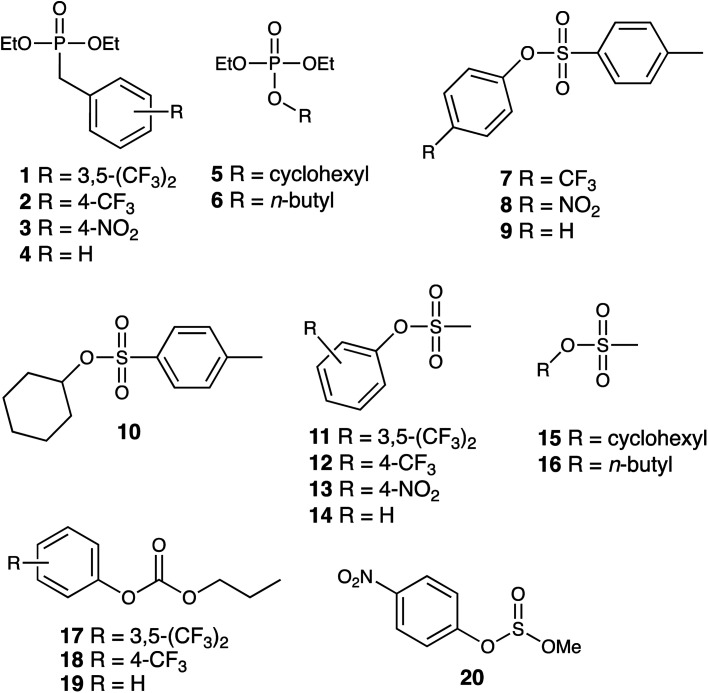
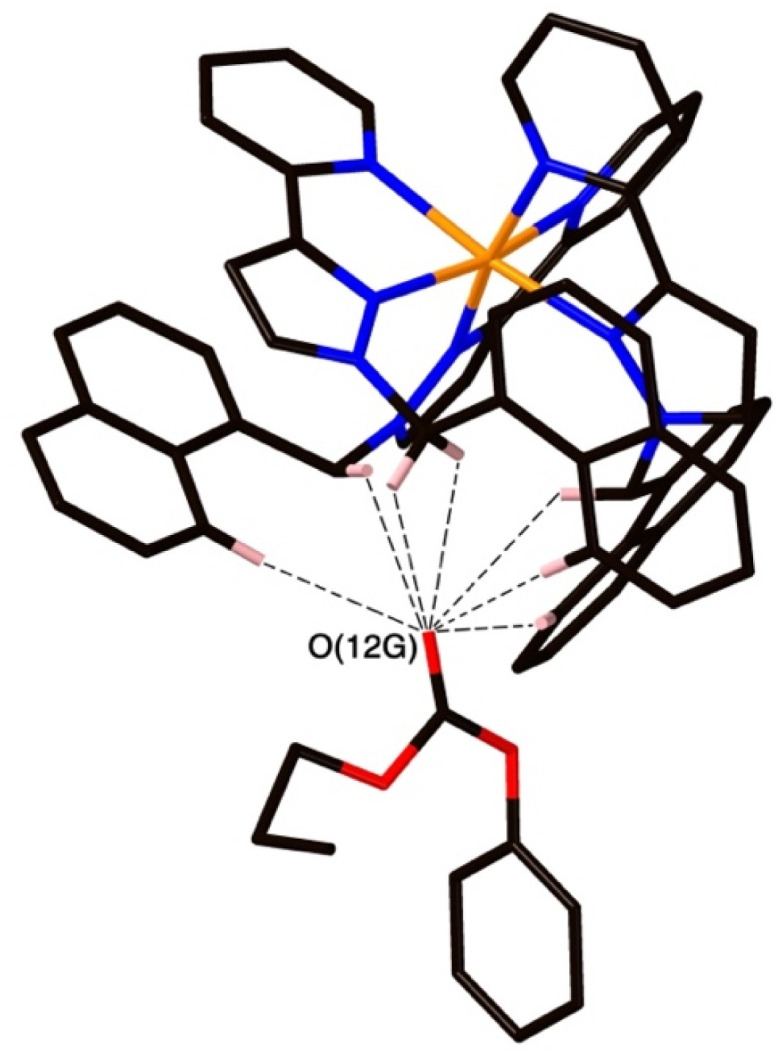
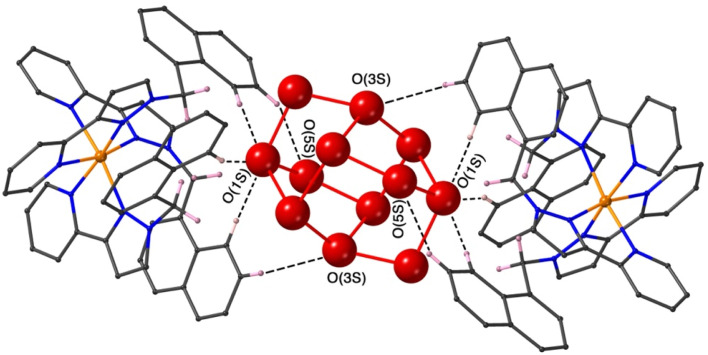
The use of organophosphorus chemical warfare agents still remains an ongoing global threat. Here we investigate the binding of small-molecule organic guests including phosphate esters, sulfonate esters, carbonate esters and a sulfite ester - some of which act as simulants for organophosphorus chemical warfare agents - in the cavity of a water-soluble coordination cage. For several of these guest species, binding constants in the range 10 to 10 M were determined in water/DMSO (98 : 2 v/v) solution, through a combination of fluorescence and H NMR spectroscopy, and subsequent fitting of titration data to a 1 : 1 binding isotherm model. For three cage/guest complexes crystallographic structure determinations were possible: in two cases (with guests phenyl methanesulfonate and phenyl propyl carbonate) the guest lies inside the cavity, forming a range of CH⋯O hydrogen-bonding interactions with the cage interior surface involving CH groups on the cationic cage surface that act as H-bond donors and O atoms on the guests that act as H-bond acceptors. In a third case, with the guest 4-nitrophenyl-methanesulfonate, the guest lies in the spaces outside a cage cavity between cages and forms weak CH⋯O interactions with the cage exterior surface: the cavity is occupied by a network of H-bonded water molecules, though this guest does show cavity binding in solution. For the isomeric guests 4-nitrophenyl-methanesulfonate and 4-nitrophenyl methyl sulfite, hydrolysis in water/DMSO (98 : 2 v/v) could be monitored colorimetrically appearance of the 4-nitrophenolate anion; both showed accelerated hydrolysis rates in the presence of the host cage with second-order rate constants for the catalysed reactions in the range 10 to 10 M s at pH 9. The typical rate dependence on external pH and the increased reaction rates when chloride ions are present (which can bind inside the cavity and displace other cavity-bound guests) imply that the catalysed reaction actually occurs at the external surface of the cage rather than inside the cavity.
有机磷化学战剂的使用仍然是一个持续存在的全球威胁。在此,我们研究了包括磷酸酯、磺酸酯、碳酸酯和亚硫酸酯在内的小分子有机客体在水溶性配位笼腔中的结合情况,其中一些可作为有机磷化学战剂的模拟物。对于其中几种客体物种,通过荧光光谱和核磁共振氢谱相结合,并将滴定数据拟合到1:1结合等温线模型,在水/二甲亚砜(98:2 v/v)溶液中测定了其结合常数,范围为10至10 M。对于三种笼/客体配合物,确定了晶体结构:在两种情况下(客体为苯甲磺酸苯酯和苯丙基碳酸酯),客体位于腔内,与笼内表面形成一系列CH⋯O氢键相互作用,涉及阳离子笼表面的CH基团作为氢键供体,客体上的O原子作为氢键受体。在第三种情况下,客体为4-硝基苯甲磺酸酯,客体位于笼之间的笼腔外部空间,与笼外表面形成弱CH⋯O相互作用:腔内被氢键连接的水分子网络占据,不过该客体在溶液中确实表现出腔结合。对于同分异构体客体4-硝基苯甲磺酸酯和4-硝基苯基亚硫酸甲酯,可通过比色法监测其在水/二甲亚砜(98:2 v/v)中的水解情况——4-硝基苯酚阴离子的出现;在主体笼存在的情况下,两者均显示水解速率加快,在pH 9时催化反应的二级速率常数范围为10至10 M s。对外部pH的典型速率依赖性以及存在氯离子时反应速率的增加(氯离子可结合在腔内并取代其他腔结合客体)表明,催化反应实际上发生在笼的外表面而非腔内。