Bohnen Nicolaas I, Kanel Prabesh, Koeppe Robert A, Sanchez-Catasus Carlos A, Frey Kirk A, Scott Peter, Constantine Gregory M, Albin Roger L, Müller Martijn L T M
Department of Radiology, University of Michigan, Ann Arbor, MI 48105, USA.
Department of Neurology, University of Michigan, Ann Arbor, MI 48105, USA.
Brain Commun. 2021 May 22;3(2):fcab109. doi: 10.1093/braincomms/fcab109. eCollection 2021.
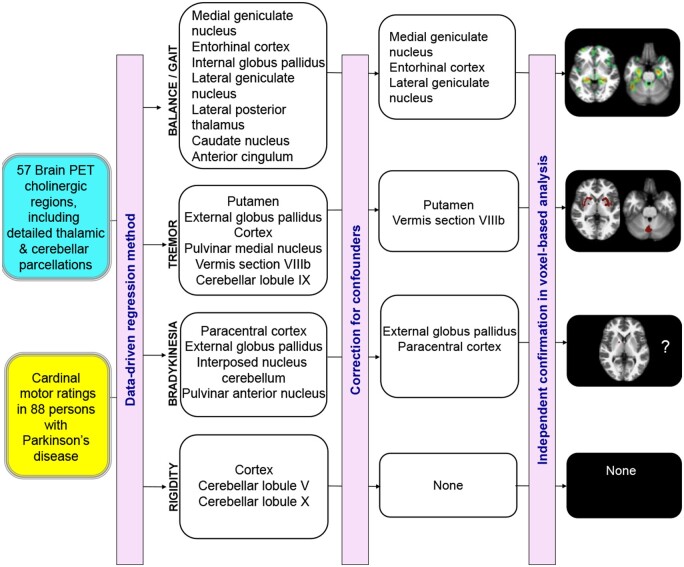
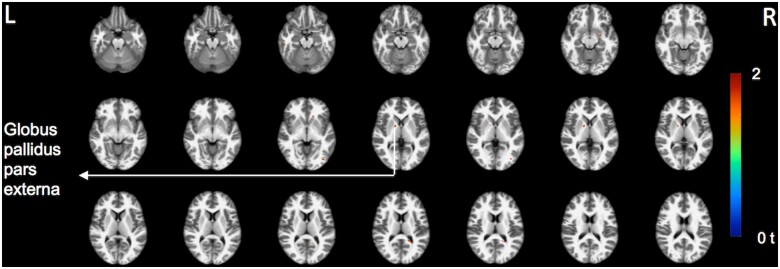
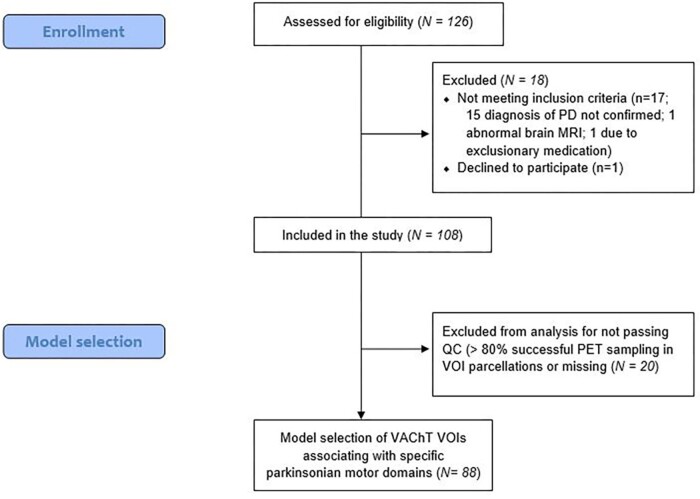
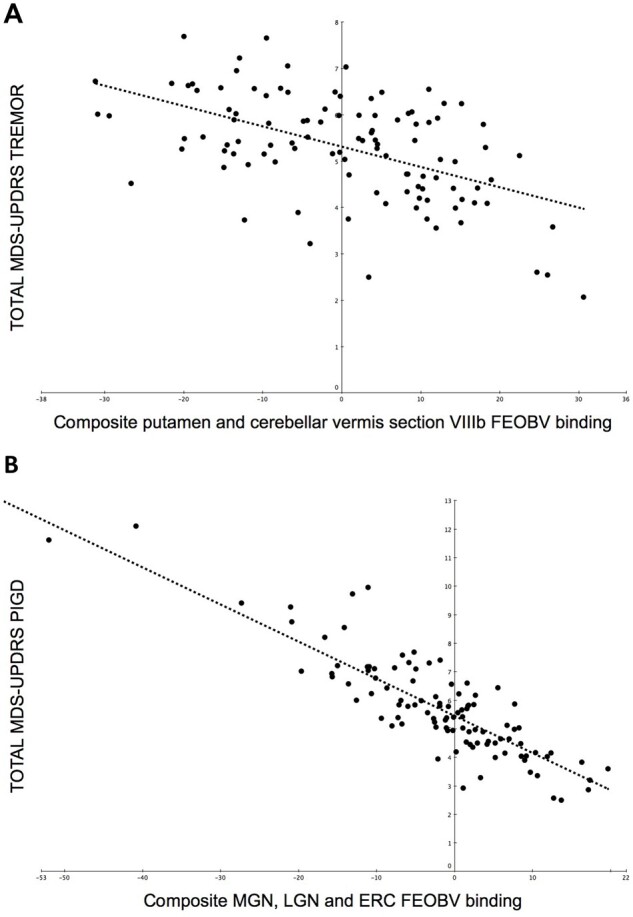
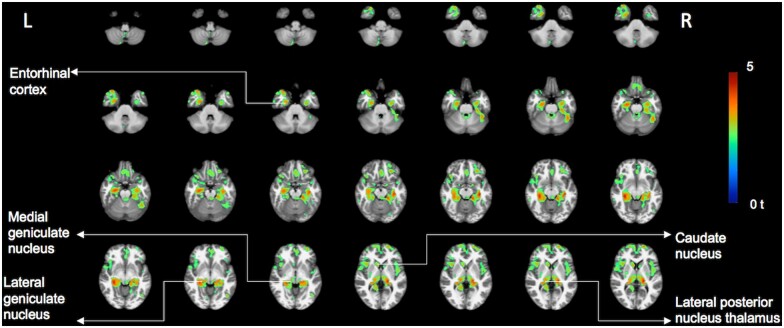
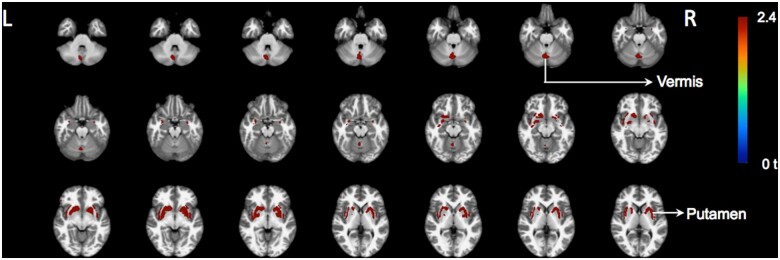
Clinical effects of anti-cholinergic drugs implicate cholinergic systems alterations in the pathophysiology of some cardinal motor impairments in Parkinson's disease. The topography of affected cholinergic systems deficits and motor domain specificity are poorly understood. Parkinson's disease patients ( = 108) underwent clinical and motor assessment and vesicular acetylcholine transporter [F]-fluoroethoxybenzovesamicol PET imaging. Volumes-of-interest-based analyses included detailed thalamic and cerebellar parcellations. Successful PET sampling for most of the small-sized parcellations was available in 88 patients. A data-driven approach, stepwise regression using the forward selection method, was used to identify cholinergic brain regions associating with cardinal domain-specific motor ratings. Regressions with motor domain scores for model-selected regions followed by confounder analysis for effects of age of onset, duration of motor disease and levodopa equivalent dose were performed. Among 7 model-derived regions associating with postural instability and gait difficulties domain scores three retained significance in confounder variable analysis: medial geniculate nucleus (standardized β = -0.34, = -3.78, = 0.0003), lateral geniculate nucleus (β = -0.32, = -3.4, = 0.001) and entorhinal cortex (β = -0.23, = -2.6, = 0.011). A sub-analysis of non-episodic postural instability and gait difficulties scores demonstrated significant effects of the medial geniculate nucleus, entorhinal cortex and globus pallidus pars interna. Among 6 tremor domain model-selected regions two regions retained significance in confounder variable analysis: cerebellar vermis section of lobule VIIIb (β = -0.22, = -2.4, = 0.021) and the putamen (β = -0.23, = -2.3, = 0.024). None of the three model-selected variables for the rigidity domain survived confounder analysis. Two out of the four model-selected regions for the distal limb bradykinesia domain survived confounder analysis: globus pallidus pars externa (β = 0.36, = 3.9, = 0.0097) and the paracentral lobule (β = 0.26, = 2.5, = 0.013). Emphasizing the utility of a systems-network conception of the pathophysiology of Parkinson's disease cardinal motor features, our results are consistent with specific deficits in basal forebrain corticopetal, peduncupontine-laterodorsal tegmental complex, and medial vestibular nucleus cholinergic pathways, against the background of nigrostriatal dopaminergic deficits, contributing significantly to postural instability, gait difficulties, tremor and distal limb bradykinesia cardinal motor features of Parkinson's disease. Our results suggest significant and distinct consequences of degeneration of cholinergic peduncupontine-laterodorsal tegmental complex afferents to both segments of the globus pallidus. Non-specific regional cholinergic nerve terminal associations with rigidity scores likely reflect more complex multifactorial signalling mechanisms with smaller contributions from cholinergic pathways.
抗胆碱能药物的临床效果表明,胆碱能系统改变在帕金森病某些主要运动障碍的病理生理学中起作用。受影响的胆碱能系统缺陷的拓扑结构和运动领域特异性尚不清楚。108例帕金森病患者接受了临床和运动评估以及囊泡乙酰胆碱转运体[F]-氟乙氧基苯并维司米可PET成像。基于感兴趣区域的分析包括详细的丘脑和小脑分区。88例患者可对大多数小尺寸分区进行成功的PET采样。采用数据驱动方法,即使用向前选择法的逐步回归,来识别与主要领域特异性运动评分相关的胆碱能脑区。对模型选择区域的运动领域评分进行回归分析,然后对发病年龄、运动疾病持续时间和左旋多巴等效剂量的影响进行混杂因素分析。在与姿势不稳和步态困难领域评分相关的7个模型衍生区域中,有3个在混杂变量分析中仍具有显著性:内侧膝状体(标准化β=-0.34,t=-3.78,P=0.0003)、外侧膝状体(β=-0.32,t=-3.4,P=0.001)和内嗅皮质(β=-0.23,t=-2.6,P=0.011)。对非发作性姿势不稳和步态困难评分的亚分析显示,内侧膝状体、内嗅皮质和苍白球内侧部有显著影响。在与震颤领域模型选择的6个区域中,有2个区域在混杂变量分析中仍具有显著性:小叶VIIIb的小脑蚓部(β=-0.22,t=-2.4,P=0.021)和壳核(β=-0.23,t=-2.3,P=0.024)。在混杂因素分析中,刚性领域的3个模型选择变量均未通过。远端肢体运动迟缓领域的4个模型选择区域中有2个在混杂因素分析中通过:苍白球外侧部(β=0.36,t=3.9,P=0.0097)和中央旁小叶(β=0.26,t=2.5,P=0.013)。强调帕金森病主要运动特征病理生理学的系统网络概念的实用性,我们的结果与基底前脑向心性、脚桥被盖外侧被盖复合体和内侧前庭核胆碱能通路的特定缺陷一致,在黑质纹状体多巴胺能缺陷的背景下,对帕金森病的姿势不稳、步态困难、震颤和远端肢体运动迟缓主要运动特征有显著贡献。我们的结果表明,胆碱能脚桥被盖外侧被盖复合体传入苍白球两部分的变性有显著且不同的后果。非特异性区域胆碱能神经末梢与刚性评分的关联可能反映了更复杂的多因素信号机制,胆碱能通路的贡献较小。