Grech Olivia, Clouter Andrew, Mitchell James L, Alimajstorovic Zerin, Ottridge Ryan S, Yiangou Andreas, Roque Marianne, Tahrani Abd A, Nicholls Matthew, Taylor Angela E, Shaheen Fozia, Arlt Wiebke, Lavery Gareth G, Shapiro Kimron, Mollan Susan P, Sinclair Alexandra J
Metabolic Neurology, Institute of Metabolism and Systems Research, University of Birmingham, Edgbaston B15 2TT, UK.
Department of Psychology, Nottingham Trent University, Nottingham NG1 5LT, UK.
Brain Commun. 2021 Sep 2;3(3):fcab202. doi: 10.1093/braincomms/fcab202. eCollection 2021.
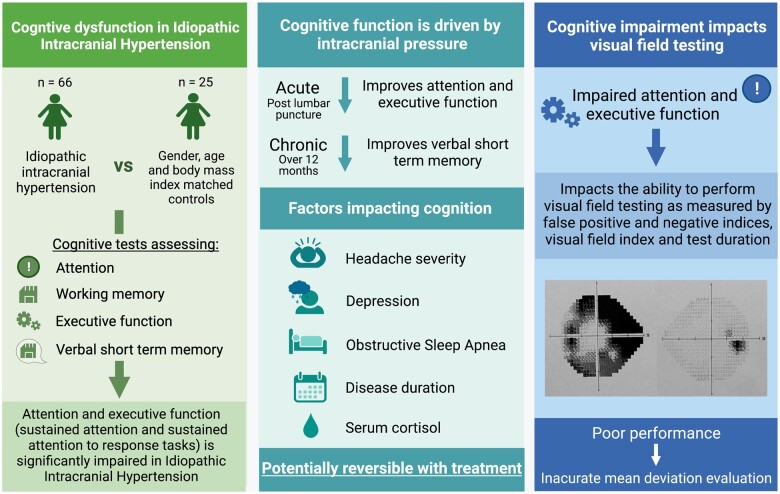
Cognitive impairments have been reported in idiopathic intracranial hypertension; however, evidence supporting these deficits is scarce and contributing factors have not been defined. Using a case-control prospective study, we identified multiple domains of deficiency in a cohort of 66 female adult idiopathic intracranial hypertension patients. We identified significantly impaired attention networks (executive function) and sustained attention compared to a body mass index and age matched control group of 25 healthy female participants. We aimed to investigate how cognitive function changed over time and demonstrated that deficits were not permanent. Participants exhibited improvement in several domains including executive function, sustained attention and verbal short-term memory over 12-month follow-up. Improved cognition over time was associated with reduction in intracranial pressure but not body weight. We then evaluated cognition before and after a lumbar puncture with acute reduction in intracranial pressure and noted significant improvement in sustained attention to response task performance. The impact of comorbidities (headache, depression, adiposity and obstructive sleep apnoea) was also explored. We observed that body mass index and the obesity associated cytokine interleukin-6 (serum and cerebrospinal fluid) were not associated with cognitive performance. Headache severity during cognitive testing, co-morbid depression and markers of obstructive sleep apnoea were adversely associated with cognitive performance. Dysregulation of the cortisol generating enzyme 11β hydroxysteroid dehydrogenase type 1 has been observed in idiopathic intracranial hypertension. Elevated cortisol has been associated with impaired cognition. Here, we utilized liquid chromatography-tandem mass spectrometry for multi-steroid profiling in serum and cerebrospinal fluid in idiopathic intracranial hypertension patients. We noted that reduction in the serum cortisol:cortisone ratio in those undergoing bariatric surgery at 12 months was associated with improving verbal working memory. The clinical relevance of cognitive deficits was noted in their significant association with impaired reliability to perform visual field tests, the cornerstone of monitoring vision in idiopathic intracranial hypertension. Our findings propose that cognitive impairment should be accepted as a clinical manifestation of idiopathic intracranial hypertension and impairs the ability to perform visual field testing reliably. Importantly, cognitive deficits can improve over time and with reduction of intracranial pressure. Treating comorbid depression, obstructive sleep apnoea and headache could improve cognitive performance in idiopathic intracranial hypertension.
特发性颅内高压患者中已报告存在认知障碍;然而,支持这些缺陷的证据很少,且促成因素尚未明确。通过一项病例对照前瞻性研究,我们在一组66名成年女性特发性颅内高压患者中确定了多个功能缺陷领域。与25名健康女性参与者组成的体重指数和年龄匹配的对照组相比,我们发现注意力网络(执行功能)和持续注意力明显受损。我们旨在研究认知功能如何随时间变化,并证明这些缺陷并非永久性的。在12个月的随访中,参与者在包括执行功能、持续注意力和言语短期记忆在内的几个领域都有改善。认知功能随时间的改善与颅内压降低有关,而与体重无关。然后,我们在颅内压急性降低的腰椎穿刺前后评估认知情况,发现对反应任务表现的持续注意力有显著改善。我们还探讨了合并症(头痛、抑郁、肥胖和阻塞性睡眠呼吸暂停)的影响。我们观察到体重指数以及与肥胖相关的细胞因子白细胞介素-6(血清和脑脊液)与认知表现无关。认知测试期间的头痛严重程度、合并的抑郁症和阻塞性睡眠呼吸暂停的标志物与认知表现呈负相关。在特发性颅内高压中观察到皮质醇生成酶11β-羟类固醇脱氢酶1型的调节异常。皮质醇升高与认知障碍有关。在此,我们利用液相色谱-串联质谱法对特发性颅内高压患者的血清和脑脊液中的多种类固醇进行分析。我们注意到,在接受减肥手术12个月的患者中,血清皮质醇:可的松比值的降低与言语工作记忆的改善有关。认知缺陷的临床相关性在于它们与视野测试可靠性受损显著相关,而视野测试是监测特发性颅内高压患者视力的基石。我们的研究结果表明,认知障碍应被视为特发性颅内高压的一种临床表现,并会损害可靠进行视野测试的能力。重要的是,认知缺陷会随着时间的推移和颅内压的降低而改善。治疗合并的抑郁症、阻塞性睡眠呼吸暂停和头痛可能会改善特发性颅内高压患者的认知表现。