College of Animal Science and Technology, Sichuan Agricultural University, Chengdu, 611130, China.
Animal Genomics and Improvement Laboratory, BARC, Agricultural Research Service, USDA, Beltsville, MD, 20705, USA.
BMC Genomics. 2021 Oct 28;22(1):769. doi: 10.1186/s12864-021-08089-w.
There is a long-term interest in investigating the genetic basis of the horned/polled phenotype in domestic goats. Here, we report a genome-wide association study (GWAS) to detect the genetic loci affecting the polled phenotype in goats.
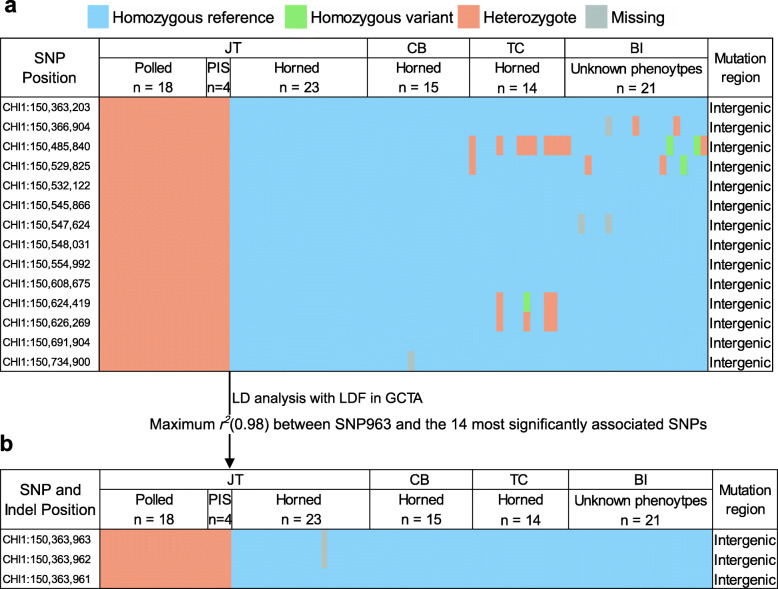
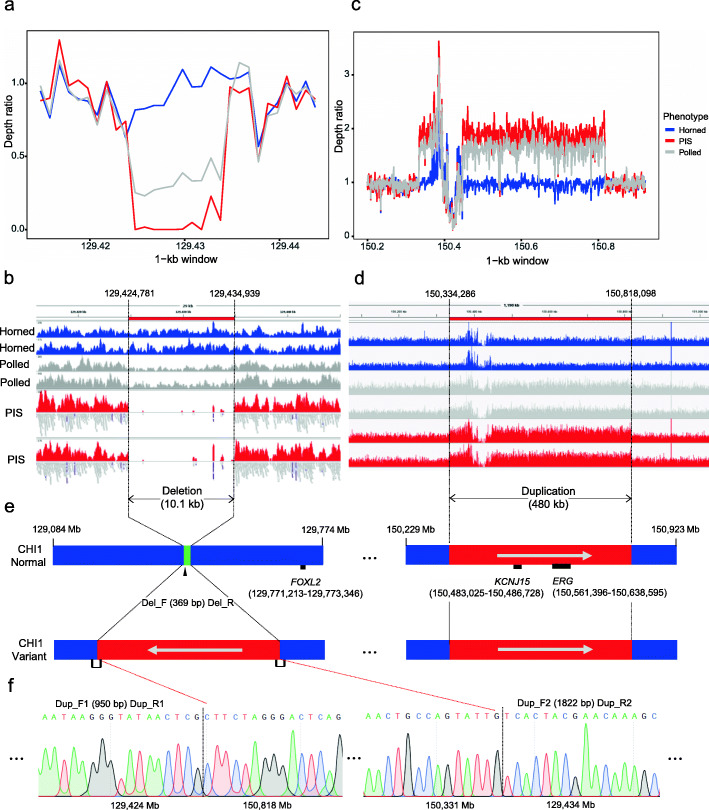
We obtained a total of 13,980,209 biallelic SNPs, using the genotyping-by-sequencing data from 45 Jintang Black (JT) goats, which included 32 female and nine male goats, and four individuals with the polled intersex syndrome (PIS). Using a mixed-model based GWAS, we identified two association signals, which were located at 150,334,857-150,817,260 bp (P = 5.15 × 10) and 128,286,704-131,306,537 bp (P = 2.74 × 10) on chromosome 1. The genotype distributions of the 14 most significantly associated SNPs were completely correlated with horn status in goats, based on the whole-genome sequencing (WGS) data from JT and two other Chinese horned breeds. However, variant annotation suggested that none of the detected SNPs within the associated regions were plausible causal mutations. Via additional read-depth analyses and visual inspections of WGS data, we found a 10.1-kb deletion (CHI1:g. 129424781_129434939del) and a 480-kb duplication (CHI1:150,334,286-150,818,098 bp) encompassing two genes KCNJ15 and ERG in the associated regions of polled and PIS-affected goats. Notably, the 10.1-kb deletion also served as the insertion site for the 480-kb duplication, as validated by PCR and Sanger sequencing. Our WGS genotyping showed that all horned goats were homozygous for the reference alleles without either the structural variants (SVs), whereas the PIS-affected goats were homozygous for both the SVs. We also demonstrated that horned, polled, and PIS-affected individuals among 333 goats from JT and three other Chinese horned breeds can be accurately classified via PCR amplification and agarose gel electrophoresis of two fragments in both SVs.
Our results revealed that two genomic regions on chromosome 1 are major loci affecting the polled phenotypes in goats. We provided a diagnostic PCR to accurately classify horned, polled, and PIS-affected goats, which will enable a reliable genetic test for the early-in-life prediction of horn status in goats.
长期以来,人们一直致力于研究家山羊角/无角表型的遗传基础。在这里,我们报告了一项全基因组关联研究(GWAS),以检测影响山羊无角表型的遗传位点。
我们使用来自 45 只金堂黑山羊(JT)的测序基因型数据,共获得了 13980209 个双等位基因 SNP,其中包括 32 只雌性山羊和 9 只雄性山羊,以及 4 只具有无角间性综合征(PIS)的个体。使用基于混合模型的 GWAS,我们在第 1 号染色体上鉴定出了两个关联信号,分别位于 150334857-150817260bp(P=5.15×10)和 128286704-131306537bp(P=2.74×10)。基于 JT 及另外两个中国有角品种的全基因组测序(WGS)数据,14 个最显著关联 SNP 的基因型分布与山羊的角状态完全相关。然而,变异注释表明,在关联区域内检测到的 SNP 中没有一个是合理的因果突变。通过额外的读深度分析和 WGS 数据的可视化检查,我们发现了一个 10.1kb 的缺失(CHI1:g.129424781_129434939del)和一个 480kb 的重复(CHI1:150334286-150818098bp),包含两个基因 KCNJ15 和 ERG 在无角和 PIS 影响的山羊的关联区域。值得注意的是,10.1kb 的缺失也作为 480kb 重复的插入位点,这通过 PCR 和 Sanger 测序得到了验证。我们的 WGS 基因分型表明,所有有角的山羊均为参考等位基因的纯合子,没有结构变异(SVs),而 PIS 影响的山羊均为 SVs 的纯合子。我们还证明,通过在两个 SV 中两个片段的 PCR 扩增和琼脂糖凝胶电泳,可以准确地对来自 JT 及另外三个中国有角品种的 333 只山羊中的有角、无角和 PIS 影响的个体进行分类。
我们的研究结果表明,第 1 号染色体上的两个基因组区域是影响山羊无角表型的主要位点。我们提供了一种诊断 PCR,可准确分类有角、无角和 PIS 影响的山羊,这将为山羊早期角状态的可靠遗传测试提供帮助。