Akram Alirameen, Nicosia Francesca, Lee Jennifer, Lee Maria, Martin Lynn, Martinez Steven, Ordoñez Cherry, Woo Michele, Barnes Deborah E
CA Northstate University College of Medicine, Elk Grove, CA, USA.
University of California, San Francisco, San Francisco, CA, USA.
BMC Geriatr. 2021 Oct 27;21(1):607. doi: 10.1186/s12877-021-02494-2.
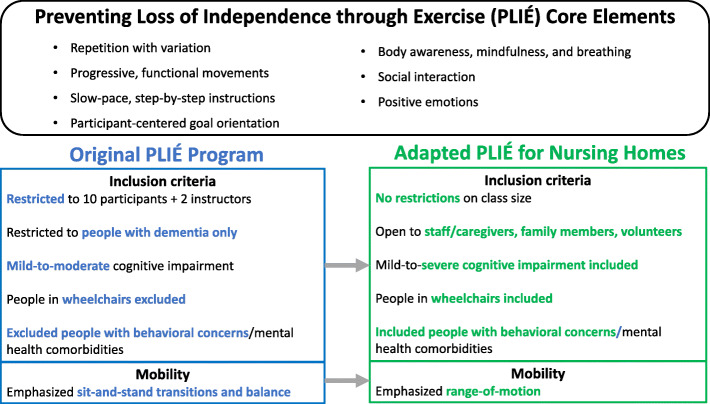
Preventing Loss of Independence through Exercise (PLIÉ) is an integrative group movement program developed for adults with mild-to-moderate dementia attending day programs. However, many older adults with dementia ultimately require assistance with their activities of daily living and become residents in nursing homes or other long-term care facilities with their complex comorbidities and unique needs. We conducted a post-implementation evaluation of PLIÉ at a San Francisco Veterans Affairs (VA) nursing home to assess reach and effectiveness among residents, staff, and family members who participated in ≥ 1 PLIÉ class from 9/2018 to 6/2019.
Post-implementation number of classes offered and mean attendance; anonymous satisfaction surveys (5-point Likert scales); qualitative content analysis of open-ended survey responses and clinical progress notes.
Forty-five PLIÉ classes were offered over 9 months. Residents attended an average of 13 ± 12 classes with an average class size of 14 residents, 4 staff members, and 2 family members. Most survey respondents rated the program overall as "very good" or "excellent" (100 % residents, n = 15; 87 % staff, n = 14; 100 % family members, n = 8). Respondents reported improvements in themselves and/or others in four domains: (1) physical, (2) psychological, (3) social, and (4) cognitive. Physical improvements among veterans included mobility, strength, and energy. Psychological improvements included feelings of happiness/well-being, enjoyment, and self-empowerment. Social improvements included connection, social skills, and social support. Cognitive improvements included engagement, communication ability, and focus/attention. Responses were similar among resident, staff, and family member surveys and clinical progress notes. Participants frequently reported improvements in multiple domains (e.g., "The veterans are more alert and engaged, many are smiling and laughing."). Negative comments were primarily related to logistics, suggesting that the class occur more frequently.
PLIÉ was successfully implemented in a VA nursing home with high attendance and satisfaction among residents, staff, and family members. Participants reported clinically meaningful physical, psychological, social, and cognitive benefits. Other long-term care facilities could potentially benefit from implementing PLIÉ to increase quality of life in residents with dementia.
通过运动预防独立能力丧失(PLIÉ)是一项综合团体运动项目,专为参加日间项目的轻度至中度痴呆症成年人开发。然而,许多患有痴呆症的老年人最终需要在日常生活活动中得到帮助,并因复杂的合并症和独特需求而入住养老院或其他长期护理机构。我们在旧金山退伍军人事务部(VA)养老院对PLIÉ进行了实施后评估,以评估2018年9月至2019年6月期间参加≥1节PLIÉ课程的居民、工作人员和家庭成员中的参与度和有效性。
实施后提供的课程数量和平均出勤率;匿名满意度调查(5点李克特量表);对开放式调查回复和临床进展记录进行定性内容分析。
在9个月内共提供了45节PLIÉ课程。居民平均参加13±12节课程,平均每班有14名居民、4名工作人员和2名家庭成员。大多数调查受访者对该项目总体评价为“非常好”或“优秀”(100%的居民,n = 15;87%的工作人员,n = 14;100%的家庭成员,n = 8)。受访者报告了自己和/或他人在四个方面的改善:(1)身体方面,(2)心理方面,(3)社交方面,以及(4)认知方面。退伍军人的身体改善包括行动能力、力量和精力。心理改善包括幸福感、愉悦感和自我赋权感。社交改善包括人际关系、社交技能和社会支持。认知改善包括参与度、沟通能力和注意力。居民、工作人员和家庭成员的调查回复以及临床进展记录中的回复相似。参与者经常报告在多个方面有所改善(例如,“退伍军人更加警觉和投入,许多人面带微笑。”)。负面评论主要与后勤安排有关,建议课程更频繁地开展。
PLIÉ在VA养老院成功实施,居民、工作人员和家庭成员的出勤率和满意度都很高。参与者报告了在身体、心理、社交和认知方面具有临床意义的益处。其他长期护理机构可能会从实施PLIÉ中受益,以提高痴呆症患者的生活质量。