School of Traditional Chinese Medicine, Southern Medical University, Guangzhou, Guangdong, China.
The First Affiliated Hospital of Guangzhou University of Chinese Medicine, Guangzhou, Guangdong, China.
Clin Transl Med. 2021 Oct;11(10):e541. doi: 10.1002/ctm2.541.
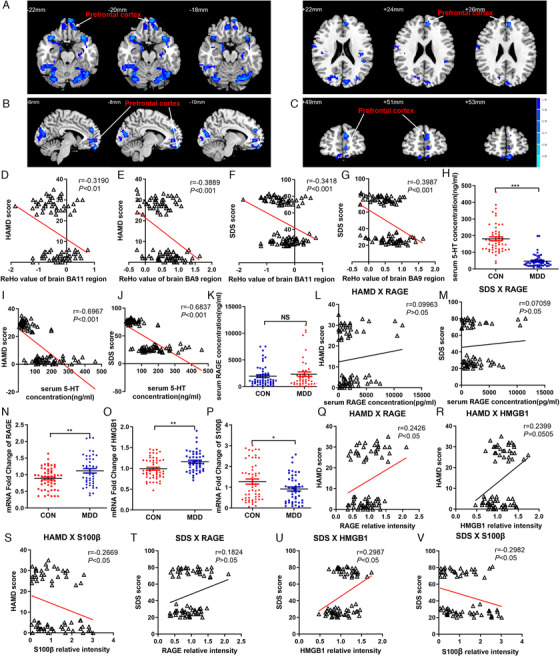
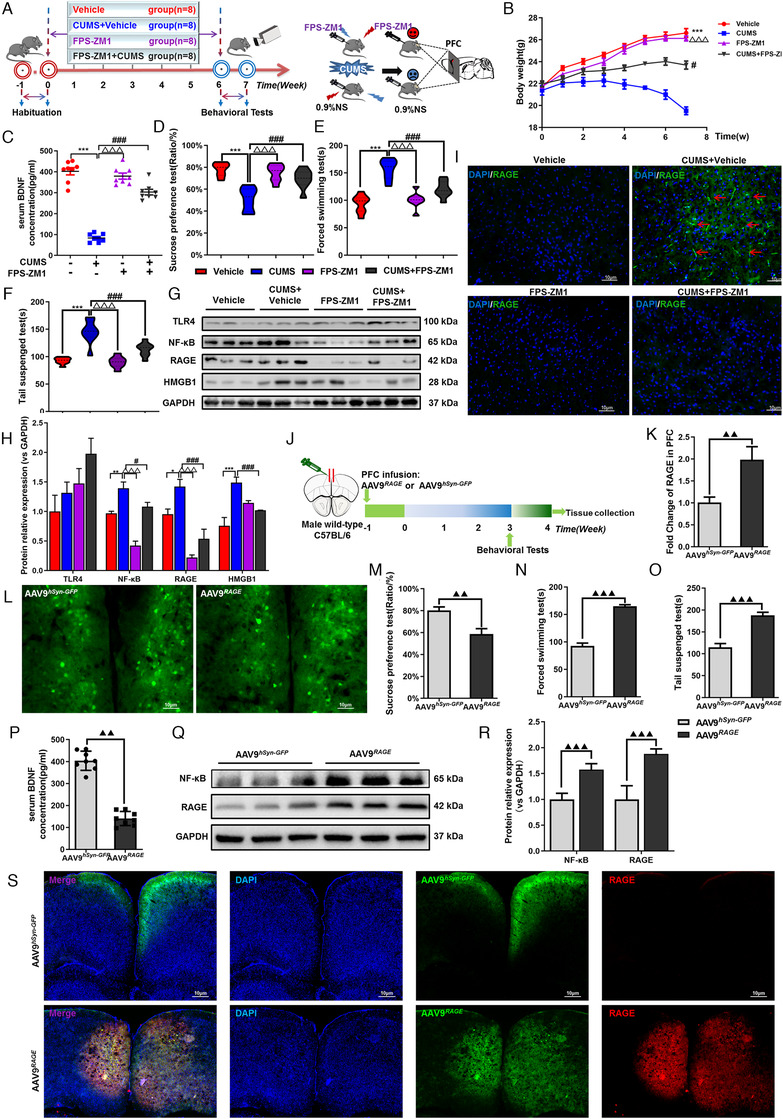
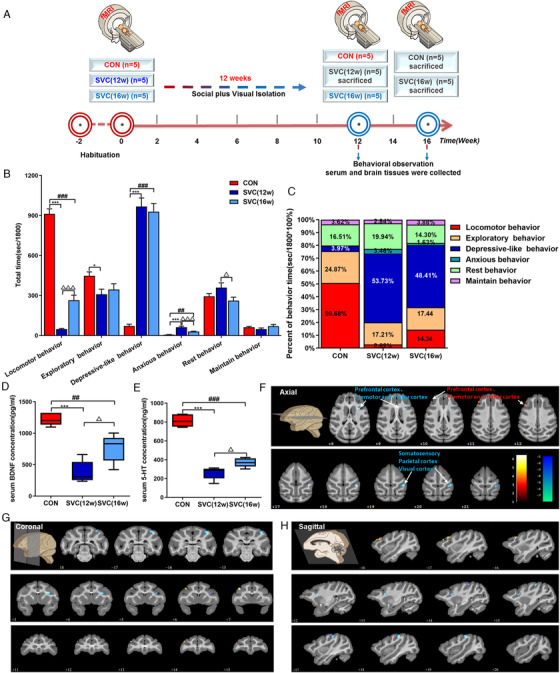
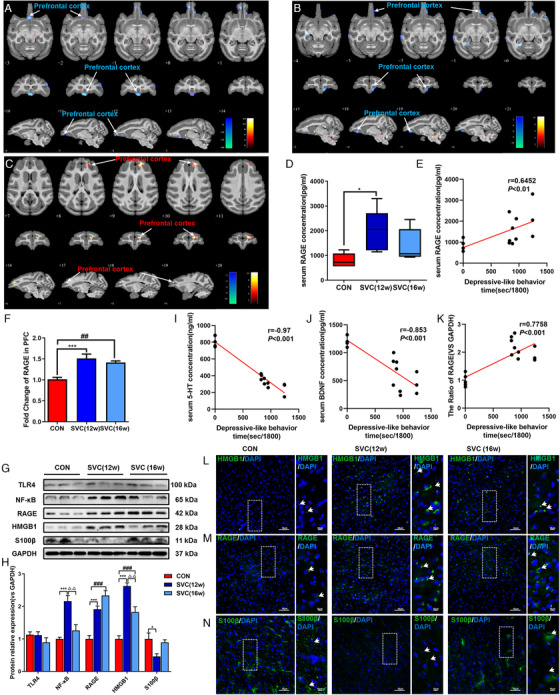
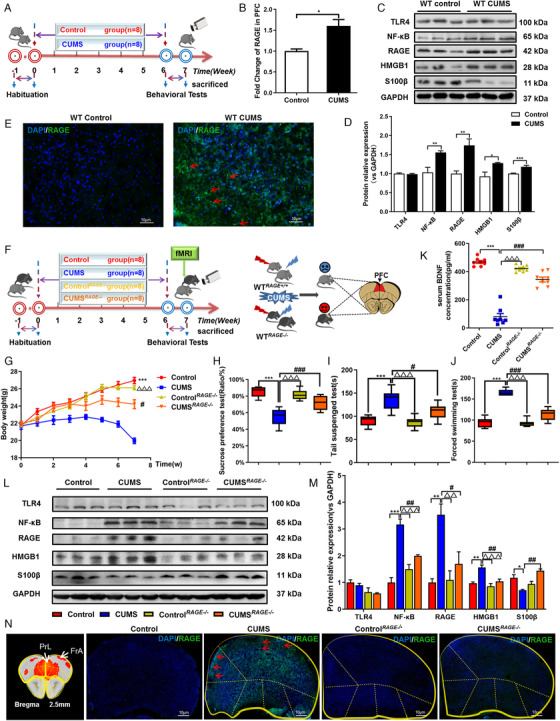
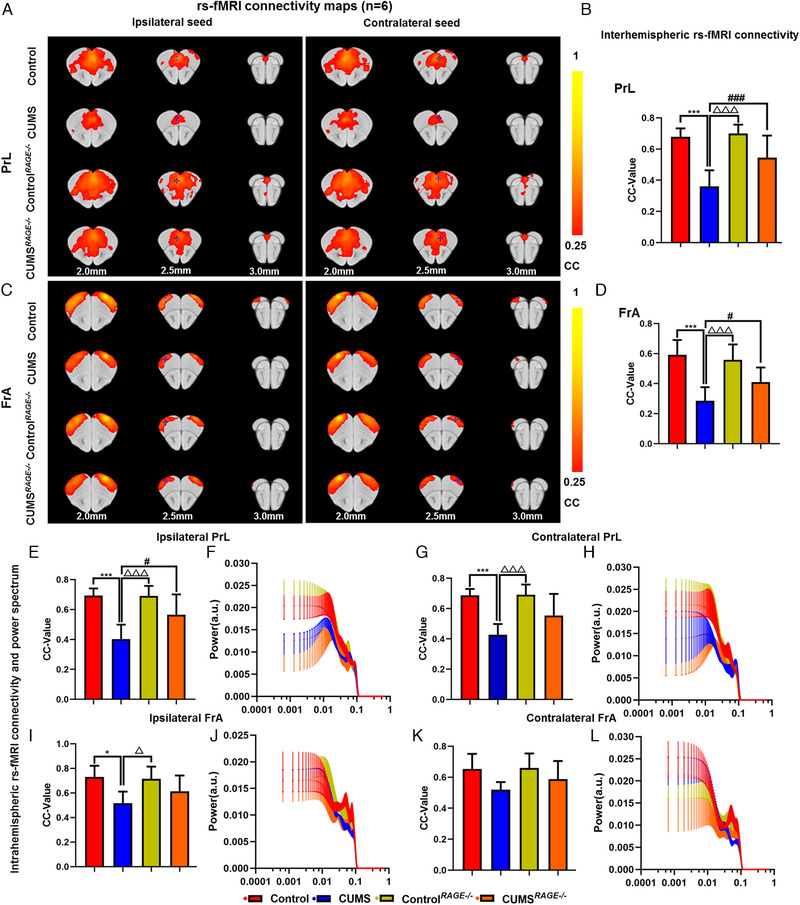
More and more evidence show that major depressive disorder (MDD) is closely related to inflammation caused by chronic stress, which seriously affects human physical and mental health. However, the inflammatory mechanism of depression and its effect on brain function have not been clarified. Based on resting-state functional magnetic resonance imaging (rs-fMRI), we investigated change of brain functional imaging and the inflammatory mechanism of damage-related molecular patterns (DAMPs)-receptor of advanced glycation protein end product (RAGE) in MDD patients and depressive-like cynomolgus monkeys and mice models induced by chronic stress. The regional homogeneity (ReHo) and functional connectivity (FC) were analyzed using MATLAB and SPM12 software. We detected the expression of DAMPs-RAGE pathway-related proteins and mRNA in MDD peripheral blood and in serum and brain tissue of cynomolgus monkeys and mice. Meanwhile, RAGE gene knockout mice, RAGE inhibitor, and overexpression of AVV9 adeno-associated virus were used to verify that RAGE is a reliable potential biomarker of depression. The results showed that the ReHo value of prefrontal cortex (PFC) in MDD patients and depressive-like cynomolgus monkeys was decreased. Then, the PFC was used as a seed point, the FC of ipsilateral and contralateral PFC were weakened in depressive-like mice. At the same time, qPCR showed that RAGE and HMGB1 mRNA were upregulated and S100β mRNA was downregulated. The expression of RAGE-related inflammatory protein in PFC of depressive-like monkeys and mice were consistent with that in peripheral blood of MDD patients. Moreover, the results were confirmed in RAGE mice, injection of FPS-ZM1, and overexpression of AAV9 in mice. To sum up, our findings enhance the evidence that chronic stress-PFC-RAGE are associated with depression. These results attempt to establish the links between brain functional imaging, and molecular targets among different species will help to reveal the pathophysiological mechanism of depression from multiple perspectives.
越来越多的证据表明,重度抑郁症(MDD)与慢性应激引起的炎症密切相关,这严重影响了人类的身心健康。然而,抑郁症的炎症机制及其对大脑功能的影响尚不清楚。基于静息态功能磁共振成像(rs-fMRI),我们研究了慢性应激诱导的 MDD 患者和抑郁样食蟹猴及小鼠模型的脑功能影像学改变和损伤相关分子模式(DAMPs)-晚期糖基化终产物受体(RAGE)的炎症机制。采用 MATLAB 和 SPM12 软件分析局部一致性(ReHo)和功能连接(FC)。我们检测了 MDD 外周血和食蟹猴及小鼠血清和脑组织中 DAMPs-RAGE 通路相关蛋白和 mRNA 的表达。同时,利用 RAGE 基因敲除小鼠、RAGE 抑制剂和过表达 AVV9 腺相关病毒来验证 RAGE 是抑郁症的可靠潜在生物标志物。结果表明,MDD 患者和抑郁样食蟹猴前额叶皮质(PFC)的 ReHo 值降低。然后,以 PFC 为种子点,抑郁样小鼠同侧和对侧 PFC 的 FC 减弱。同时,qPCR 显示 RAGE 和 HMGB1mRNA 上调,S100βmRNA 下调。抑郁样猴和小鼠 PFC 中 RAGE 相关炎症蛋白的表达与 MDD 患者外周血中的表达一致。此外,在 RAGE 小鼠、FPS-ZM1 注射和 AAV9 在小鼠中的过表达中得到了验证。总之,我们的研究结果增强了慢性应激-PFC-RAGE 与抑郁症相关的证据。这些结果试图在不同物种之间建立脑功能影像学和分子靶标之间的联系,将有助于从多个角度揭示抑郁症的病理生理机制。