ITQB NOVA, Instituto de Tecnologia Química e Biológica António Xavier, Universidade Nova de Lisboa, Oeiras, Portugal.
FEBS Open Bio. 2021 Dec;11(12):3253-3261. doi: 10.1002/2211-5463.13323. Epub 2021 Nov 8.
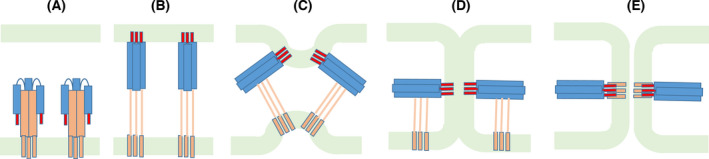
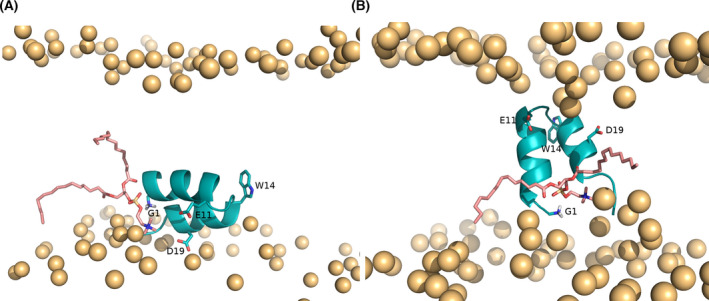
A key step in infections by enveloped viruses, such as influenza, is the fusion between the viral envelope and the host cell membrane, which allows the virus to insert its genetic material into the host cell and replicate. The influenza virus fusion process is promoted by hemagglutinin (HA), a glycoprotein that contains three identical monomers composed of two polypeptide chains (HA1 and HA2). Early studies on this protein revealed that HA-mediated fusion involves the insertion of the HA2 N-terminal segment into the host membrane and that this segment, known as the fusion peptide, is a key player in the fusion process. This mini-review highlights the main findings that have been obtained by experimental and computational studies on the HA fusion peptide, which give us a glimpse of its mode of action.
包膜病毒(如流感)感染的一个关键步骤是病毒包膜与宿主细胞膜之间的融合,这使得病毒能够将其遗传物质插入宿主细胞并进行复制。流感病毒的融合过程是由血凝素(HA)促进的,血凝素是一种糖蛋白,包含三个由两条多肽链(HA1 和 HA2)组成的相同单体。早期对这种蛋白质的研究表明,HA 介导的融合涉及 HA2 N 端片段插入宿主膜,并且该片段被称为融合肽,是融合过程中的关键因素。这篇迷你综述重点介绍了对 HA 融合肽进行实验和计算研究得出的主要发现,这些发现使我们对其作用模式有了初步了解。