Lai Szu-Hsueh, Tamara Sem, Heck Albert J R
Biomolecular Mass Spectrometry and Proteomics, Bijvoet Center for Biomolecular Research and Utrecht Institute for Pharmaceutical Sciences, Utrecht University, 3584 CH Utrecht, The Netherlands.
Netherlands Proteomics Center, Padualaan 8, 3584 CH Utrecht, The Netherlands.
iScience. 2021 Oct 2;24(11):103211. doi: 10.1016/j.isci.2021.103211. eCollection 2021 Nov 19.
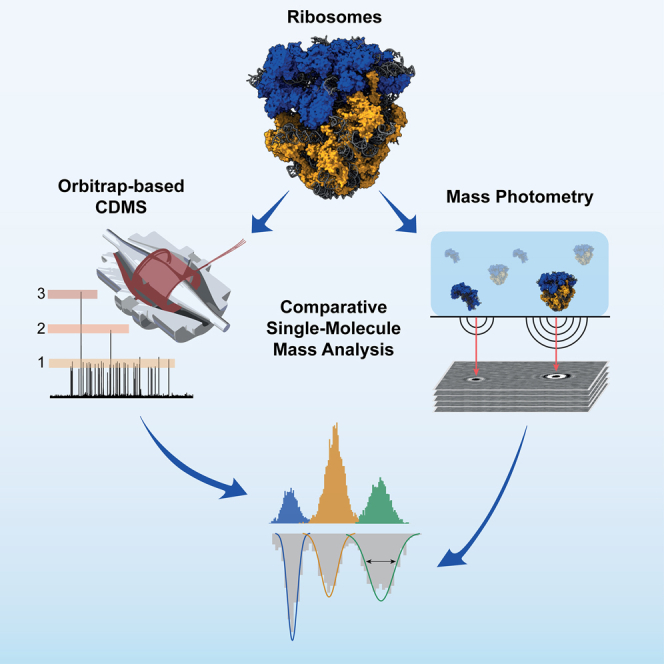
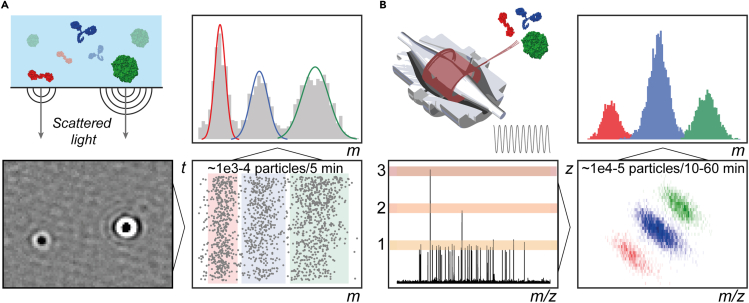
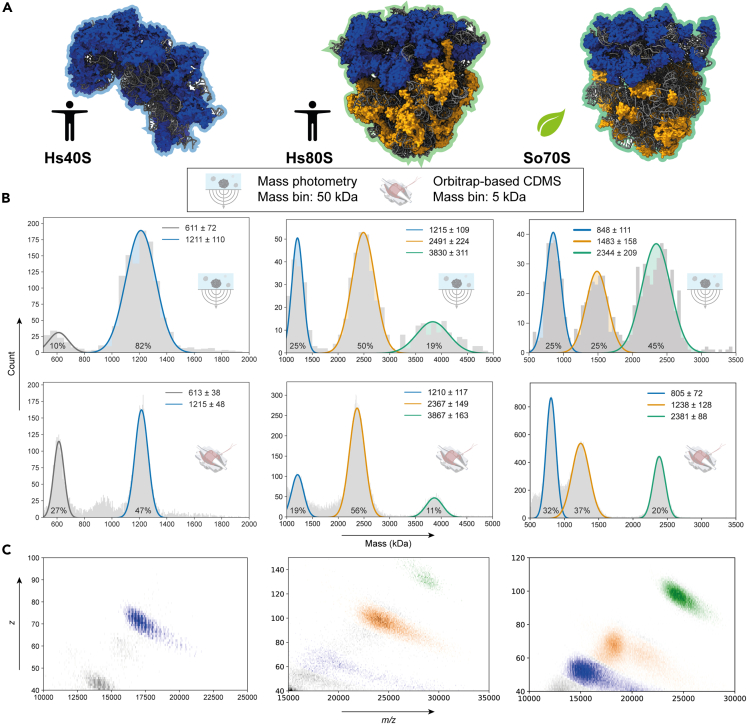
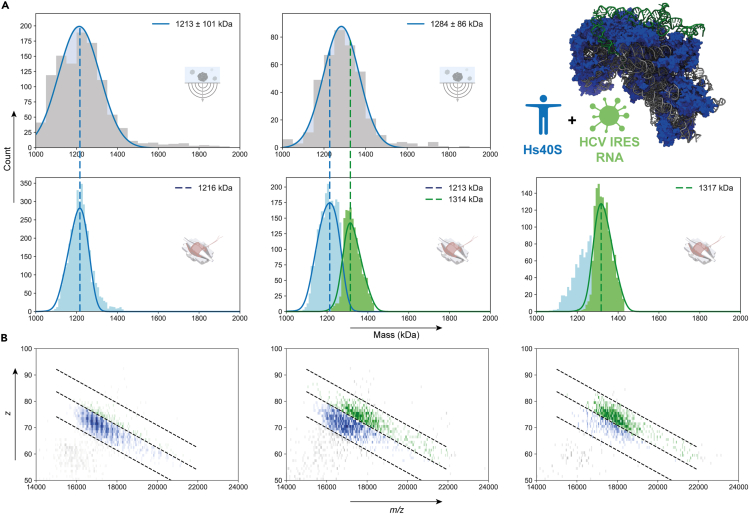
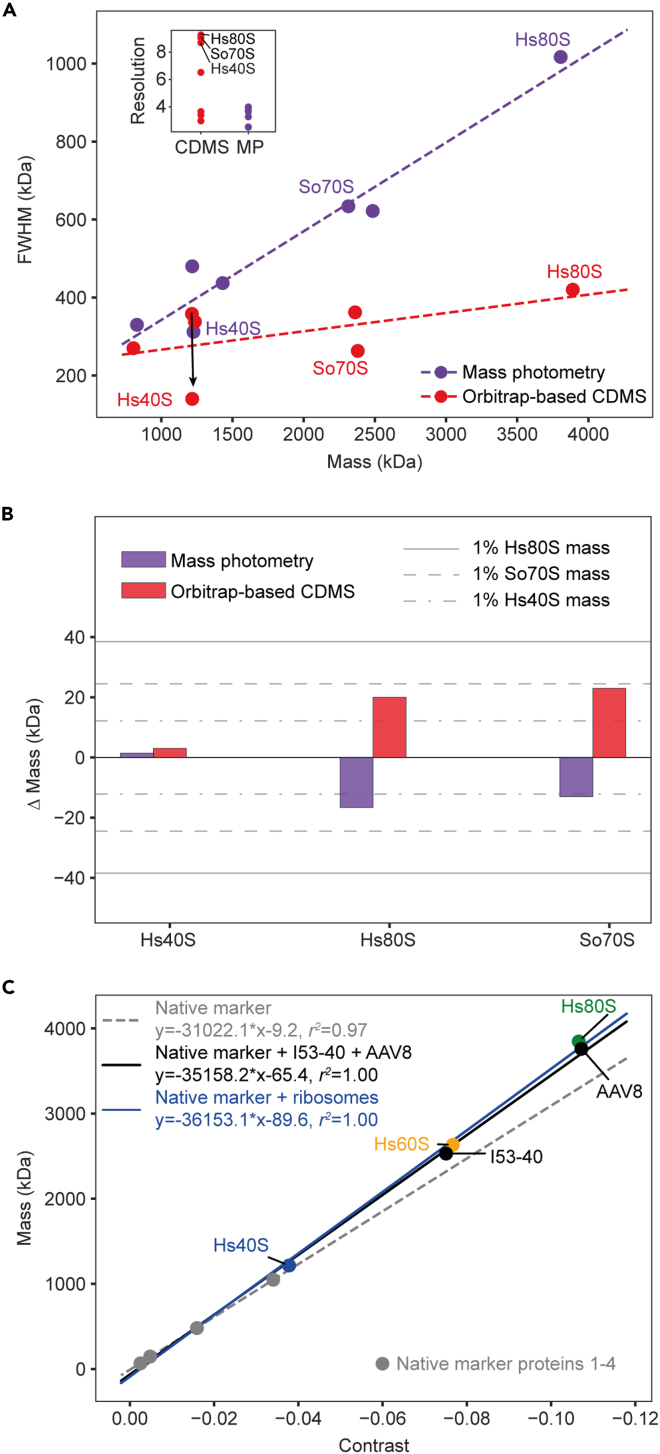
Standard methods for mass analysis measure ensembles of thousand to millions of molecules. This approach enables analysis of monodisperse recombinant proteins, whereas some heterogeneous protein assemblies pose a significant challenge, whereby co-occurring stoichiometries, sub-complexes, and modifications hamper analysis using native mass spectrometry. To tackle the challenges posed by mass heterogeneity, single-particle methods may come to the rescue. Recently, two such approaches have been introduced, namely, mass photometry (MP) and Orbitrap-based charge detection mass spectrometry (CDMS). Both methods assess masses of individual molecules, albeit adhering to distinct physical principles. To evaluate these methods side by side, we analyzed a set of ribosomal particles, representing polydisperse ribonucleoprotein assemblies in the MDa range. MP and CDMS provide accurate masses for intact ribosomes and enable quantitative analysis of concomitant distinct particles within each ribosome sample. Here, we discuss pros and cons of these single-molecule techniques, also in the context of other techniques used for mass analysis.
传统的质量分析方法用于测量数千到数百万个分子的集合。这种方法能够分析单分散的重组蛋白,然而一些异质性蛋白质组装体却构成了重大挑战,其中同时出现的化学计量、亚复合物和修饰会妨碍使用原生质谱进行分析。为应对质量异质性带来的挑战,单颗粒方法可能会有所帮助。最近,引入了两种这样的方法,即质量光度法(MP)和基于轨道阱的电荷检测质谱法(CDMS)。这两种方法都能评估单个分子的质量,尽管遵循不同的物理原理。为了并行评估这些方法,我们分析了一组核糖体颗粒,它们代表了MDa范围内的多分散核糖核蛋白组装体。MP和CDMS为完整的核糖体提供了准确的质量,并能够对每个核糖体样品中同时存在的不同颗粒进行定量分析。在此,我们还结合用于质量分析的其他技术,讨论了这些单分子技术的优缺点。