Njoroge Martin W, Mjojo Patrick, Chirwa Catherine, Rylance Sarah, Nightingale Rebecca, Gordon Stephen B, Mortimer Kevin, Burney Peter, Balmes John, Rylance Jamie, Obasi Angela, Niessen Louis W, Devereux Graham
Department of Clinical Sciences and International Public Health, Liverpool School of Tropical Medicine, Pembroke Place, Liverpool L3 5QA, UK.
Malawi Liverpool Wellcome Trust Programme, Blantyre, Malawi.
EClinicalMedicine. 2021 Oct 18;41:101166. doi: 10.1016/j.eclinm.2021.101166. eCollection 2021 Nov.
In Sub-Saharan Africa cross-sectional studies report a high prevalence of abnormal lung function indicative of chronic respiratory disease. The natural history and health impact of this abnormal lung function in low-and middle-income countries is largely unknown.
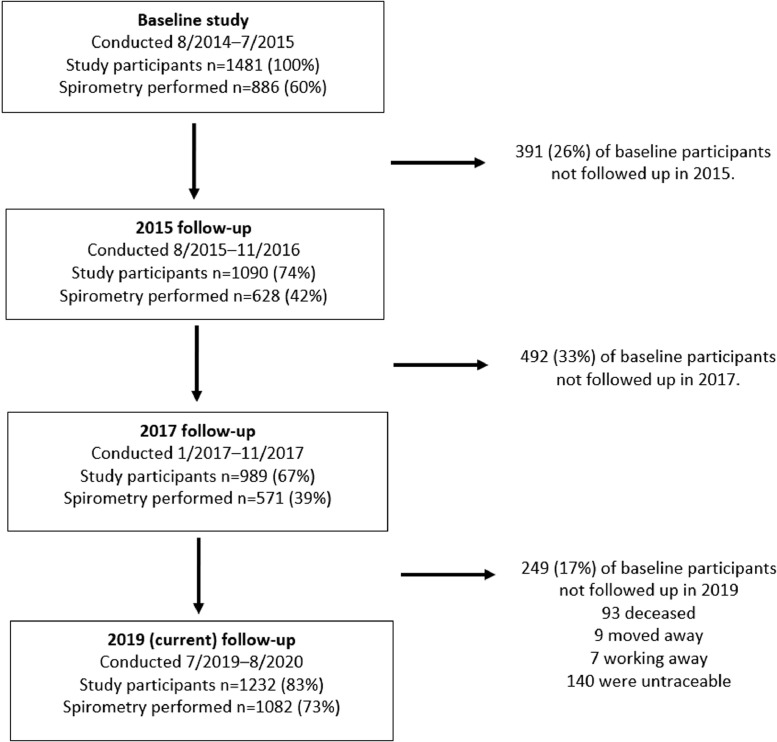
A cohort of 1481 adults representative of rural Chikwawa in Malawi were recruited in 2014 and followed-up in 2019. Respiratory symptoms and health-related quality of life (HRQoL) were quantified. Lung function was measured by spirometry.
1232 (83%) adults participated; spirometry was available for 1082 (73%). Mean (SD) age 49.5 (17.0) years, 278(23%) had ever smoked, and 724 (59%) were women. Forced expiratory volume in one second (FEV) declined by 53.4 ml/year (95% CI: 49.0, 57.8) and forced vital capacity (FVC) by 45.2 ml/year (95% CI: 39.2, 50.5) . Chronic airflow obstruction increased from 9.5% (7.6, 11.6%) in 2014 to 17.5% (15.3, 19.9%) in 2019. There was no change in diagnosed asthma or in spirometry consistent with asthma or restriction. Rate of FEV decline was not associated with diagnosed Chronic obstructive pulmonary disease (COPD), asthma, or spirometry consistent with asthma, COPD, or restriction. HRQoL was adversely associated with respiratory symptoms (dyspnoea, wheeze, cough), previous tuberculosis, declining FEV and spirometry consistent with asthma or restriction. These differences exceeded the minimally important difference.
In this cohort, the increasing prevalence of COPD is associated with the high rate of FEV decline and lung function deficits present before recruitment. Respiratory symptoms and sub-optimal lung function are independently associated with reduced HRQoL.
在撒哈拉以南非洲地区,横断面研究报告显示,提示慢性呼吸道疾病的肺功能异常患病率很高。在低收入和中等收入国家,这种肺功能异常的自然史及其对健康的影响在很大程度上尚不清楚。
2014年招募了一组代表马拉维奇夸瓦农村地区的1481名成年人,并于2019年进行随访。对呼吸道症状和健康相关生活质量(HRQoL)进行了量化。通过肺活量测定法测量肺功能。
1232名(83%)成年人参与;1082名(73%)有肺活量测定数据。平均(标准差)年龄为49.5(17.0)岁,278名(23%)曾经吸烟,724名(59%)为女性。一秒用力呼气量(FEV)每年下降53.4毫升(95%置信区间:49.0,57.8),用力肺活量(FVC)每年下降45.2毫升(95%置信区间:39.2,50.5)。慢性气流受限从2014年的9.5%(7.6,11.6%)增至2019年的17.5%(15.3,19.9%)。确诊哮喘或与哮喘或受限相符的肺活量测定结果无变化。FEV下降率与确诊的慢性阻塞性肺疾病(COPD)、哮喘或与哮喘、COPD或受限相符的肺活量测定结果无关。HRQoL与呼吸道症状(呼吸困难、喘息、咳嗽)、既往结核病、FEV下降以及与哮喘或受限相符的肺活量测定结果呈负相关。这些差异超过了最小重要差异。
在该队列中,COPD患病率上升与FEV下降率高以及招募前存在的肺功能缺陷有关。呼吸道症状和肺功能欠佳与HRQoL降低独立相关。