Issom David-Zacharie, Hardy-Dessources Marie-Dominique, Romana Marc, Hartvigsen Gunnar, Lovis Christian
Department of Radiology and Medical Informatics, Faculty of Medicine, University of Geneva, Geneva, Switzerland.
INSERM U1134 Biologie Intégrée du Globule Rouge, Paris, France.
Front Digit Health. 2021 Jan 29;3:600333. doi: 10.3389/fdgth.2021.600333. eCollection 2021.
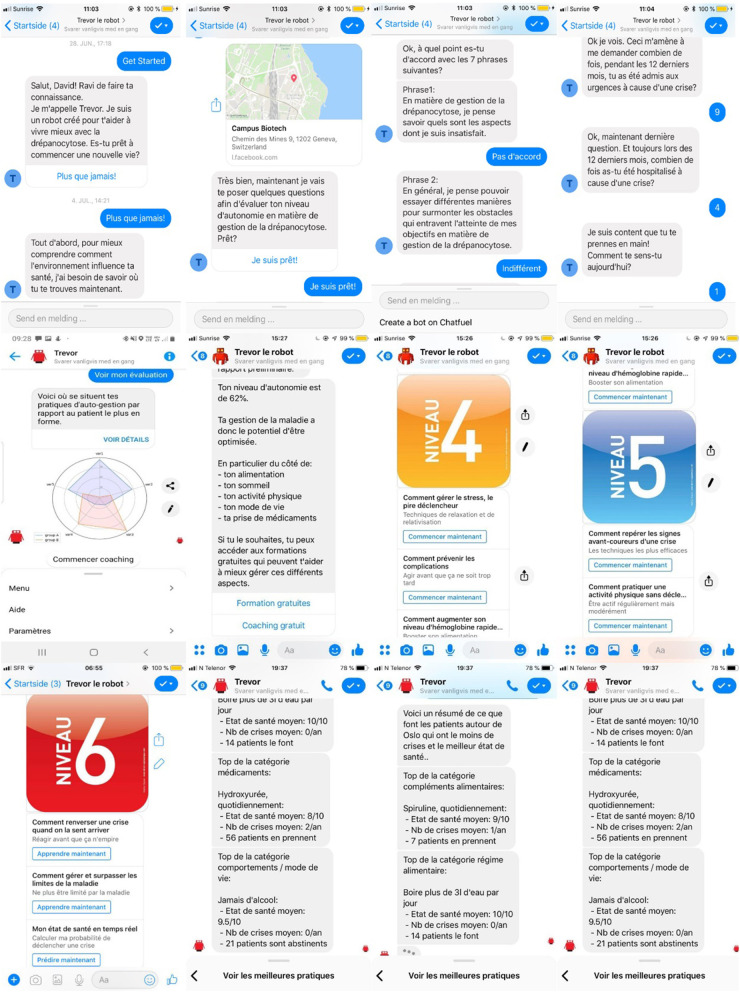
Sickle cell disease (SCD) is the most common genetic blood disorder in the world and affects millions of people. With aging, patients encounter an increasing number of comorbidities that can be acute, chronic, and potentially lethal (e.g., pain, multiple organ damages, lung disease). Comprehensive and preventive care for adults with SCD faces disparities (e.g., shortage of well-trained providers). Consequently, many patients do not receive adequate treatment, as outlined by evidence-based guidelines, and suffer from mistrust, stigmatization or neglect. Thus, adult patients often avoid necessary care, seek treatment only as a last resort, and rely on self-management to maintain control over the course of the disease. Hopefully, self-management positively impacts health outcomes. However, few patients possess the required skills (e.g., disease-specific knowledge, self-efficacy), and many lack motivation for effective self-care. Health coaching has emerged as a new approach to enhance patients' self-management and support health behavior changes. Recent studies have demonstrated that conversational agents (chatbots) could effectively support chronic patients' self-management needs, improve self-efficacy, encourage behavior changes, and reduce disease-severity. To date, the use of chatbots to support SCD self-management remains largely under-researched. Consequently, we developed a high-fidelity prototype of a fully automated health coaching chatbot, following patient-important requirements and preferences collected during our previous work. We recruited a small convenience sample of adults with SCD to examine the usability and perceived usefulness of the system. Participants completed a post-test survey using the System Usability Scale and the Usefulness Scale for Patient Information Material questionnaire. Thirty-three patients participated. The majority (64%) was affected by the most clinically severe SCD genotypes (Hb SS, HbSβ0). Most participants (94%) rated the chatbots as easy and fun to use, while 88% perceived it as useful support for patient empowerment. In the qualitative phase, 72% of participants expressed their enthusiasm using the chatbot, and 82% emphasized its ability to improve their knowledge about self-management. Findings suggest that chatbots could be used to promote the acquisition of recommended health behaviors and self-care practices related to the prevention of the main symptoms of SCD. Further work is needed to refine the system, and to assess clinical validity.
镰状细胞病(SCD)是世界上最常见的遗传性血液疾病,影响着数百万人。随着年龄的增长,患者会出现越来越多的合并症,这些合并症可能是急性、慢性的,甚至有潜在致命风险(如疼痛、多器官损伤、肺部疾病)。为成年SCD患者提供全面的预防性护理面临着差异(如训练有素的医护人员短缺)。因此,许多患者没有按照循证指南接受充分的治疗,并且遭受不信任、污名化或忽视。所以,成年患者常常回避必要的护理,仅在万不得已时才寻求治疗,并依靠自我管理来控制疾病进程。希望自我管理能对健康结果产生积极影响。然而,很少有患者具备所需技能(如疾病相关知识、自我效能感),而且许多人缺乏进行有效自我护理的动力。健康指导已成为一种新方法,以增强患者的自我管理能力并支持健康行为改变。最近的研究表明,对话代理(聊天机器人)可以有效地满足慢性病患者的自我管理需求,提高自我效能感,鼓励行为改变,并降低疾病严重程度。迄今为止,使用聊天机器人支持SCD自我管理的研究仍非常少。因此,我们根据在之前工作中收集的患者重要需求和偏好,开发了一个全自动健康指导聊天机器人的高保真原型。我们招募了一小群方便样本的成年SCD患者,以检验该系统的可用性和感知有用性。参与者使用系统可用性量表和患者信息材料有用性量表问卷完成了一项测试后调查。33名患者参与了调查。大多数(64%)患者受临床最严重的SCD基因型(Hb SS、HbSβ0)影响。大多数参与者(94%)认为聊天机器人使用起来轻松有趣,而88%的人认为它对增强患者能力很有帮助。在定性阶段,72%的参与者表示使用聊天机器人很有热情,82%的人强调它能够提高他们对自我管理的认识。研究结果表明,聊天机器人可用于促进获取与预防SCD主要症状相关的推荐健康行为和自我护理实践。还需要进一步开展工作来完善该系统,并评估其临床有效性。