Department of Internal Medicine, Nelson R. Mandela School of Medicine, University of KwaZulu-Natal, South Africa.
Discipline of Pharmaceutical Sciences, School of Health Sciences, University of KwaZulu-Natal, South Africa.
Medicine (Baltimore). 2021 Oct 29;100(43):e27342. doi: 10.1097/MD.0000000000027342.
Worldwide despite the availability of antiretroviral therapy, human immunodeficiency virus/acquired immunodeficiency syndrome still causes morbidity and mortality among patients. In Sub-Saharan Africa, human immunodeficiency virus/acquired immunodeficiency syndrome remains a major public health concern. The aim of this study was to identify the causes of morbidity and mortality in the modern antiretroviral therapy era in Sub-Saharan Africa.
We conducted a systematic review according to the Preferred Reporting Items for Systematic Review and Meta-Analysis guidelines. We searched relevant studies from 3 databases which are Google Scholar, PubMed, and CINAHL. Two review authors independently screened titles, abstracts, and full-text articles in duplicate, extracted data, and assessed bias. Discrepancies were resolved by discussion or arbitration of a third review author. R software version 3.6.2 was used to analyze the data. Maximum values were used in order to show which disease was mostly spread out by looking at the highest prevalence reported. This systematic review protocol was registered with the International Prospective Register of Systematic Reviews (PROSPERO).
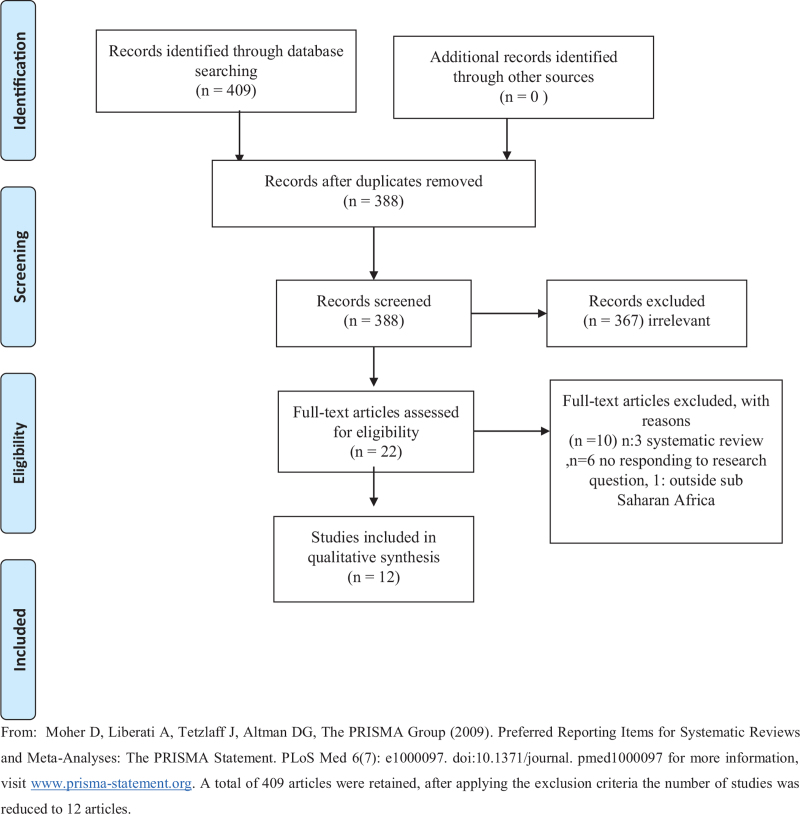
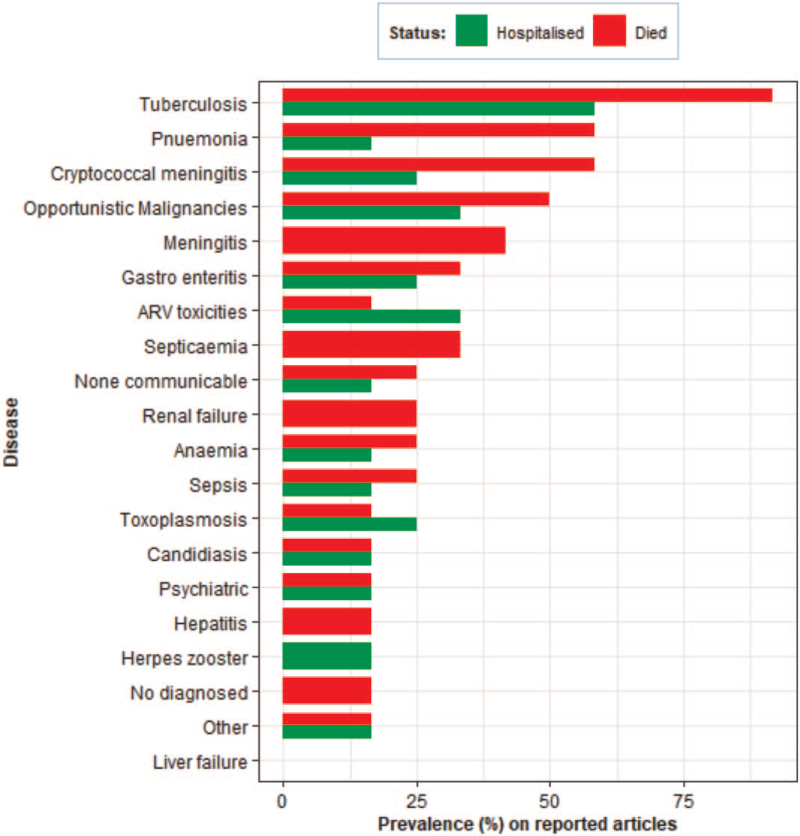
A total of 409 articles were obtained from the database search, finally 12 articles met the inclusion criteria and were eligible for data extraction. Among them, 3 were conducted in Nigeria, 2 were conducted in Uganda, 3 were conducted in South Africa, 1 in Gabon, 1 in Ethiopia, 1 in Ghana, and 1 in Burkina Faso. In most of the included studies, tuberculosis was the leading cause of hospitalization which accounted for between 18% and 40.7% and it was also the leading cause of death and accounted for between 16% and 44.3%, except in 1 which reported anemia as the leading cause of hospitalization and in 2 which reported wasting syndrome and meningitis respectively as the leading causes of death. Opportunistic malignancies accounted between for 1.8% to 5% of hospitalization and 1.2% to 9.8% of deaths.
Tuberculosis is the commonest cause of hospitalization and death in Sub-Saharan Africa, but it is always followed by other infectious disease and other non-AIDS related causes.
尽管全世界都有抗逆转录病毒疗法,但人类免疫缺陷病毒/获得性免疫缺陷综合征仍然导致撒哈拉以南非洲的患者发病和死亡。在撒哈拉以南非洲,人类免疫缺陷病毒/获得性免疫缺陷综合征仍然是一个主要的公共卫生关注点。本研究旨在确定撒哈拉以南非洲在现代抗逆转录病毒治疗时代发病和死亡的原因。
我们按照系统评价和荟萃分析的首选报告项目指南进行了系统评价。我们从 Google Scholar、PubMed 和 CINAHL 这 3 个数据库中搜索了相关研究。两位综述作者独立地对标题、摘要和全文文章进行了重复筛选,提取数据并评估了偏倚。意见分歧通过第三位综述作者的讨论或仲裁解决。使用 R 软件版本 3.6.2 对数据进行分析。为了显示哪种疾病的报告发病率最高,使用了最大值。本系统评价方案已在国际前瞻性系统评价注册库(PROSPERO)中注册。
从数据库搜索中总共获得了 409 篇文章,最终有 12 篇文章符合纳入标准并适合提取数据。其中,3 篇在尼日利亚进行,2 篇在乌干达进行,3 篇在南非进行,1 篇在加蓬进行,1 篇在埃塞俄比亚进行,1 篇在加纳进行,1 篇在布基纳法索进行。在大多数纳入的研究中,结核病是导致住院的主要原因,占 18%至 40.7%,也是导致死亡的主要原因,占 16%至 44.3%,除了 1 篇报告贫血是导致住院的主要原因,2 篇分别报告消瘦综合征和脑膜炎是导致死亡的主要原因。机会性恶性肿瘤占住院的 1.8%至 5%,占死亡的 1.2%至 9.8%。
结核病是撒哈拉以南非洲住院和死亡的最常见原因,但总是紧随其他传染病和其他非艾滋病相关原因之后。