Environmental Science Program, Department of Biological and Environmental Sciences, College of Arts and Science, Qatar University, Doha, Qatar.
PLoS One. 2021 Oct 29;16(10):e0259302. doi: 10.1371/journal.pone.0259302. eCollection 2021.
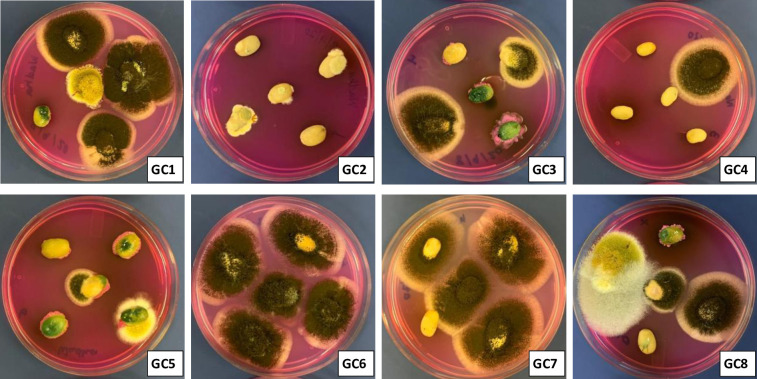
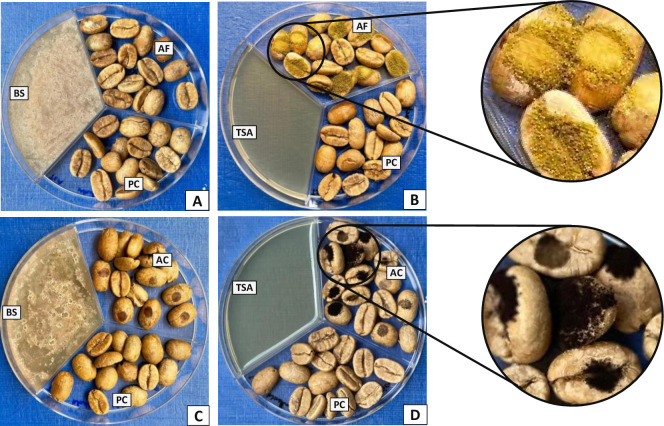
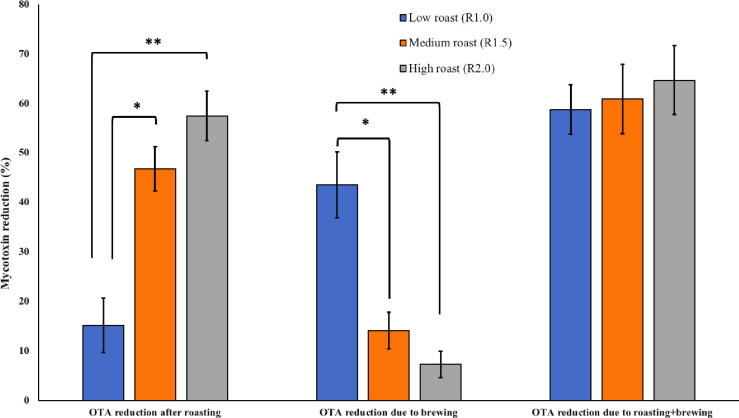
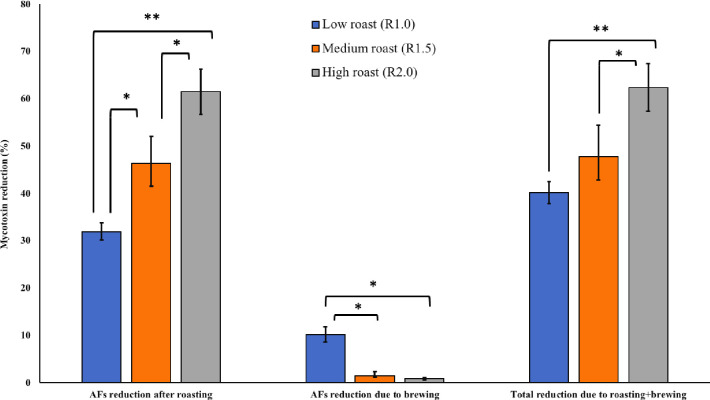
Fungal infection and synthesis of mycotoxins in coffee leads to significant economic losses. This study aimed to investigate the prevalence of toxigenic fungi, their metabolites, and the effect of traditional roasting and brewing on ochratoxin A (OTA) and aflatoxins (AFs) contents of naturally contaminated coffee samples. In addition, in vivo biocontrol assays were performed to explore the antagonistic activities of Bacillus simplex 350-3 (BS350-3) on the growth and mycotoxins synthesis of Aspergillus ochraceus and A. flavus. The relative density of A. niger, A. flavus, Penicillium verrucosum and A. carbonarius on green coffee bean was 60.82%, 7.21%, 3.09% and 1.03%, respectively. OTA contents were lowest in green coffee beans (2.15 μg/kg), followed by roasted (2.76 μg/kg) and soluble coffee (8.95 μg/kg). Likewise, AFs levels were highest in soluble coffee (90.58 μg/kg) followed by roasted (33.61 μg/kg) and green coffee (9.07 μg/kg). Roasting naturally contaminated coffee beans at three traditional methods; low, medium and high, followed by brewing resulted in reduction of 58.74% (3.50 μg/kg), 60.88% (3.72 μg/kg) and 64.70% (4.11 μg/kg) in OTA and 40.18% (34.65 μg/kg), 47.86% (41.17 μg/kg) and 62.38% (53.73 μg/kg) AFs contents, respectively. Significant inhibitions of AFs and OTA synthesis by A. flavus and A. carbonarius, respectively, on infected coffee beans were observed in presence of Bacillus simplex BS350-3 volatiles. Gas chromatography mass spectrochemistry (GC-MS/MS) analysis of head-space BS350-3 volatiles showed quinoline, benzenemethanamine and 1-Octadecene as bioactive antifungal molecules. These findings suggest that marketed coffee samples are generally contaminated with OTA and AFs, with a significant level of roasted and soluble coffee contaminated above EU permissible limits for OTA. Further, along with coffee roasting and brewing; microbial volatiles can be optimized to minimize the dietary exposure to mycotoxins.
真菌感染和霉菌毒素的合成导致咖啡的重大经济损失。本研究旨在调查产毒真菌的流行情况,及其代谢物,并研究传统烘焙和酿造对天然污染咖啡样品中赭曲霉毒素 A(OTA)和黄曲霉毒素(AFs)含量的影响。此外,还进行了体内生物防治试验,以探索枯草芽孢杆菌 350-3(BS350-3)对赭曲霉和黄曲霉生长和霉菌毒素合成的拮抗作用。在绿咖啡豆上,黑曲霉、黄曲霉、展青霉和构巢曲霉的相对密度分别为 60.82%、7.21%、3.09%和 1.03%。OTA 含量在绿咖啡豆中最低(2.15μg/kg),其次是烘焙咖啡豆(2.76μg/kg)和速溶咖啡(8.95μg/kg)。同样,AFs 水平在速溶咖啡中最高(90.58μg/kg),其次是烘焙咖啡豆(33.61μg/kg)和绿咖啡豆(9.07μg/kg)。采用三种传统方法(低、中、高)对天然污染的咖啡豆进行烘焙,然后再进行酿造,结果导致 OTA 含量降低了 58.74%(3.50μg/kg)、60.88%(3.72μg/kg)和 64.70%(4.11μg/kg),AFs 含量降低了 40.18%(34.65μg/kg)、47.86%(41.17μg/kg)和 62.38%(53.73μg/kg)。在枯草芽孢杆菌 BS350-3 挥发物存在的情况下,观察到黄曲霉和构巢曲霉分别对感染咖啡的 AFs 和 OTA 合成有显著抑制作用。顶空 BS350-3 挥发物的气相色谱-质谱联用(GC-MS/MS)分析表明,喹啉、苯甲胺和 1-十八烯是具有生物活性的抗真菌分子。这些发现表明,市售咖啡样品通常受到 OTA 和 AFs 的污染,其中大量烘焙和速溶咖啡的污染超过了欧盟对 OTA 的允许限量。此外,除了咖啡烘焙和酿造外;还可以优化微生物挥发物以最大程度地减少对霉菌毒素的饮食暴露。