Liu Haijie, Zhang Yan, Hu Yang, Zhang Haihua, Wang Tao, Han Zhifa, Gao Shan, Wang Longcai, Liu Guiyou
Department of Neurology, Xuanwu Hospital, Capital Medical University, Beijing, 100053, China.
Department of Pathology, The Affiliated Hospital of Weifang Medical University, Weifang, 261053, China.
Genes Nutr. 2021 Oct 29;16(1):19. doi: 10.1186/s12263-021-00700-9.
Until now, observational studies have explored the impact of vitamin C intake on Alzheimer's disease (AD) risk, however, reported ambiguous findings. To develop effective therapies or prevention, the causal link between vitamin C levels and AD should be established.
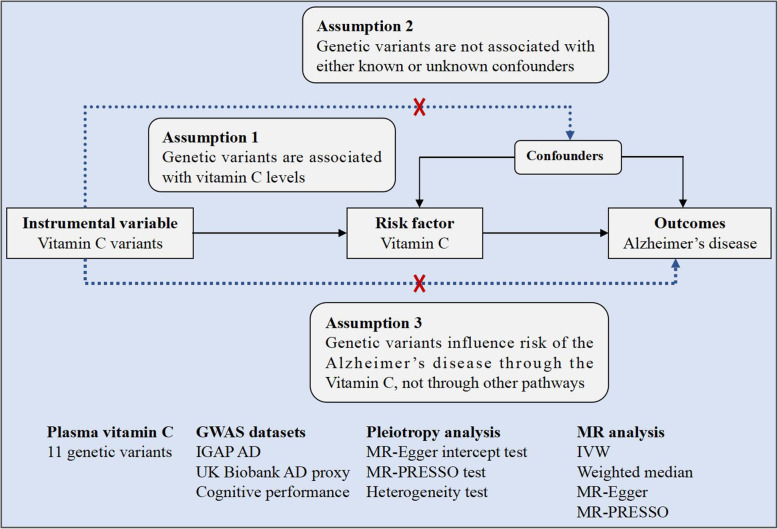
Here, we selected 11 plasma vitamin C genetic variants from a large-scale plasma vitamin C GWAS dataset (N = 52,018) as the potential instrumental variables. We extracted their corresponding summary statistics from large-scale IGAP clinically diagnosed AD GWAS dataset (N = 63,926) and UK Biobank AD proxy phenotype GWAS dataset (N = 314,278), as well as two UK Biobank subgroups including the maternal AD group (27,696 cases of maternal AD and 260,980 controls) and paternal AD group (14,338 cases of paternal AD and 245,941 controls). We then performed a Mendelian randomization (MR) study to evaluate the causal association between plasma vitamin C levels and the risk of AD and AD proxy phenotype. Meanwhile, we further verified these findings using a large-scale cognitive performance GWAS dataset (N = 257,841).
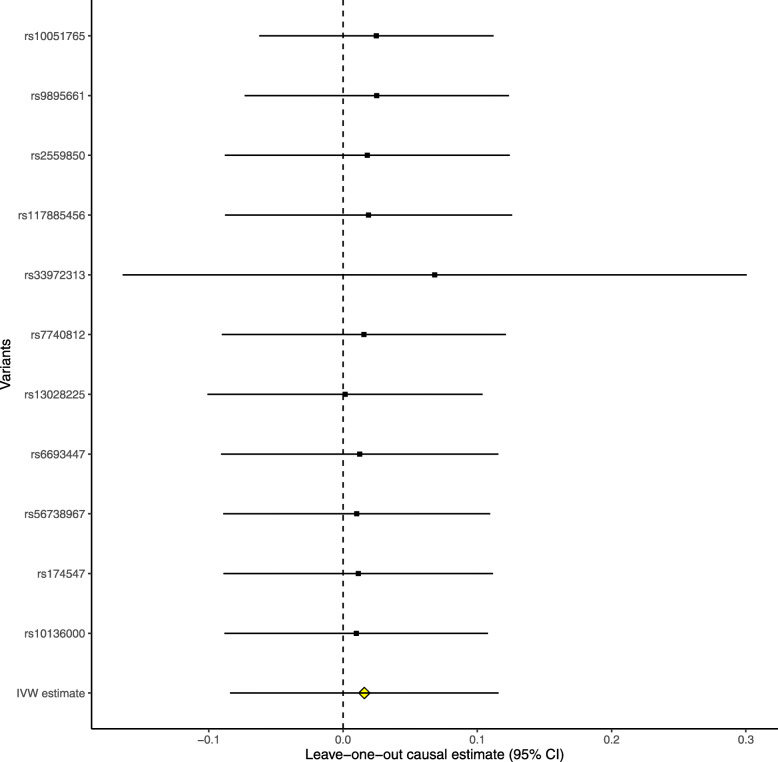
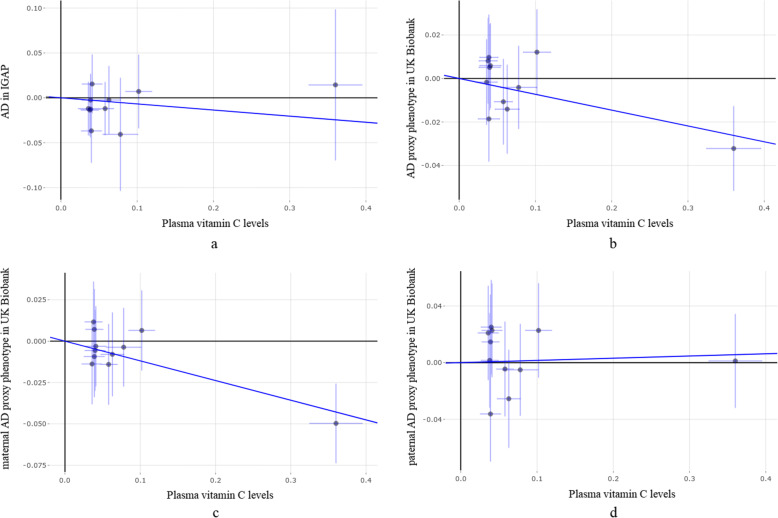
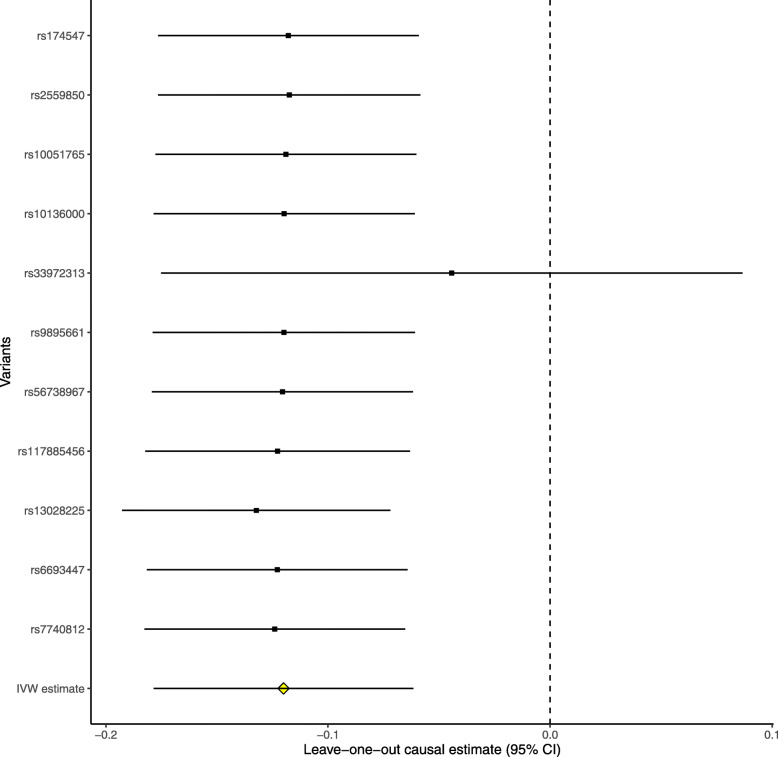
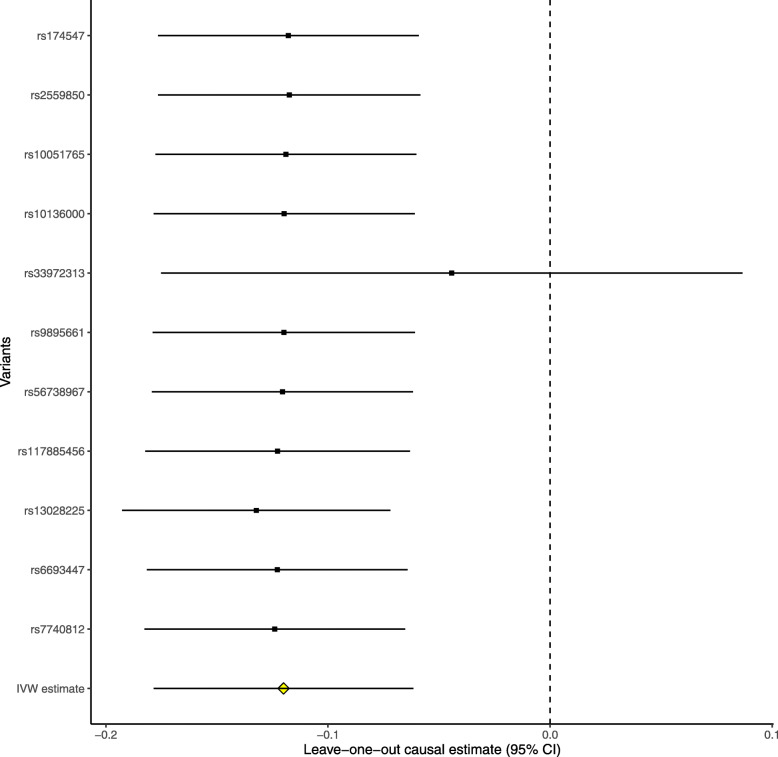
In IGAP, we found no significant causal association between plasma vitamin C levels and the risk of AD. In UK Biobank, we found that per 1 SD increase in plasma vitamin C levels (about 20.2 μmol/l) was significantly associated with the reduced risk of AD proxy phenotype (OR = 0.93, 95% CI 0.88-0.98, P = 7.00E-03). A subgroup MR analysis in UK Biobank indicated that per 1 SD increase in plasma vitamin C levels could significantly reduce the risk of AD proxy phenotype in the maternal AD group (OR = 0.89, 95% CI 0.84-0.94, P = 7.29E-05), but not in the paternal AD group (OR = 1.02, 95% CI 0.92-1.12, P = 7.59E-01). The leave-one-out permutation further showed that the SLC23A1 rs33972313 variant largely changed the precision of the overall MR estimates in all these four GWAS datasets. Meanwhile, we did not observe any significant causal effect of plasma vitamin C levels on the cognitive performance.
We demonstrated that there may be no causal association between plasma vitamin C levels and the risk of AD in people of European descent. The insistent findings in clinically diagnosed AD and AD proxy phenotype may be caused by the phenotypic heterogeneity.
迄今为止,观察性研究已探讨了维生素C摄入量对阿尔茨海默病(AD)风险的影响,然而,报告的结果并不明确。为了开发有效的治疗方法或预防措施,应建立维生素C水平与AD之间的因果联系。
在此,我们从一个大规模血浆维生素C全基因组关联研究数据集(N = 52,018)中选择了11个血浆维生素C基因变异作为潜在的工具变量。我们从大规模国际基因组学与阿尔茨海默病计划(IGAP)临床诊断的AD全基因组关联研究数据集(N = 63,926)、英国生物银行AD替代表型全基因组关联研究数据集(N = 314,278)以及两个英国生物银行亚组(包括母系AD组(27,696例母系AD病例和260,980例对照)和父系AD组(14,338例父系AD病例和245,941例对照))中提取了它们相应的汇总统计数据。然后,我们进行了孟德尔随机化(MR)研究,以评估血浆维生素C水平与AD风险及AD替代表型之间的因果关联。同时,我们使用一个大规模认知功能全基因组关联研究数据集(N = 257,841)进一步验证了这些发现。
在IGAP中,我们未发现血浆维生素C水平与AD风险之间存在显著的因果关联。在英国生物银行中,我们发现血浆维生素C水平每增加1个标准差(约20.2μmol/l)与AD替代表型风险降低显著相关(OR = 0.93,95%CI 0.88 - 0.98,P = 7.00E - 03)。英国生物银行中的亚组MR分析表明,血浆维生素C水平每增加1个标准差可显著降低母系AD组中AD替代表型的风险(OR = 0.89,95%CI 0.84 - 0.94,P = 7.29E - 05),但在父系AD组中未发现这种关联(OR = 1.02,95%CI 0.92 - 1.12,P = 7.59E - 01)。留一法置换分析进一步表明,溶质载体家族23成员1(SLC23A1)基因的rs33972313变异在所有这四个全基因组关联研究数据集中很大程度上改变了总体MR估计的精度。同时,我们未观察到血浆维生素C水平对认知功能有任何显著的因果效应。
我们证明欧洲血统人群中血浆维生素C水平与AD风险之间可能不存在因果关联。临床诊断的AD和AD替代表型中持续出现的结果可能是由表型异质性导致的。