Department of Rheumatology, Leiden University Medical Center, PO box 9600 (Zone C1-R), Albinusdreef 2, 2233, ZA, Leiden, The Netherlands.
Flow Core Facility, Leiden University Medical Center, Leiden, The Netherlands.
Arthritis Res Ther. 2021 Oct 29;23(1):272. doi: 10.1186/s13075-021-02630-8.
Autoantibody production is a hallmark of rheumatoid arthritis (RA). Anti-citrullinated protein antibodies (ACPA) are highly disease-specific, and their presence is associated with more severe disease and poor prognosis compared to ACPA-negative patients. However, the immune cell composition associated with antibody-positive/negative disease is incompletely defined. Mass cytometry (MC) is a high-dimensional technique offering new possibilities in the determination of the immune cell composition in rheumatic diseases. Here, we set up a broad phenotyping panel to study the immune cell profile of early untreated RA to investigate if specific immune cell subsets are associated with ACPA+ versus ACPA- RA.
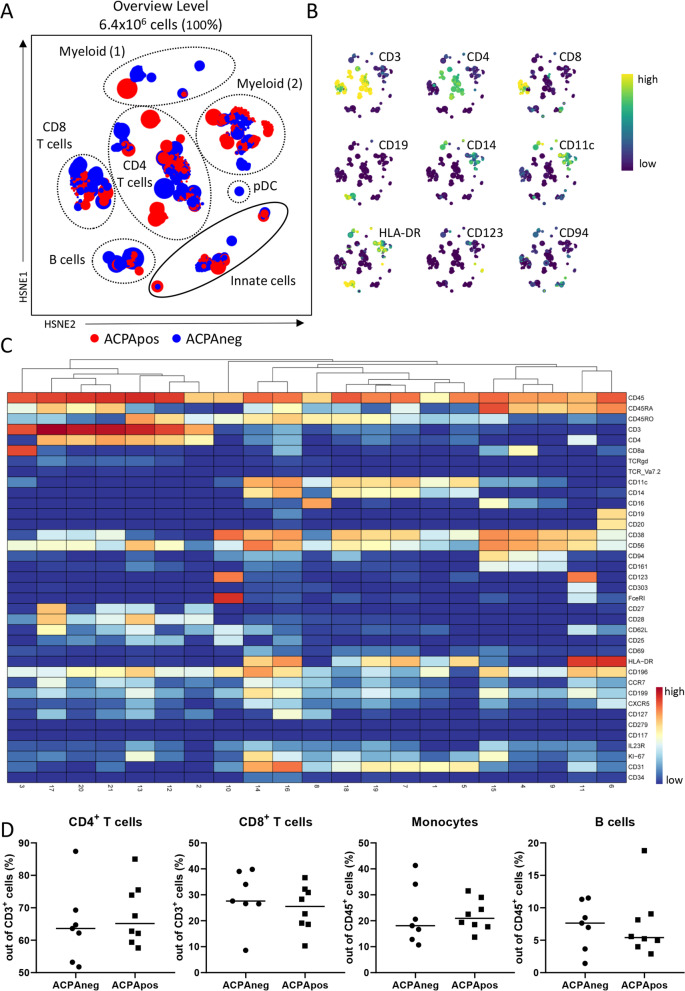
Freshly obtained PBMCs of early, untreated RA patients (8 ACPA+ and 7 ACPA-) were analysed using a 36-marker MC panel, including markers related to various immune lineages. Data were processed using Cytosplore for dimensional reduction (HSNE) and clustering. Groups were compared using Cytofast. A second validation cohort of cryopreserved PBMCs obtained from early RA patients (27 ACPA+ and 20 ACPA-) was used to confirm MC data by flow cytometry (FC). FC data were processed and analysed using both an unsupervised analysis pipeline and through manual gating.
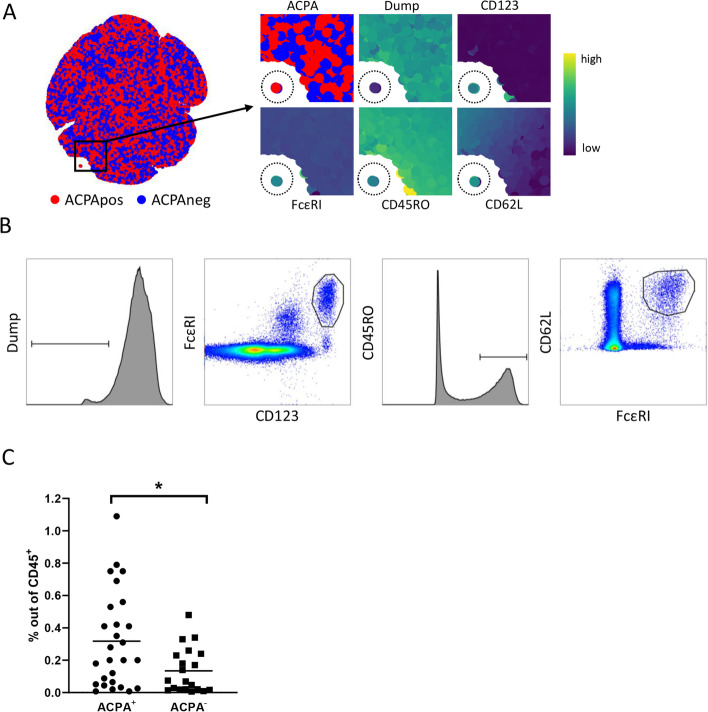
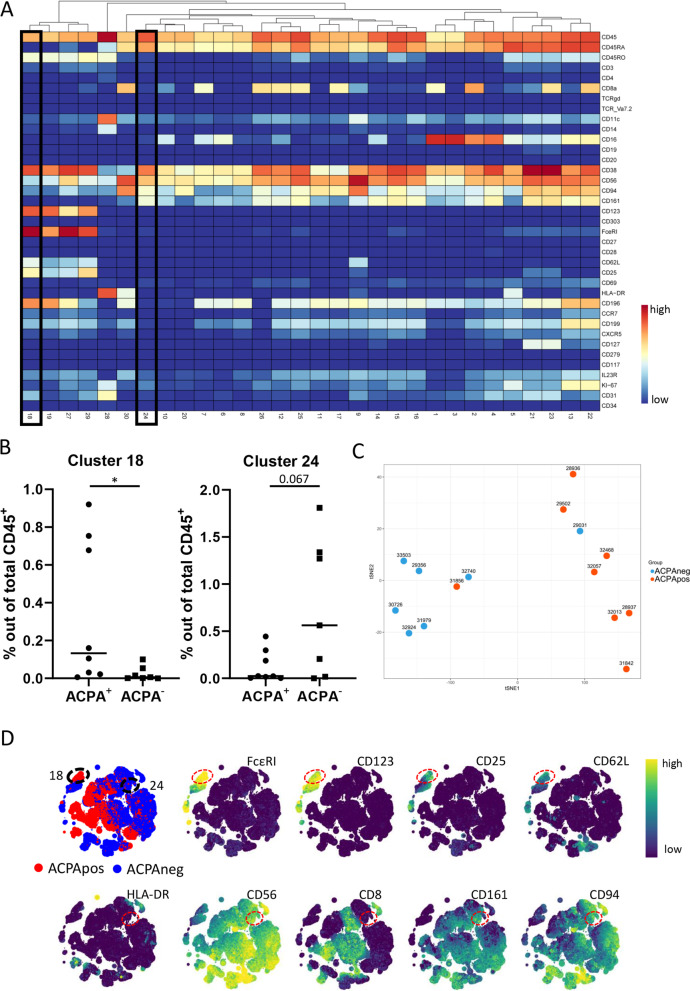
MC indicated no differences when comparing major immune lineages (i.e. monocytes, T and B cells), but highlighted two innate subsets: CD62L basophils (p = 0.33) and a subset of CD16 NK cells (p = 0.063). Although the NK cell subset did not replicate by FC, FC replication confirmed the difference in CD62L basophil frequency when comparing ACPA+ to ACPA- patients (mean 0.32% vs. 0.13%; p = 0.01).
Although no differences in major lineages were found between early ACPA+ and ACPA- RA, this study identified the reduced presence of activated basophils in ACPA-negative disease as compared to ACPA-positive disease and thereby provides the first evidence for a connection between activated basophils and ACPA status.
自身抗体的产生是类风湿关节炎(RA)的一个标志。抗瓜氨酸蛋白抗体(ACPA)具有高度的疾病特异性,与 ACPA 阴性患者相比,其存在与更严重的疾病和预后不良相关。然而,与抗体阳性/阴性疾病相关的免疫细胞组成尚不完全明确。质谱流式细胞术(MC)是一种高维技术,为确定风湿性疾病中的免疫细胞组成提供了新的可能性。在这里,我们建立了一个广泛的表型分析面板,以研究早期未经治疗的 RA 的免疫细胞谱,以研究特定的免疫细胞亚群是否与 ACPA+与 ACPA- RA 相关。
使用包括与各种免疫谱系相关的标记物的 36 标记物 MC 面板分析新获得的早期未治疗 RA 患者(8 例 ACPA+和 7 例 ACPA-)的 PBMC。使用 Cytosplore 进行数据处理(HSNE)和聚类。使用 Cytofast 比较组。来自早期 RA 患者的冷冻 PBMC 的第二个验证队列(27 例 ACPA+和 20 例 ACPA-)用于通过流式细胞术(FC)确认 MC 数据。使用无监督分析流水线和手动门控对 FC 数据进行处理和分析。
MC 在比较主要免疫谱系(即单核细胞、T 和 B 细胞)时没有差异,但突出了两个固有亚群:CD62L 嗜碱性粒细胞(p=0.33)和 CD16 NK 细胞的一个亚群(p=0.063)。虽然 NK 细胞亚群未通过 FC 复制,但 FC 复制证实了比较 ACPA+与 ACPA-患者时 CD62L 嗜碱性粒细胞频率的差异(平均值 0.32%对 0.13%;p=0.01)。
尽管在早期 ACPA+和 ACPA- RA 之间未发现主要谱系之间存在差异,但本研究发现,与 ACPA 阳性疾病相比,在 ACPA 阴性疾病中激活的嗜碱性粒细胞的存在减少,从而首次提供了激活的嗜碱性粒细胞与 ACPA 状态之间存在联系的证据。