Department of Endocrinology, Hunan Provincial People's Hospital, The First Affiliated Hospital of Hunan Normal University, Changsha, China.
Department of Orthopaedics, Peking Union Medical College Hospital, Beijing, China.
Cell Death Dis. 2021 Oct 29;12(11):1024. doi: 10.1038/s41419-021-04300-8.
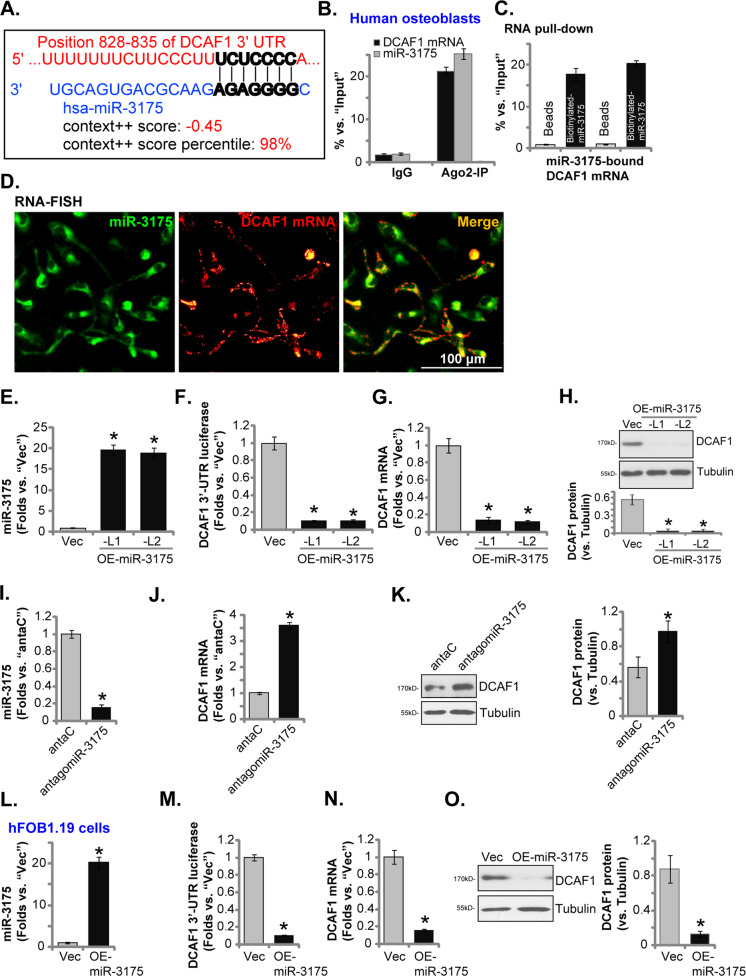
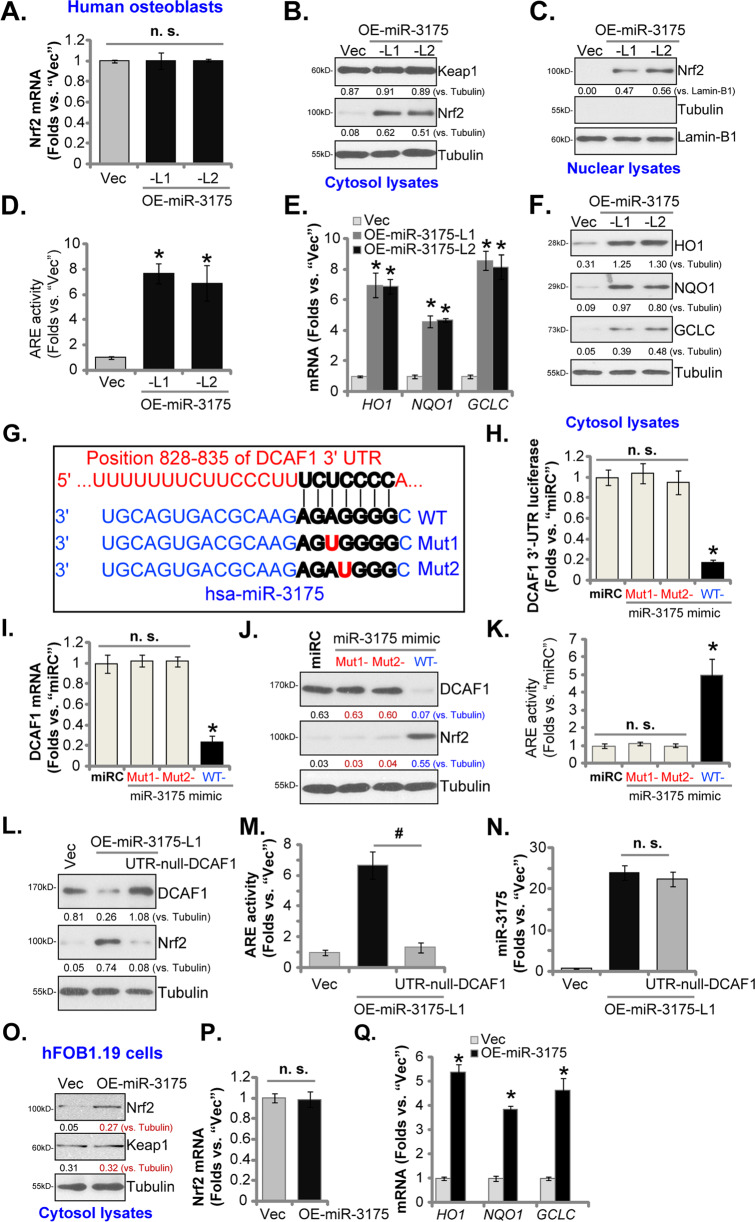
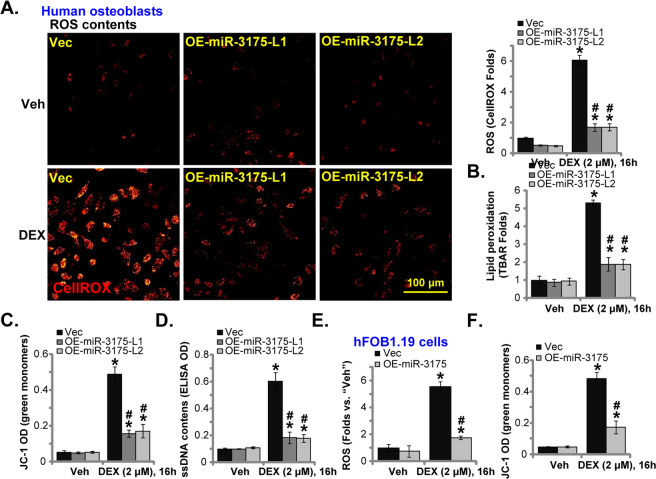
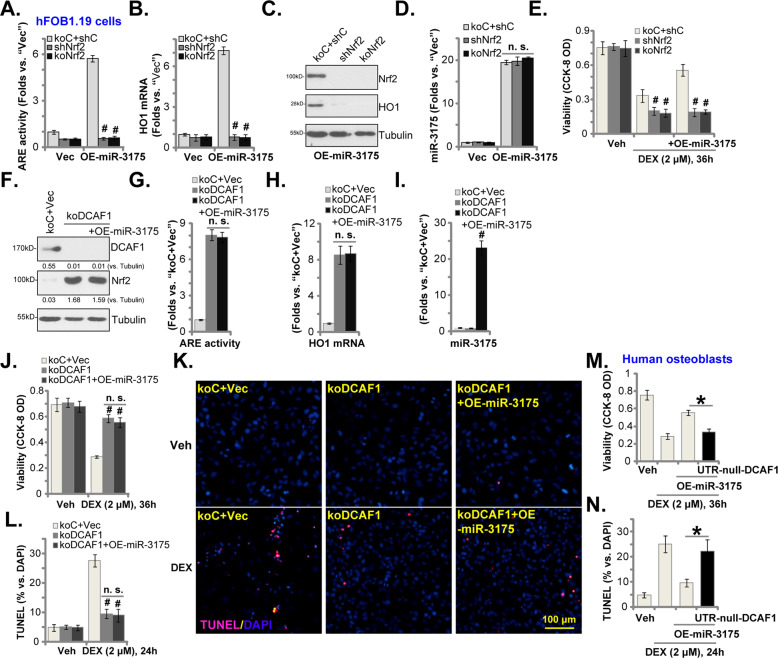
Activation of nuclear-factor-E2-related factor 2 (Nrf2) signaling can protect human osteoblasts from dexamethasone-induced oxidative injury. DDB1 and CUL4 associated factor 1 (DCAF1) is a novel ubiquitin E3 ligase for Nrf2 protein degradation. We identified a novel DCAF1-targeting miRNA, miR-3175. RNA pull-down, Argonaute 2 RNA-immunoprecipitation, and RNA fluorescent in situ hybridization results confirmed a direct binding between miR-3175 and DCAF1 mRNA in primary human osteoblasts. DCAF1 3'-untranslated region luciferase activity and its expression were significantly decreased after miR-3175 overexpression but were augmented with miR-3175 inhibition in human osteoblasts and hFOB1.19 osteoblastic cells. miR-3175 overexpression activated Nrf2 signaling, causing Nrf2 protein stabilization, antioxidant response (ARE) activity increase, and transcription activation of Nrf2-dependent genes in human osteoblasts and hFOB1.19 cells. Furthermore, dexamethasone-induced oxidative injury and apoptosis were largely attenuated by miR-3175 overexpression in human osteoblasts and hFOB1.19 cells. Importantly, shRNA-induced silencing or CRISPR/Cas9-mediated Nrf2 knockout abolished miR-3175 overexpression-induced osteoblast cytoprotection against dexamethasone. Conversely, DFAC1 knockout, by the CRISPR/Cas9 method, activated the Nrf2 cascade and inhibited dexamethasone-induced cytotoxicity in hFOB1.19 cells. Importantly, miR-3175 expression was decreased in necrotic femoral head tissues of dexamethasone-taking patients, where DCAF1 mRNA was upregulated. Together, silencing DCAF1 by miR-3175 activated Nrf2 signaling to inhibit dexamethasone-induced oxidative injury and apoptosis in human osteoblasts.
核因子-E2 相关因子 2 (Nrf2) 信号的激活可以保护人成骨细胞免受地塞米松诱导的氧化损伤。DDB1 和 CUL4 相关因子 1 (DCAF1) 是一种新型的 Nrf2 蛋白降解泛素 E3 连接酶。我们鉴定了一种新的 DCAF1 靶向 miRNA,miR-3175。RNA 下拉、Argonaute 2 RNA 免疫沉淀和 RNA 荧光原位杂交结果证实了 miR-3175 与人成骨细胞中 DCAF1 mRNA 的直接结合。miR-3175 过表达后,DCAF1 3'非翻译区荧光素酶活性及其表达显著降低,但在人成骨细胞和 hFOB1.19 成骨细胞中,miR-3175 抑制时则增加。miR-3175 过表达激活了 Nrf2 信号通路,导致 Nrf2 蛋白稳定,抗氧化反应 (ARE) 活性增加,并激活了人成骨细胞和 hFOB1.19 细胞中 Nrf2 依赖性基因的转录。此外,miR-3175 过表达在人成骨细胞和 hFOB1.19 细胞中显著减轻了地塞米松诱导的氧化损伤和凋亡。重要的是,shRNA 诱导的沉默或 CRISPR/Cas9 介导的 Nrf2 敲除消除了 miR-3175 过表达对成骨细胞的保护作用,防止地塞米松引起的细胞毒性。相反,通过 CRISPR/Cas9 方法敲除 DFAC1 激活了 Nrf2 级联反应,并抑制了 hFOB1.19 细胞中地塞米松诱导的细胞毒性。重要的是,在接受地塞米松治疗的患者的坏死性股骨头组织中,miR-3175 的表达降低,而 DCAF1 mRNA 上调。总之,miR-3175 通过沉默 DCAF1 激活了 Nrf2 信号通路,抑制了人成骨细胞中地塞米松诱导的氧化损伤和凋亡。