Department of Anaesthesia, Intensive Care and Prehospital Emergency, Ospedale Maggiore Carlo Alberto Pizzardi, Bologna, Italy.
Alma Mater Studiorum University of Bologna, Department of Experimental, Diagnostic and Specialty Medicine (DIMES), Bologna, Italy; IRCCS Azienda Ospedaliero Universitaria di Bologna, University Hospital Sant'Orsola-Malpighi - Respiratory and Critical Care Unit, Bologna, Italy.
Respir Med. 2021 Nov-Dec;189:106665. doi: 10.1016/j.rmed.2021.106665. Epub 2021 Oct 22.
Health-related quality of life (HRQoL) impairment is often reported among COVID-19 ICU survivors, and little is known about their long-term outcomes. We evaluated the HRQoL trajectories between 3 months and 1 year after ICU discharge, the factors influencing these trajectories and the presence of clusters of HRQoL profiles in a population of COVID-19 patients who underwent invasive mechanical ventilation (IMV). Moreover, pathophysiological correlations of residual dyspnea were tested.
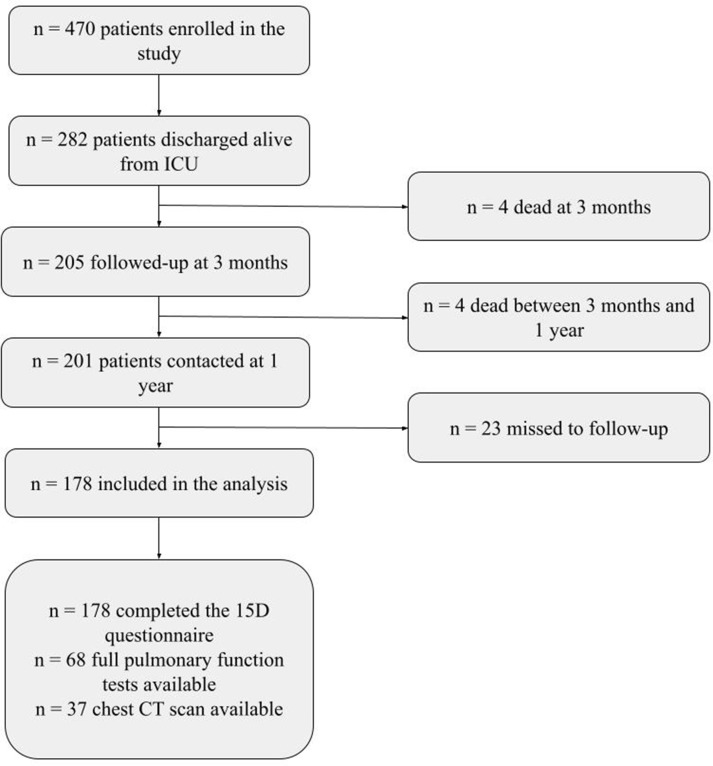
We followed up 178 survivors from 16 Italian ICUs up to one year after ICU discharge. HRQoL was investigated through the 15D instrument. Available pulmonary function tests (PFTs) and chest CT scans at 1 year were also collected. A linear mixed-effects model was adopted to identify factors associated with different HRQoL trajectories and a two-step cluster analysis was performed to identify HRQoL clusters.
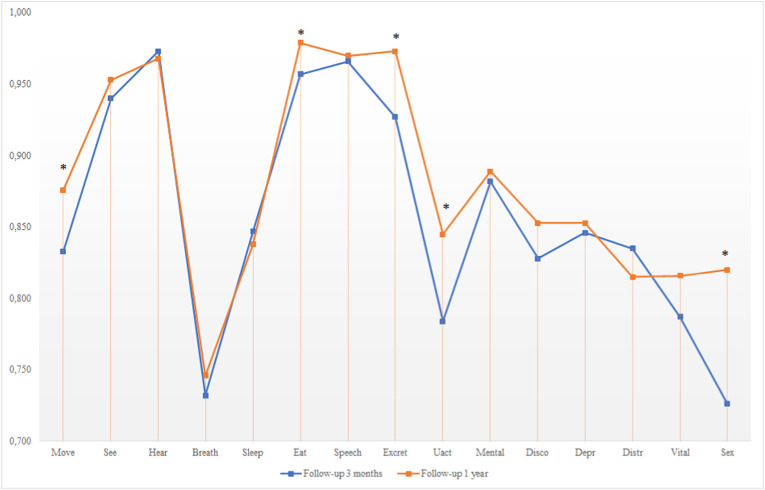
We found that HRQoL increased during the study period, especially for the significant increase of the physical dimensions, while the mental dimensions and dyspnea remained substantially unchanged. Four main 15D profiles were identified: full recovery (47.2%), bad recovery (5.1%) and two partial recovery clusters with mostly physical (9.6%) or mental (38.2%) dimensions affected. Gender, duration of IMV and number of comorbidities significantly influenced HRQoL trajectories. Persistent dyspnea was reported in 58.4% of patients, and weakly, but significantly, correlated with both DLCO and length of IMV.
HRQoL impairment is frequent 1 year after ICU discharge, and the lowest recovery is found in the mental dimensions. Persistent dyspnea is often reported and weakly correlated with PFTs alterations.
NCT04411459.
COVID-19 重症监护病房(ICU)幸存者常报告与健康相关的生活质量(HRQoL)受损,但对其长期结局知之甚少。我们评估了 COVID-19 患者接受有创机械通气(IMV)后 ICU 出院后 3 个月至 1 年内的 HRQoL 轨迹,影响这些轨迹的因素,以及 HRQoL 特征群在 COVID-19 患者人群中的存在情况。此外,还测试了残留呼吸困难的病理生理学相关性。
我们对来自意大利 16 家 ICU 的 178 名幸存者进行了随访,直至 ICU 出院后 1 年。通过 15D 工具调查 HRQoL。还收集了 1 年后的可用肺功能检查(PFT)和胸部 CT 扫描。采用线性混合效应模型确定与不同 HRQoL 轨迹相关的因素,并进行两步聚类分析以确定 HRQoL 聚类。
我们发现,HRQoL 在研究期间增加,特别是身体维度的显著增加,而心理维度和呼吸困难基本保持不变。确定了四个主要的 15D 特征群:完全恢复(47.2%)、恢复不良(5.1%)和两个部分恢复的聚类,主要受身体(9.6%)或心理(38.2%)维度的影响。性别、IMV 持续时间和合并症数量显著影响 HRQoL 轨迹。58.4%的患者报告持续呼吸困难,与 DLCO 和 IMV 持续时间均呈弱但显著相关。
ICU 出院 1 年后 HRQoL 受损仍很常见,最低的恢复发生在心理维度。常报告持续呼吸困难,与 PFT 改变呈弱相关。
NCT04411459。