Department of Anaesthesia, Intensive Care and Prehospital Emergency, Ospedale Maggiore Carlo Alberto Pizzardi, Bologna, Italy.
Department of Public Health, University of Helsinki, Helsinki, Finland.
Qual Life Res. 2021 Oct;30(10):2805-2817. doi: 10.1007/s11136-021-02865-7. Epub 2021 May 12.
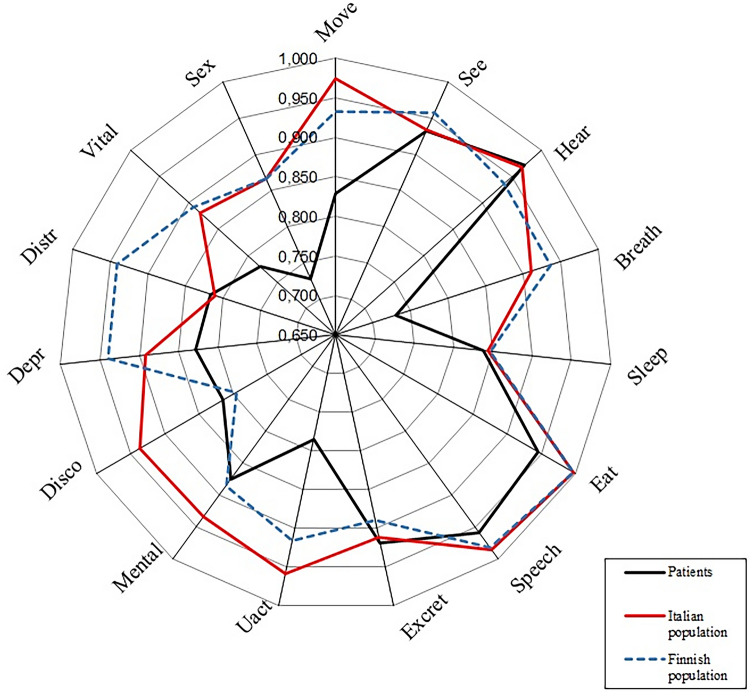
The onset of the coronavirus disease 19 (COVID-19) pandemic in Italy induced a dramatic increase in the need for intensive care unit (ICU) beds for a large proportion of patients affected by COVID-19-related acute respiratory distress syndrome (ARDS). The aim of the present study was to describe the health-related quality of life (HRQoL) at 90 days after ICU discharge in a cohort of COVID-19 patients undergoing invasive mechanical ventilation and to compare it with an age and sex-matched sample from the general Italian and Finnish populations. Moreover, the possible associations between clinical, demographic, social factors, and HRQoL were investigated.
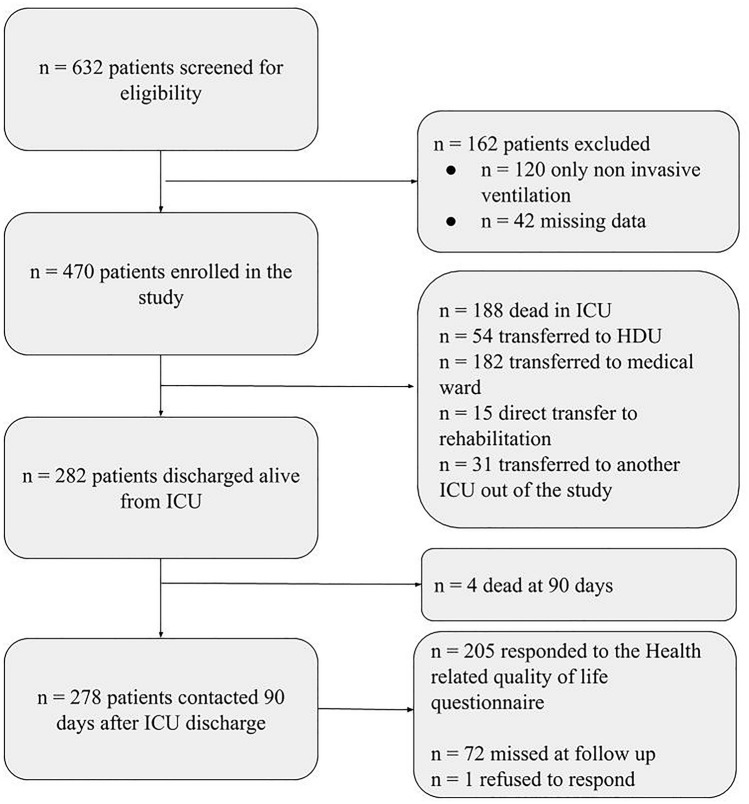
COVID-19 ARDS survivors from 16 participating ICUs were followed up until 90 days after ICU discharge and the HRQoL was evaluated with the 15D instrument. A parallel cohort of age and sex-matched Italian population from the same geographic areas was interviewed and a third group of matched Finnish population was extracted from the Finnish 2011 National Health survey. A linear regression analysis was performed to evaluate potential associations between the evaluated factors and HRQoL.
205 patients answered to the questionnaire. HRQoL of the COVID-19 ARDS patients was significantly lower than the matched populations in both physical and mental dimensions. Age, sex, number of comorbidities, ARDS class, duration of invasive mechanical ventilation, and occupational status were found to be significant determinants of the 90 days HRQoL. Clinical severity at ICU admission was poorly correlated to HRQoL.
COVID-19-related ARDS survivors at 90 days after ICU discharge present a significant reduction both on physical and psychological dimensions of HRQoL measured with the 15D instrument.
NCT04411459.
意大利发生 2019 冠状病毒病(COVID-19)大流行,导致大量 COVID-19 相关急性呼吸窘迫综合征(ARDS)患者需要大量重症监护病房(ICU)床位。本研究旨在描述接受有创机械通气的 COVID-19 患者在 ICU 出院后 90 天的健康相关生活质量(HRQoL),并将其与意大利和芬兰普通人群的年龄和性别匹配样本进行比较。此外,还探讨了临床、人口统计学和社会因素与 HRQoL 之间的可能关联。
从参与的 16 个 ICU 中随访 COVID-19 ARDS 幸存者,直至 ICU 出院后 90 天,并使用 15D 工具评估 HRQoL。对来自同一地理区域的年龄和性别匹配的意大利普通人群进行了平行队列访谈,并从芬兰 2011 年国家健康调查中提取了第三组匹配的芬兰人群。采用线性回归分析评估评估因素与 HRQoL 之间的潜在关联。
共有 205 名患者回答了问卷。COVID-19 ARDS 患者的 HRQoL 在身体和心理维度上均明显低于匹配人群。年龄、性别、合并症数量、ARDS 分级、有创机械通气持续时间和职业状况是 90 天 HRQoL 的重要决定因素。ICU 入院时的临床严重程度与 HRQoL 相关性差。
COVID-19 相关 ARDS 幸存者在 ICU 出院后 90 天,使用 15D 工具测量的 HRQoL 在身体和心理维度上均显著降低。
NCT04411459。