Carenzo Luca, Protti Alessandro, Dalla Corte Francesca, Aceto Romina, Iapichino Giacomo, Milani Angelo, Santini Alessandro, Chiurazzi Chiara, Ferrari Michele, Heffler Enrico, Angelini Claudio, Aghemo Alessio, Ciccarelli Michele, Chiti Arturo, Iwashyna Theodore J, Herridge Margaret S, Cecconi Maurizio
Department of Anesthesia and Intensive Care Medicine, Humanitas Clinical and Research Center-IRCCS, Via Manzoni 56, 20089, Rozzano, Italy.
Department of Biomedical Sciences, Humanitas University, Via Rita Levi Montalcini 4, 20090, Pieve Emanuele, Italy.
Ann Intensive Care. 2021 Jun 4;11(1):91. doi: 10.1186/s13613-021-00881-x.
Survivors of severe COVID-19 are at risk of impaired health-related quality of life (HRQoL) and persistent physical and psychological disability after ICU and hospital discharge. The subsequent social burden is a major concern. We aimed to assess the short-term HRQoL, physical function and prevalence of post-traumatic stress symptoms of invasively mechanically ventilated COVID-19 patients treated in our ICU.
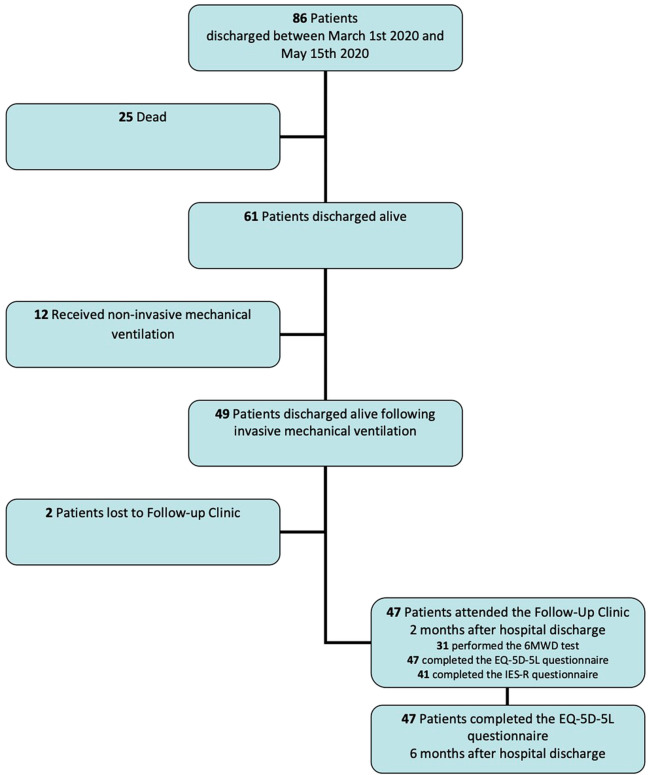
Prospective, observational cohort study in a follow-up clinic. Patients completed a 6-min walking test (6MWT) to assess their cardio-pulmonary function around 2 months (early follow-up) from hospital discharge, the EQ-5D-5L questionnaire for quality of life assessment around 2 months and at 6 months from hospital discharge and an anonymous web-based Impact of Event Scale-Revised (IES-R) questionnaire for Post-Traumatic Stress symptoms at 2 months.
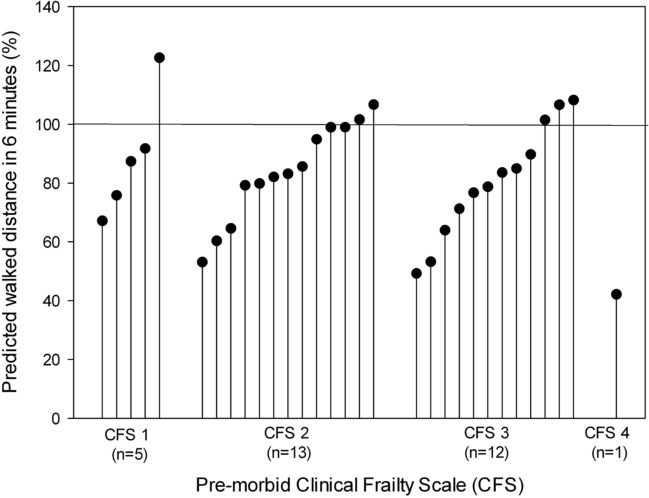
47 patients attended our follow-up program, mean age 59 ± 10 years, median pre-morbid Clinical Frailty Scale (CFS) 2 [2-3]. The median distance walked in 6 min was 470 [406-516] m, 83 [67-99]% of the predicted value. Overall 1 out 3 patients and 4/18 (22%) among those with a good functional baseline prior to COVID-19 (CFS of 1 or 2) had lower (84%) than predicted 6MWT. EQ-5D-5L quality of life VAS was 80 [70-90] out of 100 at early follow-up with a slight improvement to 85 [77.5-90] at 6 months. Mobility, self-care and usual activities improved between the two timepoints, while pain/discomfort and depression/anxiety did not improve or got worse. The IES-R total score was greater than the threshold for concern of 1.6 in 27/41(66%) respondents.
Patients recovering from severe COVID-19 requiring invasive mechanical ventilation surviving hospital discharge present with early mild to moderate functional impairment, mildly reduced quality of life from hospital discharge with an overall improvement of mobility, self-care and the ability of performing usual activities, while a worsening of pain and depression/anxiety symptoms at 6 months and a large proportion of symptoms of post-traumatic distress soon after hospital discharge.
重症新型冠状病毒肺炎(COVID-19)幸存者在重症监护病房(ICU)和出院后存在健康相关生活质量(HRQoL)受损以及持续身体和心理残疾的风险。随之而来的社会负担是一个主要问题。我们旨在评估在我们ICU接受有创机械通气的COVID-19患者的短期HRQoL、身体功能以及创伤后应激症状的患病率。
在随访门诊进行前瞻性观察队列研究。患者在出院后约2个月(早期随访)完成6分钟步行试验(6MWT)以评估其心肺功能,在出院后约2个月和6个月完成用于生活质量评估的EQ-5D-5L问卷,并在2个月时完成一份基于网络的匿名事件影响量表修订版(IES-R)问卷以评估创伤后应激症状。
47例患者参加了我们的随访项目,平均年龄59±10岁,病前临床衰弱量表(CFS)中位数为2[2-3]。6分钟步行的中位数距离为470[406-516]米,为预测值的83[67-99]%。总体而言,三分之一的患者以及COVID-19之前功能基线良好(CFS为1或2)的患者中有4/18(22%)的6MWT低于(84%)预测值。EQ-5D-5L生活质量视觉模拟量表在早期随访时为80[70-90](满分100),在6个月时略有改善至85[77.5-90]。在两个时间点之间,活动能力、自我护理和日常活动有所改善,而疼痛/不适以及抑郁/焦虑没有改善或有所恶化。IES-R总分在27/41(66%)的受访者中高于1.6的关注阈值。
从需要有创机械通气的重症COVID-19中康复并存活出院的患者存在早期轻度至中度功能障碍,出院后生活质量轻度下降,活动能力、自我护理和进行日常活动的能力总体有所改善,而在6个月时疼痛和抑郁/焦虑症状恶化,出院后不久有很大比例的创伤后困扰症状。