Department of Environmental Health, Harvard T.H. Chan School of Public Health, Boston, MA 02115, USA.
Division of Environmental Health Sciences, School of Public Health and Center for Computational Biology, University of California, Berkeley, Berkeley, CA 94720, USA.
Environ Int. 2022 Jan;158:106955. doi: 10.1016/j.envint.2021.106955. Epub 2021 Oct 28.
Several epigenome-wide association studies (EWAS) of ambient particulate matter with aerodynamic diameter ≤ 2.5 µm (PM) have been reported. However, EWAS of PM elements (PEs), reflecting different emission sources, are very limited.
We performed EWAS of short- and intermediate-term exposure to PM and 13 PEs. We hypothesized that significant changes in DNAm may vary by PM mass and its elements.
We repeatedly collected blood samples in the Normative Aging Study and measured leukocyte DNA methylation (DNAm) with the Illumina HumanMethylation450K BeadChip. We collected daily PM and 13 PEs at a fixed central site. To estimate the associations between each PE and DNAm at individual cytosine-phosphate-guanine (CpG) sites, we incorporated a distributed-lag (0-27 d) term in the setting of median regression with subject-specific intercept and examined cumulative lag associations. We also accounted for selection bias due to loss to follow-up and mortality prior to enrollment. Significantly differentially methylated probes (DMPs) were identified using Bonferroni correction for multiple testing. We further conducted regional and pathway analyses to identify significantly differentially methylated regions (DMRs) and pathways.
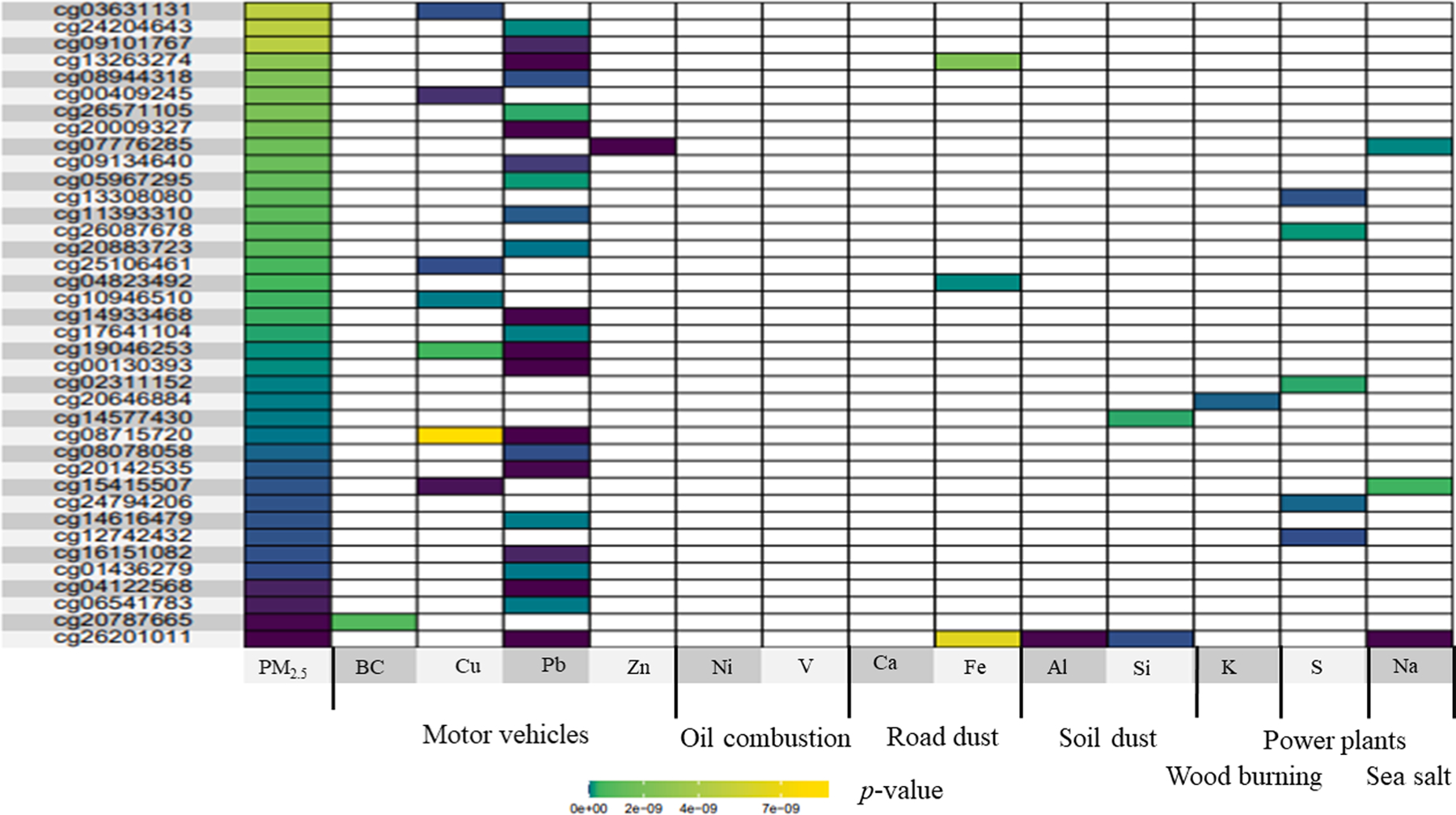
We included 695 men with 1,266 visits between 1999 and 2013. The subjects had a mean age of 75 years. The significant DMPs, DMRs, and pathways varied by to PM total mass and PEs. For example, PM total mass was associated with 2,717 DMPs and 10,470 DMRs whereas Pb was associated with 3,173 DMPs and 637 DMRs. The identified pathways by PM mass were mostly involved in mood disorders, neuroplasticity, immunity, and inflammation, whereas the pathways associated with motor vehicles (BC, Cu, Pb, and Zn) were related with cardiovascular disease and cancer (e.g., "PPARs signaling").
PM and PE were associated with methylation changes at multiple probes and along multiple pathways, in ways that varied by particle components.
已有多项针对空气动力学直径≤2.5μm 的环境细颗粒物(PM)的全基因组关联研究(EWAS)报道。然而,反映不同排放源的 PM 元素(PEs)的 EWAS 非常有限。
我们进行了 PM 及 13 种 PEs 的短期和中期暴露的 EWAS。我们假设 DNAm 的显著变化可能因 PM 质量及其元素而异。
我们在常规老化研究中反复采集血样,并使用 Illumina HumanMethylation450K BeadChip 测量白细胞 DNA 甲基化(DNAm)。我们在一个固定的中心位置采集每日 PM 和 13 种 PEs。为了评估每个 PE 与个体胞嘧啶-磷酸-鸟嘌呤(CpG)位点的 DNAm 之间的关联,我们在中位数回归中纳入了一个分布滞后(0-27d)项,并检查了累积滞后关联。我们还考虑了因随访丢失和入组前死亡导致的选择偏倚。使用 Bonferroni 校正多重检验识别显著差异甲基化探针(DMPs)。我们进一步进行了区域和途径分析,以识别显著差异甲基化区域(DMRs)和途径。
我们纳入了 695 名男性,他们在 1999 年至 2013 年期间共有 1266 次就诊。受试者的平均年龄为 75 岁。显著的 DMPs、DMRs 和途径因 PM 总质量和 PEs 而异。例如,PM 总质量与 2717 个 DMPs 和 10470 个 DMRs 相关,而 Pb 与 3173 个 DMPs 和 637 个 DMRs 相关。PM 质量相关的途径主要涉及情绪障碍、神经可塑性、免疫和炎症,而与机动车相关的途径(BC、Cu、Pb 和 Zn)与心血管疾病和癌症有关(例如,“PPARs 信号”)。
PM 和 PE 与多个探针和多个途径的甲基化变化相关,其方式因颗粒成分而异。