Thuraisingam Sharmala, Chondros Patty, Dowsey Michelle M, Spelman Tim, Garies Stephanie, Choong Peter F, Gunn Jane, Manski-Nankervis Jo-Anne
Department of Surgery, University of Melbourne, 29 Regent Street, Fitzroy, VIC, 3065, Australia.
Department of General Practice, University of Melbourne, 780 Elizabeth Street, Parkville, VIC, 3010, Australia.
BMC Med Inform Decis Mak. 2021 Oct 30;21(1):297. doi: 10.1186/s12911-021-01669-6.
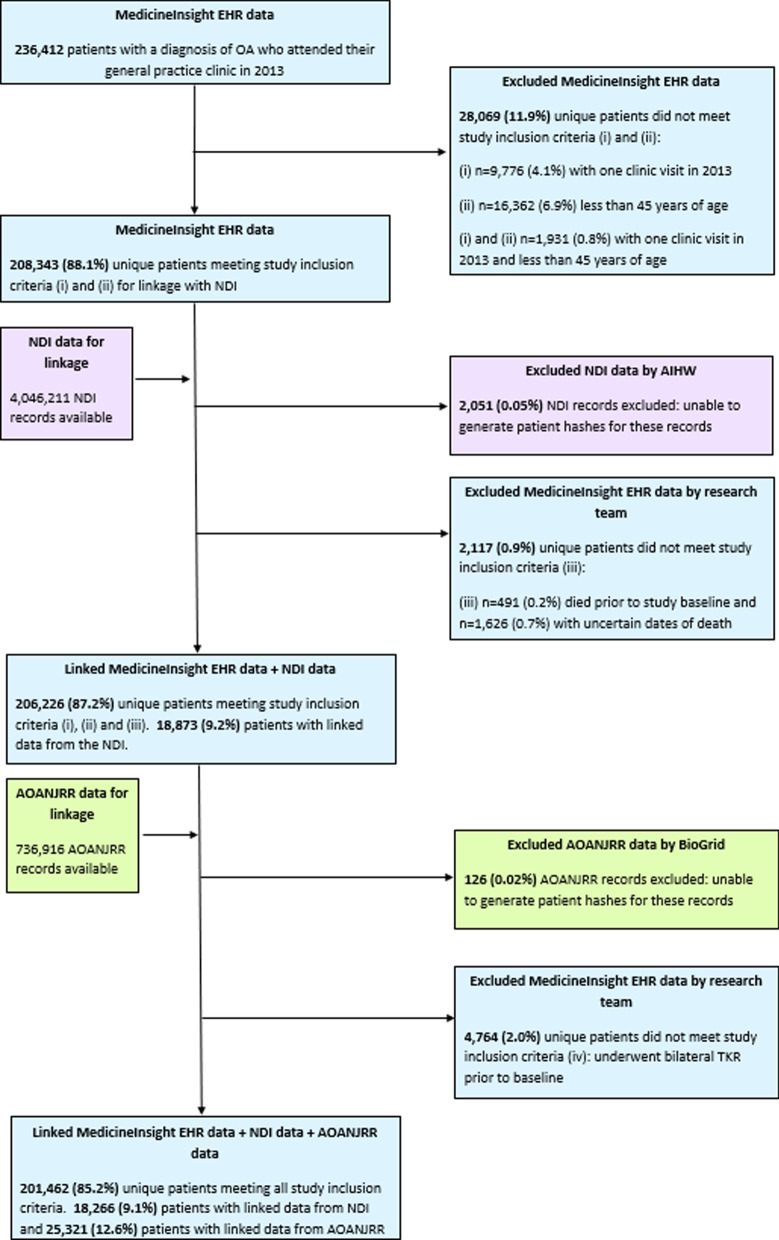
The use of general practice electronic health records (EHRs) for research purposes is in its infancy in Australia. Given these data were collected for clinical purposes, questions remain around data quality and whether these data are suitable for use in prediction model development. In this study we assess the quality of data recorded in 201,462 patient EHRs from 483 Australian general practices to determine its usefulness in the development of a clinical prediction model for total knee replacement (TKR) surgery in patients with osteoarthritis (OA).
Variables to be used in model development were assessed for completeness and plausibility. Accuracy for the outcome and competing risk were assessed through record level linkage with two gold standard national registries, Australian Orthopaedic Association National Joint Replacement Registry (AOANJRR) and National Death Index (NDI). The validity of the EHR data was tested using participant characteristics from the 2014-15 Australian National Health Survey (NHS).
There were substantial missing data for body mass index and weight gain between early adulthood and middle age. TKR and death were recorded with good accuracy, however, year of TKR, year of death and side of TKR were poorly recorded. Patient characteristics recorded in the EHR were comparable to participant characteristics from the NHS, except for OA medication and metastatic solid tumour.
In this study, data relating to the outcome, competing risk and two predictors were unfit for prediction model development. This study highlights the need for more accurate and complete recording of patient data within EHRs if these data are to be used to develop clinical prediction models. Data linkage with other gold standard data sets/registries may in the meantime help overcome some of the current data quality challenges in general practice EHRs when developing prediction models.
在澳大利亚,将全科医疗电子健康记录(EHRs)用于研究目的尚处于起步阶段。鉴于这些数据是为临床目的收集的,数据质量以及这些数据是否适合用于预测模型开发仍存在疑问。在本研究中,我们评估了来自483家澳大利亚全科诊所的201,462份患者电子健康记录中所记录数据的质量,以确定其在为骨关节炎(OA)患者全膝关节置换术(TKR)开发临床预测模型中的有用性。
对模型开发中要使用的变量进行完整性和合理性评估。通过与两个金标准国家登记处(澳大利亚骨科协会国家关节置换登记处(AOANJRR)和国家死亡指数(NDI))进行记录层面的关联,评估结局和竞争风险的准确性。使用2014 - 15年澳大利亚国民健康调查(NHS)中的参与者特征来测试电子健康记录数据的有效性。
成年早期到中年之间的体重指数和体重增加数据存在大量缺失。TKR和死亡记录的准确性良好,然而,TKR年份、死亡年份和TKR侧别记录不佳。电子健康记录中记录的患者特征与国民健康调查中的参与者特征具有可比性,但骨关节炎药物治疗和转移性实体瘤除外。
在本研究中,与结局、竞争风险和两个预测因素相关的数据不适合用于预测模型开发。这项研究强调,如果要使用这些数据来开发临床预测模型,就需要在电子健康记录中更准确、完整地记录患者数据。与此同时,在开发预测模型时,与其他金标准数据集/登记处的数据关联可能有助于克服全科医疗电子健康记录当前面临的一些数据质量挑战。