Department of Clinical Epidemiology, First Affiliated Hospital, China Medical University, Shenyang, China.
Department of Epidemiology, School of Public Health, China Medical University, 110122, Shenyang, Liaoning, China.
Cell Death Dis. 2021 Oct 30;12(11):1030. doi: 10.1038/s41419-021-04314-2.
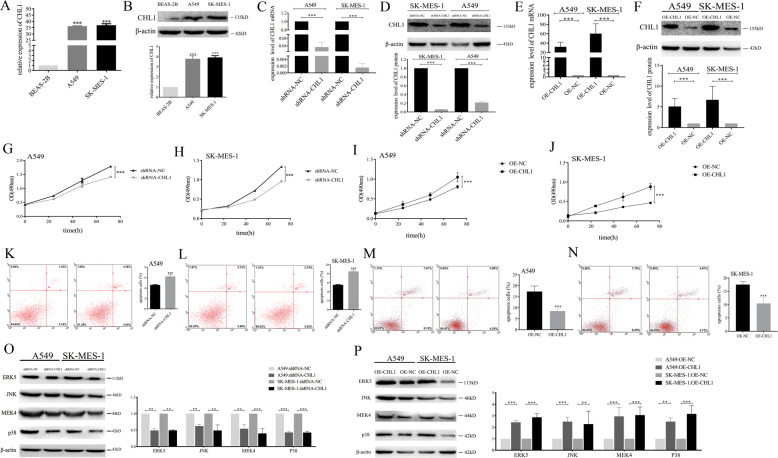
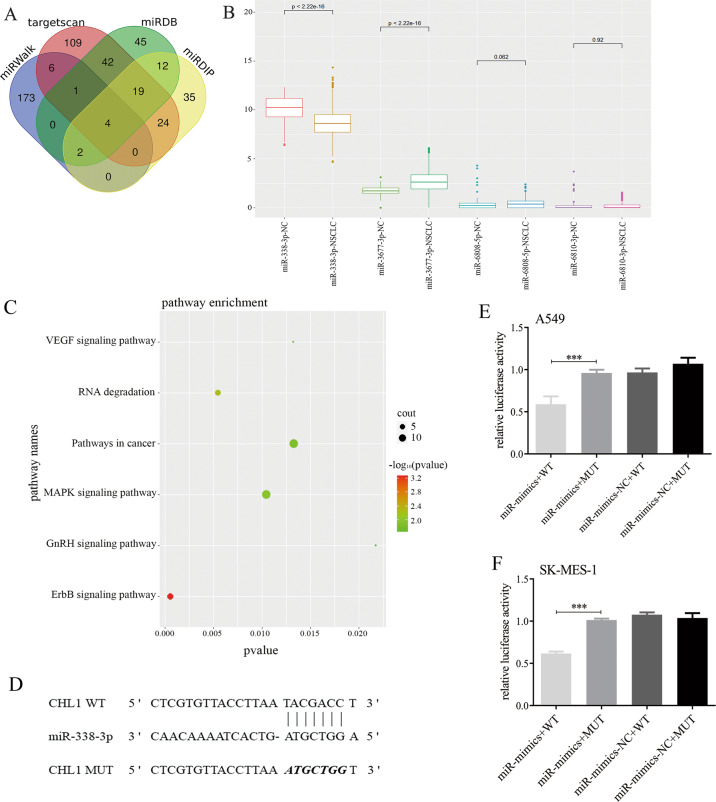
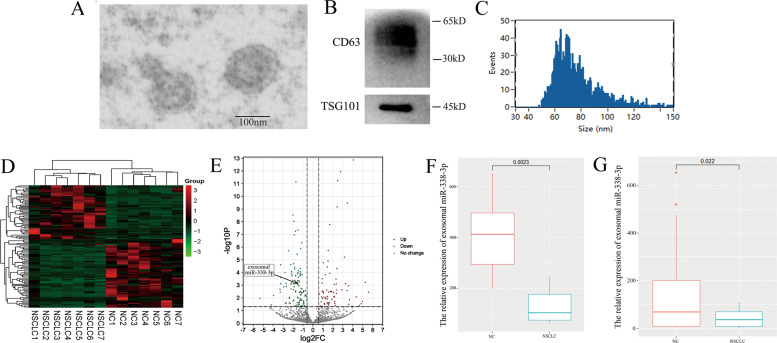
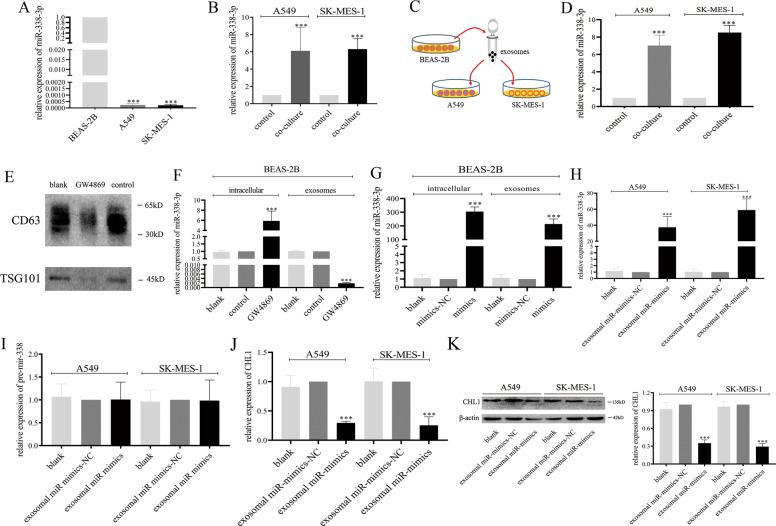
Globally, lung cancer remains one of the most prevalent malignant cancers. However, molecular mechanisms and functions involved in its pathogenesis have not been clearly elucidated. This study aimed to evaluate the specific regulatory mechanisms of exosomal miR-338-3p/CHL1/MAPK signaling pathway axis in non-small-cell lung cancer. Western blotting and qRT-PCR (reverse transcription-polymerase chain reaction) were used to determine the expression levels of CHL1 and exosomal miR-338-3p in NSCLC (non-small-cell lung cancer). The CHL1 gene was upregulated and downregulated to evaluate its functions in NSCLC progression. In vitro MTS and apoptotic assays were used to investigate the functions of CHL1 and exosomal miR-338-3p in NSCLC progression. The high-throughput sequencing was used to explore differently expressed exosomal miRNAs. The biological relationships between MAPK signaling pathway and CHL1 and exosomal miR-338-3p in NSCLC were predicted through bioinformatics analyses and verified by western blotting. Elevated CHL1 levels were observed in NSCLC tissues and cells. Upregulated CHL1 expression enhanced NSCLC cells' progression by promoting tumor cells proliferation while suppressing their apoptosis. Conversely, the downregulation of the CHL1 gene inhibited NSCLC cells' growth and promoted tumor cells' apoptotic rate. Additionally, CHL1 activated the MAPK signaling pathway. Besides, we confirmed that miR-338-3p directly sponged with CHL1 to mediate tumor cells progression. Moreover, exosomal miR-338-3p serum levels in NSCLC patients were found to be low. BEAS-2B cells can transfer exosomal miR-338-3p to A549 cells and SK-MES-1 cells. In addition, elevated exosomal miR-338-3p levels significantly inhibited tumor cells proliferation and promoted their apoptosis by suppressing activation of the MAPK signaling pathway. Exosomal miR-338-3p suppresses tumor cells' metastasis by downregulating the expression of CHL1 through MAPK signaling pathway inactivation.
全球范围内,肺癌仍然是最常见的恶性肿瘤之一。然而,其发病机制涉及的分子机制和功能尚未得到明确阐明。本研究旨在评估外泌体 miR-338-3p/CHL1/MAPK 信号通路轴在非小细胞肺癌中的特定调节机制。Western blot 和 qRT-PCR(逆转录-聚合酶链反应)用于确定 NSCLC(非小细胞肺癌)中 CHL1 和外泌体 miR-338-3p 的表达水平。上调和下调 CHL1 基因以评估其在 NSCLC 进展中的作用。体外 MTS 和凋亡测定用于研究 CHL1 和外泌体 miR-338-3p 在 NSCLC 进展中的作用。高通量测序用于探索差异表达的外泌体 miRNAs。通过生物信息学分析预测 MAPK 信号通路与 CHL1 和外泌体 miR-338-3p 在 NSCLC 中的生物学关系,并通过 Western blot 验证。在 NSCLC 组织和细胞中观察到 CHL1 水平升高。上调的 CHL1 表达通过促进肿瘤细胞增殖而抑制其凋亡来增强 NSCLC 细胞的进展。相反,下调 CHL1 基因抑制 NSCLC 细胞的生长并促进肿瘤细胞的凋亡率。此外,CHL1 激活了 MAPK 信号通路。此外,我们证实 miR-338-3p 可以直接与 CHL1 结合来介导肿瘤细胞的进展。此外,还发现 NSCLC 患者血清中的外泌体 miR-338-3p 水平较低。BEAS-2B 细胞可以将外泌体 miR-338-3p 转移至 A549 细胞和 SK-MES-1 细胞。此外,升高的外泌体 miR-338-3p 水平通过抑制 MAPK 信号通路的激活显著抑制肿瘤细胞的增殖并促进其凋亡。外泌体 miR-338-3p 通过下调 MAPK 信号通路失活下调 CHL1 的表达来抑制肿瘤细胞的转移。