Vector Biology Department, Liverpool School of Tropical Medicine, Liverpool L3 5QA, UK.
LSTM Research Unit, Centre for Research in Infectious Diseases (CRID), Yaoundé, P.O. Box 1359, Cameroon.
G3 (Bethesda). 2022 Jan 4;12(1). doi: 10.1093/g3journal/jkab352.
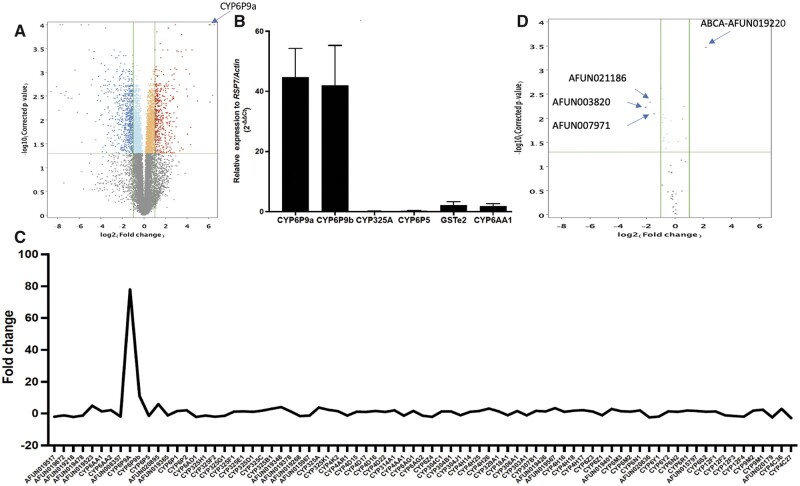
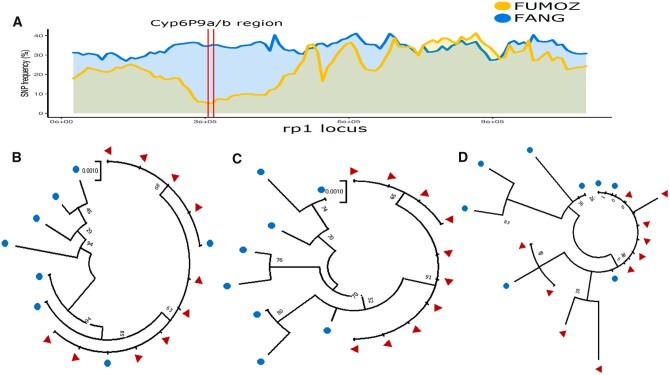
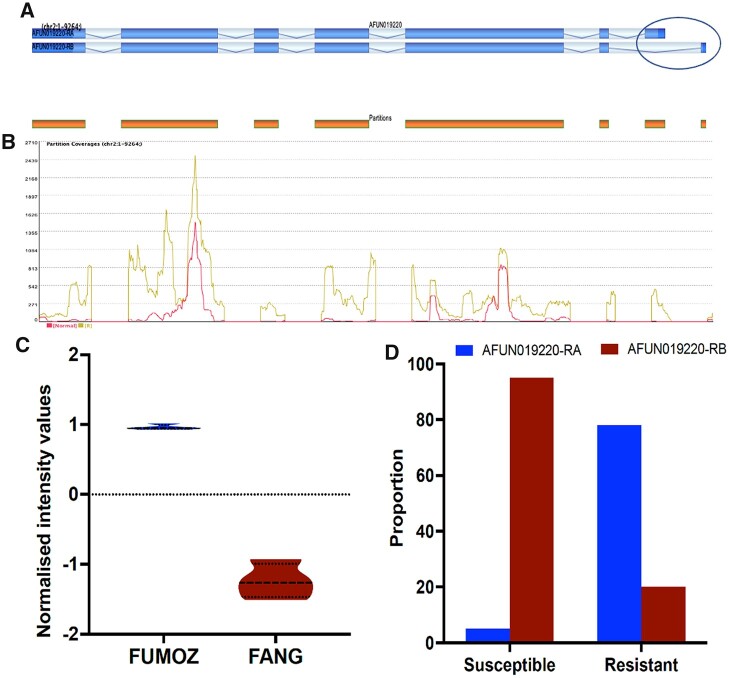
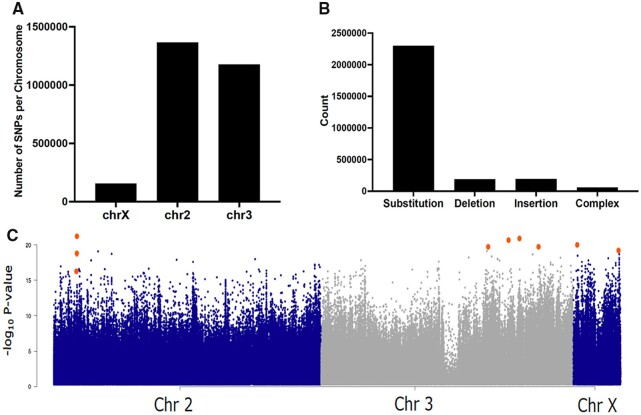
Insecticide-based interventions, notably long-lasting insecticidal nets, against mosquito vectors of malaria are currently threatened by pyrethroid resistance. Here, we contrasted RNAseq-based gene expression profiling of laboratory-resistant (FUMOZ) and susceptible (FANG) strains of the major malaria vector Anopheles funestus. Cytochrome P450 genes were the predominant over-expressed detoxification genes in FUMOZ, with high expression of the duplicated CYP6P9a (fold-change of 82.23 vs FANG) and CYP6P9b (FC 11.15). Other over-expressed P450s belonged to the same cluster of P450s corresponding to the resistance to pyrethroid 1 (rp1) quantitative trait loci (QTL) on chromosome 2R. Several Epsilon class glutathione S-transferases were also over-expressed in FUMOZ, as was the ATP-binding cassette transporter AFUN019220 (ABCA) which also exhibited between-strain alternative splicing events at exon 7. Significant differences in single-nucleotide polymorphism frequencies between strains occurred in resistance QTLs rp1 (CYP6P9a/b and CYP6AA1), rp2 on chromosome 2L (CYP6Z1, CYP6M7, and CYP6Z3), and rp3 on chromosome 3R (CYP9J5, CYP9J4, and CYP9J3). Differences were also detected in CYP4G17 and CYP4G16 genes on the X chromosome, both of which are associated with cuticular resistance in Anopheles gambiae. A close analysis of nonsynonymous diversity at the CYP6P9a/b loci revealed a drastic loss of diversity in FUMOZ with only a single polymorphism and 2 haplotypes vs 18 substitutions and 8 haplotypes in FANG. By contrast, a lowly expressed cytochrome P450 (CYP4C36) did not exhibit diversity differences between strains. We also detected the known pyrethroid resistance conferring amino acid change N384S in CYP6P9b. This study further elucidates the molecular bases of resistance in An. funestus, informing strategies to better manage widespread resistance across Africa.
基于杀虫剂的干预措施,特别是长效杀虫蚊帐,用于对抗疟疾的蚊子传播媒介,目前正受到拟除虫菊酯抗性的威胁。在这里,我们对比了实验室抗性(FUMOZ)和敏感(FANG)品系的主要疟疾传播媒介冈比亚按蚊的基于 RNAseq 的基因表达谱。细胞色素 P450 基因是 FUMOZ 中主要过表达的解毒基因,其中 CYP6P9a(与 FANG 的倍数变化为 82.23)和 CYP6P9b(FC 11.15)高度表达。其他过表达的 P450 属于与 2R 染色体上的拟除虫菊酯 1(rp1)数量性状基因座(QTL)抗性相对应的同一 P450 簇。在 FUMOZ 中,几个 Epsilon 类谷胱甘肽 S-转移酶也过表达,同时也表达了 ABCA 转运蛋白 AFUN019220(ABCA),该基因在 7 号外显子上也表现出了菌株间的选择性剪接事件。在抗性 QTL rp1(CYP6P9a/b 和 CYP6AA1)、2L 染色体上的 rp2(CYP6Z1、CYP6M7 和 CYP6Z3)和 3R 染色体上的 rp3(CYP9J5、CYP9J4 和 CYP9J3)中,菌株间的单核苷酸多态性频率也存在显著差异。在 X 染色体上的 CYP4G17 和 CYP4G16 基因中也检测到差异,这两个基因都与冈比亚按蚊的表皮抗性有关。对 CYP6P9a/b 基因座的非同义多样性进行的详细分析表明,与 FANG 相比,FUMOZ 的多样性急剧丧失,只有一个多态性和 2 个单倍型,而 FANG 有 18 个取代和 8 个单倍型。相比之下,一个低表达的细胞色素 P450(CYP4C36)在菌株间没有表现出多样性差异。我们还检测到 CYP6P9b 中已知的赋予拟除虫菊酯抗性的氨基酸变化 N384S。这项研究进一步阐明了冈比亚按蚊抗性的分子基础,为更好地管理非洲广泛存在的抗性提供了信息。