Department of Biology, Lund University, Lund, Sweden.
Department of Health, Life and Environmental Sciences, University of L'Aquila, Coppito, L'Aquila, Italy.
Mol Biol Evol. 2022 Jan 7;39(1). doi: 10.1093/molbev/msab311.
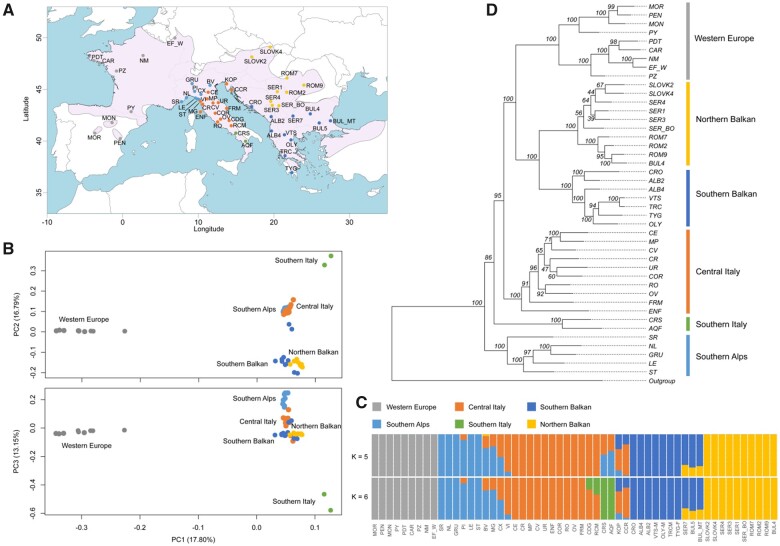
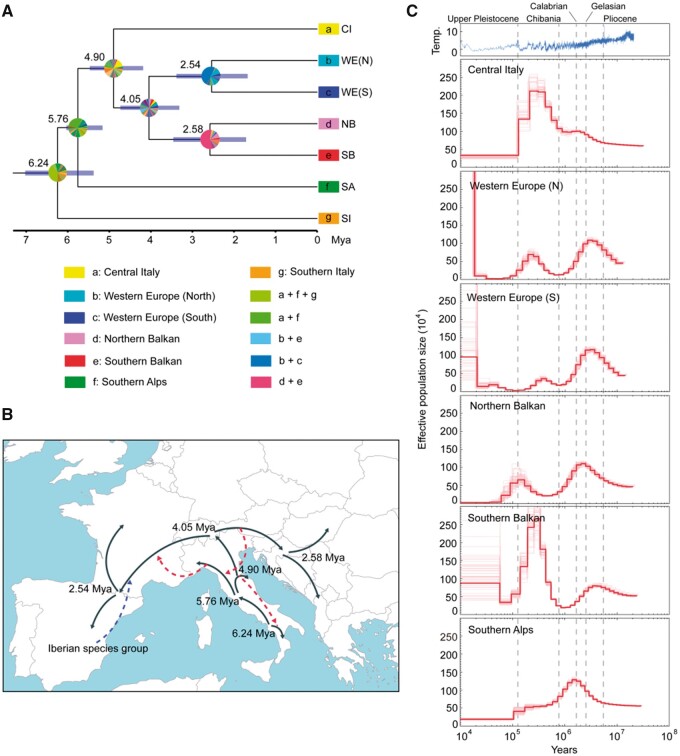
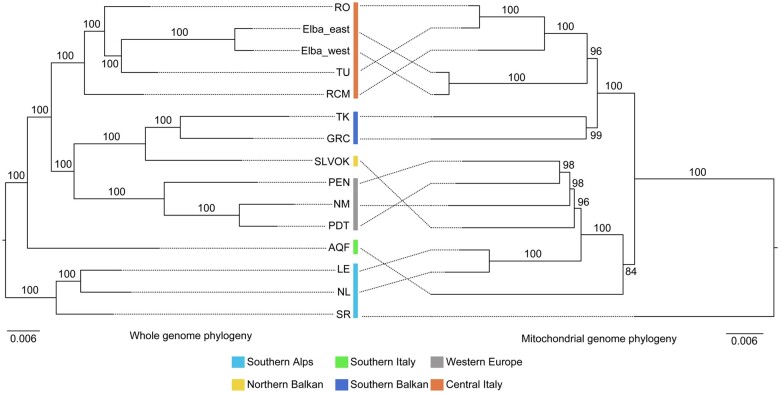
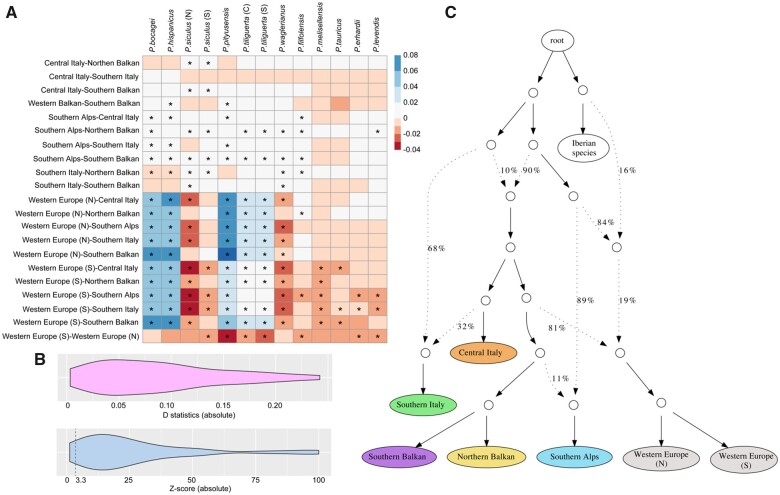
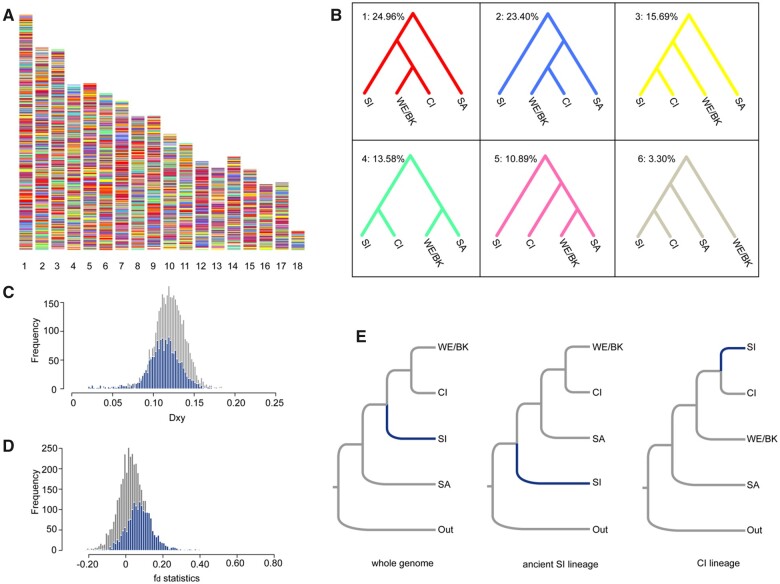
The Mediterranean Basin has experienced extensive change in geology and climate over the past six million years. Yet, the relative importance of key geological events for the distribution and genetic structure of the Mediterranean fauna remains poorly understood. Here, we use population genomic and phylogenomic analyses to establish the evolutionary history and genetic structure of common wall lizards (Podarcis muralis). This species is particularly informative because, in contrast to other Mediterranean lizards, it is widespread across the Iberian, Italian, and Balkan Peninsulas, and in extra-Mediterranean regions. We found strong support for six major lineages within P. muralis, which were largely discordant with the phylogenetic relationship of mitochondrial DNA. The most recent common ancestor of extant P. muralis was likely distributed in the Italian Peninsula, and experienced an "Out-of-Italy" expansion following the Messinian salinity crisis (∼5 Mya), resulting in the differentiation into the extant lineages on the Iberian, Italian, and Balkan Peninsulas. Introgression analysis revealed that both inter- and intraspecific gene flows have been pervasive throughout the evolutionary history of P. muralis. For example, the Southern Italy lineage has a hybrid origin, formed through admixture between the Central Italy lineage and an ancient lineage that was the sister to all other P. muralis. More recent genetic differentiation is associated with the onset of the Quaternary glaciations, which influenced population dynamics and genetic diversity of contemporary lineages. These results demonstrate the pervasive role of Mediterranean geology and climate for the evolutionary history and population genetic structure of extant species.
过去六百万年来,地中海盆地的地质和气候发生了广泛变化。然而,关键地质事件对地中海动物群的分布和遗传结构的相对重要性仍知之甚少。在这里,我们使用群体基因组学和系统发育基因组学分析来确定普通壁蜥(Podarcis muralis)的进化历史和遗传结构。该物种特别有启发性,因为与其他地中海蜥蜴不同,它广泛分布于伊比利亚半岛、意大利半岛和巴尔干半岛,以及地中海以外的地区。我们发现,在 P. muralis 中有六个主要谱系,这与线粒体 DNA 的系统发育关系在很大程度上不一致。现存 P. muralis 的最近共同祖先可能分布在意大利半岛,并且在 Messinian 盐度危机(约 500 万年前)之后经历了一次“意大利境外”扩张,导致了现存谱系在伊比利亚半岛、意大利半岛和巴尔干半岛上的分化。基因渗入分析表明,P. muralis 的种间和种内基因流在其进化历史中一直普遍存在。例如,意大利南部谱系具有杂种起源,是由中央意大利谱系和一个古老谱系之间的混合形成的,而古老谱系是所有其他 P. muralis 的姐妹谱系。更近的遗传分化与第四纪冰川作用的开始有关,这影响了当代谱系的种群动态和遗传多样性。这些结果表明,地中海地质和气候对现存物种的进化历史和种群遗传结构具有普遍的作用。