MRC Epidemiology Unit, University of Cambridge School of Clinical Medicine, Box 285 Institute of Metabolic Science, Cambridge Biomedical Campus, Cambridge, CB2 0QQ, UK.
École de Nutrition, Université Laval, Pavillon des Services, bureau 2729-E, 2440 boul. Hochelaga, Quebec City, QC, G1V 0A6, Canada.
BMC Public Health. 2021 Oct 31;21(1):1968. doi: 10.1186/s12889-021-11953-9.
Online food delivery services facilitate 'online' access to food outlets that typically sell lenergy-dense nutrient-poor food. Greater online food outlet access might be related to the use of this purchasing format and living with excess bodyweight, however, this is not known. We aimed to investigate the association between aspects of online food outlet access and online food delivery service use, and differences according to customer sociodemographic characteristics, as well as the association between the number of food outlets accessible online and bodyweight.
In 2019, we used an automated data collection method to collect data on all food outlets in the UK registered with the leading online food delivery service Just Eat (n = 33,204). We linked this with contemporaneous data on food purchasing, bodyweight, and sociodemographic information collected through the International Food Policy Study (analytic sample n = 3067). We used adjusted binomial logistic, linear, and multinomial logistic regression models to examine associations.
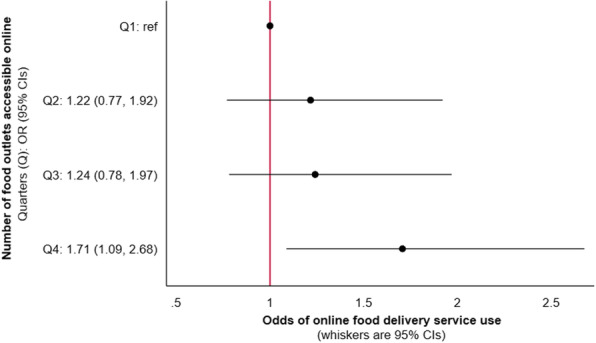
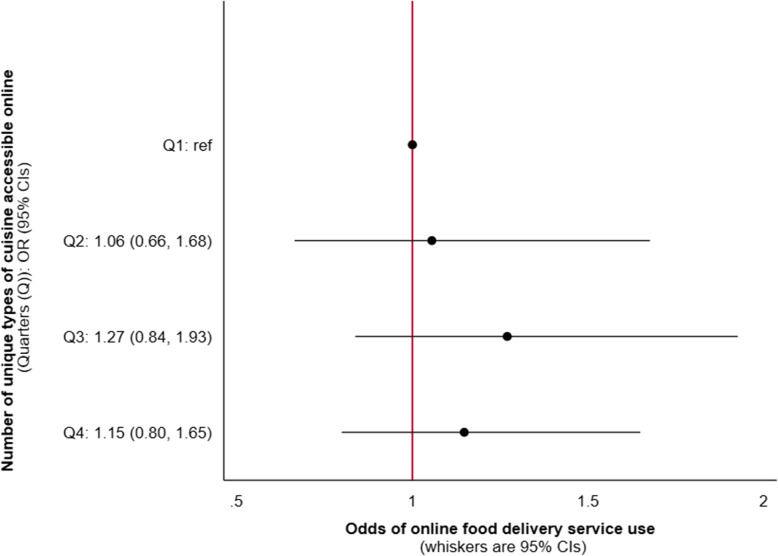
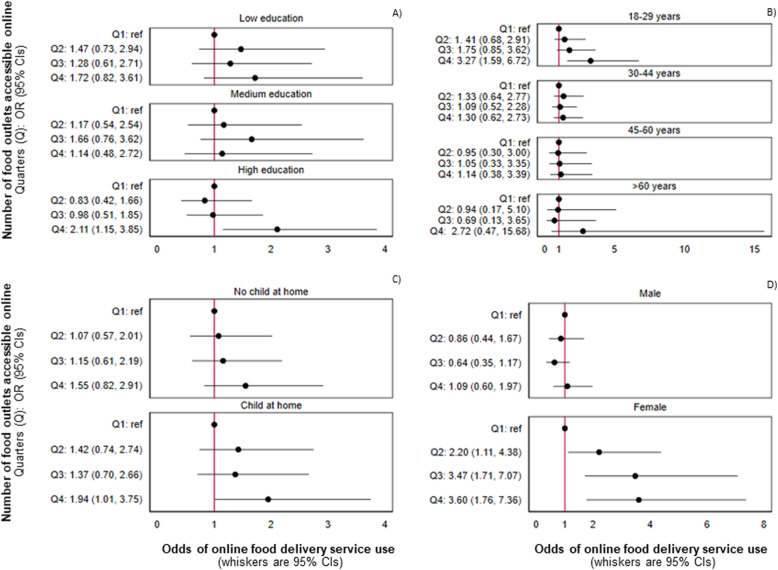
Adults in the UK had online access to a median of 85 food outlets (IQR: 34-181) and 85 unique types of cuisine (IQR: 64-108), and 15.1% reported online food delivery service use in the previous week. Those with the greatest number of accessible food outlets (quarter four, 182-879) had 71% greater odds of online food delivery service use (OR: 1.71; 95% CI: 1.09, 2.68) compared to those with the least (quarter one, 0-34). This pattern was evident amongst adults with a university degree (OR: 2.11; 95% CI: 1.15, 3.85), adults aged between 18 and 29 years (OR: 3.27, 95% CI: 1.59, 6.72), those living with children (OR: 1.94; 95% CI: 1.01; 3.75), and females at each level of increased exposure. We found no association between the number of unique types of cuisine accessible online and online food delivery service use, or between the number of food outlets accessible online and bodyweight.
The number of food outlets accessible online is positively associated with online food delivery service use. Adults with the highest education, younger adults, those living with children, and females, were particularly susceptible to the greatest online food outlet access. Further research is required to investigate the possible health implications of online food delivery service use.
在线食品配送服务使人们能够“在线”访问通常销售高能量、低营养食物的食品店。更多的在线食品店访问可能与这种购买方式的使用以及超重有关,但这一点尚不清楚。我们旨在调查在线食品店访问的各个方面与在线食品配送服务使用之间的关联,以及根据顾客社会人口统计学特征的差异,以及在线可访问的食品店数量与体重之间的关联。
2019 年,我们使用一种自动数据收集方法收集了英国领先的在线食品配送服务 Just Eat 注册的所有食品店的数据(n=33204)。我们将这些数据与同期通过国际食品政策研究收集的食品购买、体重和社会人口学信息(分析样本 n=3067)进行了关联。我们使用调整后的二项逻辑、线性和多项逻辑回归模型来检验关联。
英国成年人在线访问中位数为 85 个食品店(IQR:34-181)和 85 种独特的菜肴类型(IQR:64-108),15.1%的人在过去一周内报告使用了在线食品配送服务。与可访问的食品店数量最少的(第一季度,0-34)相比,可访问的食品店数量最多的(第四季度,182-879)使用在线食品配送服务的可能性高 71%(OR:1.71;95%CI:1.09,2.68)。这种模式在具有大学学历的成年人(OR:2.11;95%CI:1.15,3.85)、18 至 29 岁的成年人(OR:3.27,95%CI:1.59,6.72)、有孩子的成年人(OR:1.94;95%CI:1.01;3.75)和每个暴露水平的女性中均可见。我们没有发现在线可访问的独特菜肴类型数量与在线食品配送服务使用之间的关联,也没有发现在线可访问的食品店数量与体重之间的关联。
在线可访问的食品店数量与在线食品配送服务的使用呈正相关。受教育程度最高的成年人、年轻成年人、有孩子的成年人和女性,特别容易受到最大的在线食品店访问的影响。需要进一步研究在线食品配送服务使用可能对健康的影响。