Luo Xiaoning, Sun Daoyang, Wang Shu, Luo Sha, Fu Yaqi, Niu Lixin, Shi Qianqian, Zhang Yanlong
College of Landscape Architecture and Art, Northwest A&F University, Yangling, China.
Hortic Res. 2021 Nov 1;8(1):235. doi: 10.1038/s41438-021-00666-0.
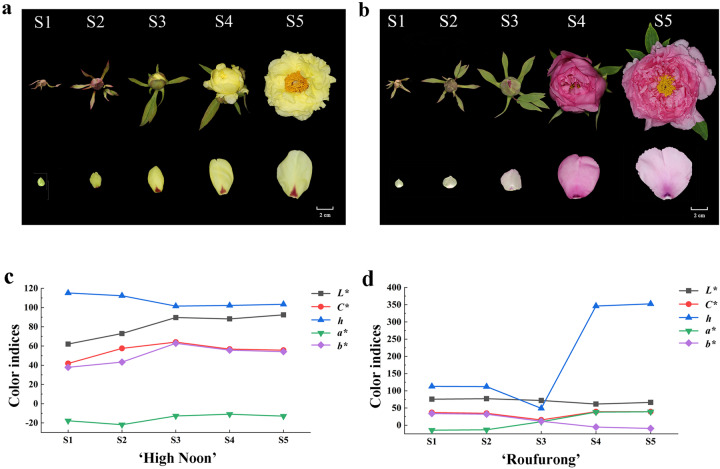
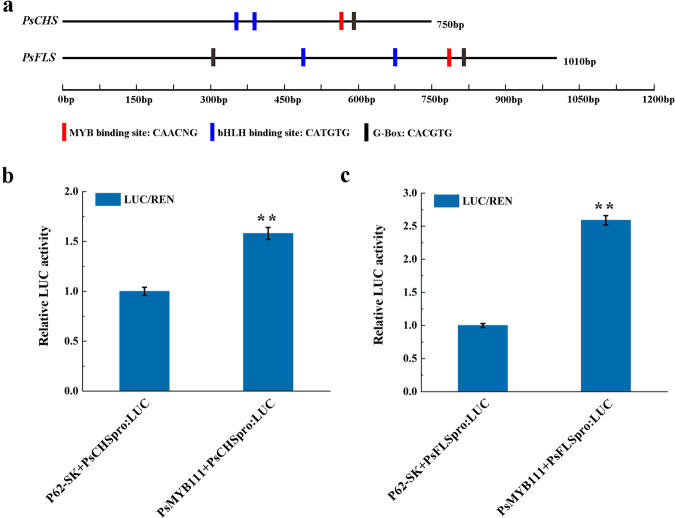
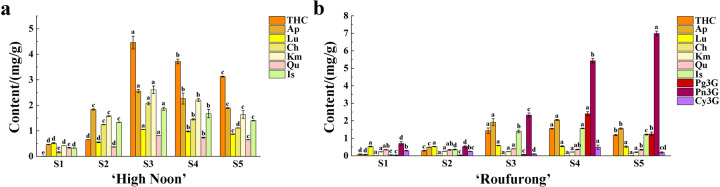
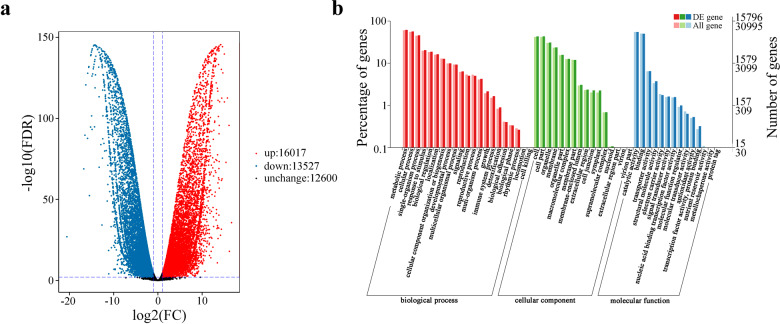
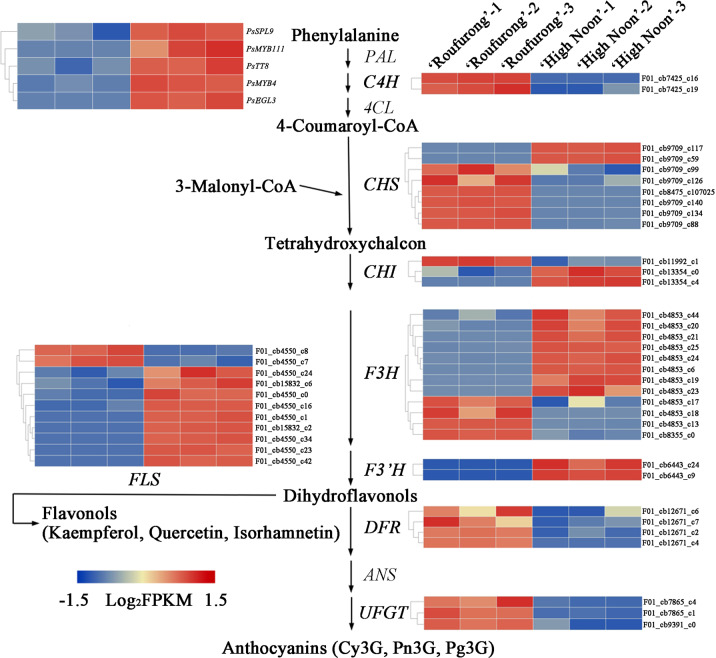
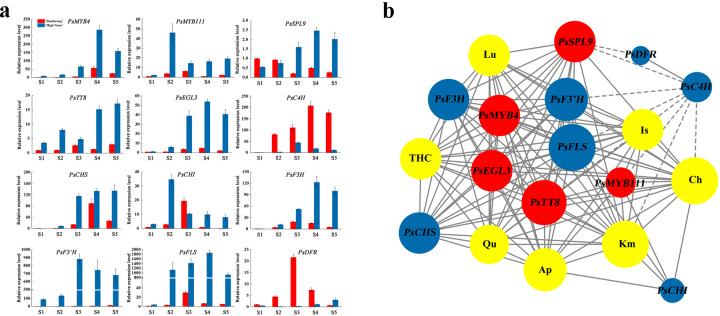
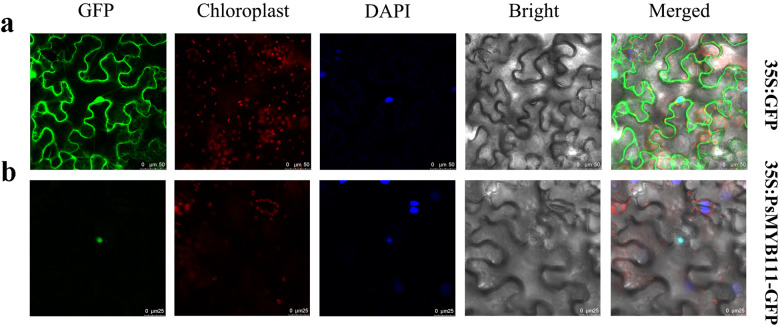
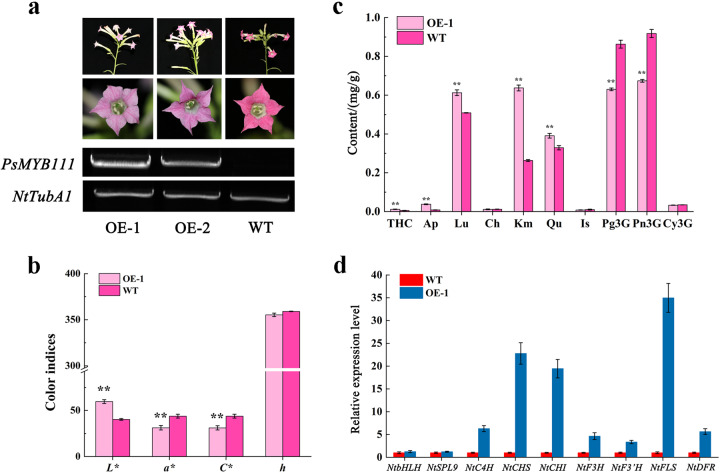
Tree peony (Paeonia suffruticosa Andr.) is a popular ornamental plant in China due to its showy and colorful flowers. However, yellow-colored flowers are rare in both wild species and domesticated cultivars. The molecular mechanisms underlying yellow pigmentation remain poorly understood. Here, petal tissues of two tree peony cultivars, "High Noon" (yellow flowers) and "Roufurong" (purple-red flowers), were sampled at five developmental stages (S1-S5) from early flower buds to full blooms. Five petal color indices (brightness, redness, yellowness, chroma, and hue angle) and the contents of ten different flavonoids were determined. Compared to "Roufurong," which accumulated abundant anthocyanins at S3-S5, the yellow-colored "High Noon" displayed relatively higher contents of tetrahydroxychalcone (THC), flavones, and flavonols but no anthocyanin production. The contents of THC, flavones, and flavonols in "High Noon" peaked at S3 and dropped gradually as the flower bloomed, consistent with the color index patterns. Furthermore, RNA-seq analyses at S3 showed that structural genes such as PsC4Hs, PsDFRs, and PsUFGTs in the flavonoid biosynthesis pathway were downregulated in "High Noon," whereas most PsFLSs, PsF3Hs, and PsF3'Hs were upregulated. Five transcription factor (TF) genes related to flavonoid biosynthesis were also upregulated in "High Noon." One of these TFs, PsMYB111, was overexpressed in tobacco, which led to increased flavonols but decreased anthocyanins. Dual-luciferase assays further confirmed that PsMYB111 upregulated PsFLS. These results improve our understanding of yellow pigmentation in tree peony and provide a guide for future molecular-assisted breeding experiments in tree peony with novel flower colors.
牡丹(Paeonia suffruticosa Andr.)因其艳丽多彩的花朵而成为中国一种受欢迎的观赏植物。然而,无论是野生种还是栽培品种中,黄色花朵都很罕见。黄色素沉着背后的分子机制仍知之甚少。在此,对两个牡丹品种“High Noon”(黄花)和“肉芙蓉”(紫红色花)的花瓣组织在从早期花芽到盛开的五个发育阶段(S1-S5)进行了采样。测定了五个花瓣颜色指标(亮度、红色度、黄色度、色度和色相角)以及十种不同黄酮类化合物的含量。与在S3-S5积累大量花青素的“肉芙蓉”相比,黄色的“High Noon”显示出相对较高的四羟基查耳酮(THC)、黄酮和黄酮醇含量,但没有花青素生成。“High Noon”中THC、黄酮和黄酮醇的含量在S3达到峰值,并随着花朵开放而逐渐下降,这与颜色指标模式一致。此外,在S3进行的RNA测序分析表明,黄酮生物合成途径中的结构基因如PsC4Hs、PsDFRs和PsUFGTs在“High Noon”中下调,而大多数PsFLSs、PsF3Hs和PsF3'Hs上调。五个与黄酮生物合成相关的转录因子(TF)基因在“High Noon”中也上调。其中一个TF,PsMYB111,在烟草中过表达后导致黄酮醇增加但花青素减少。双荧光素酶测定进一步证实PsMYB111上调了PsFLS。这些结果增进了我们对牡丹黄色素沉着的理解,并为未来牡丹新花色分子辅助育种实验提供了指导。