Bhalla Shireen Jagriti, Kemmers Roy, Vasques Ana, Vanak Abi Tamim
Erasmus University College, Rotterdam, The Netherlands.
Ashoka Trust for Research in Ecology and the Environment, Bengaluru, India.
Urban Ecosyst. 2021;24(6):1245-1258. doi: 10.1007/s11252-021-01097-4. Epub 2021 Feb 16.
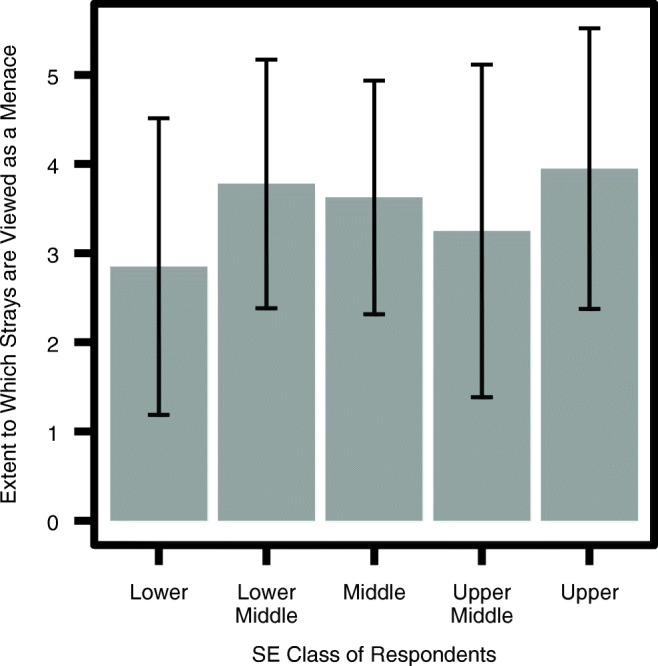
Across the developing world, humans and free-ranging domestic dogs share common spaces. The relationship between these dogs and humans can range from one of dependence, to apathy, to conflict. Given the high number of humans attacked by dogs every year in India, and the lack of an effective population control strategy, we seek to provide insights into the conflict and propose alternative population management options based on reducing the carrying capacity of the environment. We used a mixed methods approach to understand both ecological and sociological underpinnings of free-ranging dog-human relationships in Bangalore, India. We conducted a photographic capture-recapture survey of free-ranging dogs to estimate population size and linked it to the availability of potential food sources. We also conducted a qualitative survey to assess attitudes of residents towards the dog population. We found that dog population varied from 192 to 1888 per square kilometre across a gradient of housing densities. The density of houses, bakeries and garbage piles were significant predictors of dog population size. Crucially, as low as 10 to 18% of houses supported the large population of dogs, highlighting the need for residents to act responsibly towards the dogs. Further, we found that garbage, although significant, is a secondary food source to household-maintained dogs. Since on the whole, respondents expressed the desire for a reduction in dog population, we suggest decreasing the carrying capacity of the environment by targeting these three food sources.
The online version contains supplementary material available at 10.1007/s11252-021-01097-4.
在整个发展中世界,人类和自由放养的家犬共享公共空间。这些狗与人类之间的关系从依赖到冷漠再到冲突不等。鉴于印度每年有大量人被狗攻击,且缺乏有效的种群控制策略,我们试图深入了解这种冲突,并基于降低环境承载能力提出替代性的种群管理方案。我们采用混合方法来理解印度班加罗尔自由放养家犬与人类关系的生态和社会学基础。我们对自由放养家犬进行了拍照重捕调查以估计种群数量,并将其与潜在食物来源的可得性联系起来。我们还进行了定性调查以评估居民对犬类种群的态度。我们发现,在不同住房密度梯度下,每平方公里的犬类数量从192只到1888只不等。房屋、面包店和垃圾堆的密度是犬类种群规模的重要预测因素。至关重要的是,只有10%至18%的房屋养活了大量的狗,这凸显了居民对狗采取负责任行动的必要性。此外,我们发现垃圾虽然重要,但对家养犬来说是次要食物来源。总体而言,由于受访者表示希望减少犬类数量,我们建议通过针对这三种食物来源来降低环境承载能力。
在线版本包含可在10.1007/s11252-021-01097-4获取的补充材料。