de Vries Lianne P, Baselmans Bart M L, Bartels Meike
Department of Biological Psychology, Vrije Universiteit Amsterdam, Van der Boechorststraat 7, 1081 BT Amsterdam, The Netherlands.
Amsterdam Public Health Research Institute, Amsterdam University Medical Centres, Amsterdam, The Netherlands.
J Happiness Stud. 2021;22(5):2361-2408. doi: 10.1007/s10902-020-00324-7. Epub 2020 Oct 23.
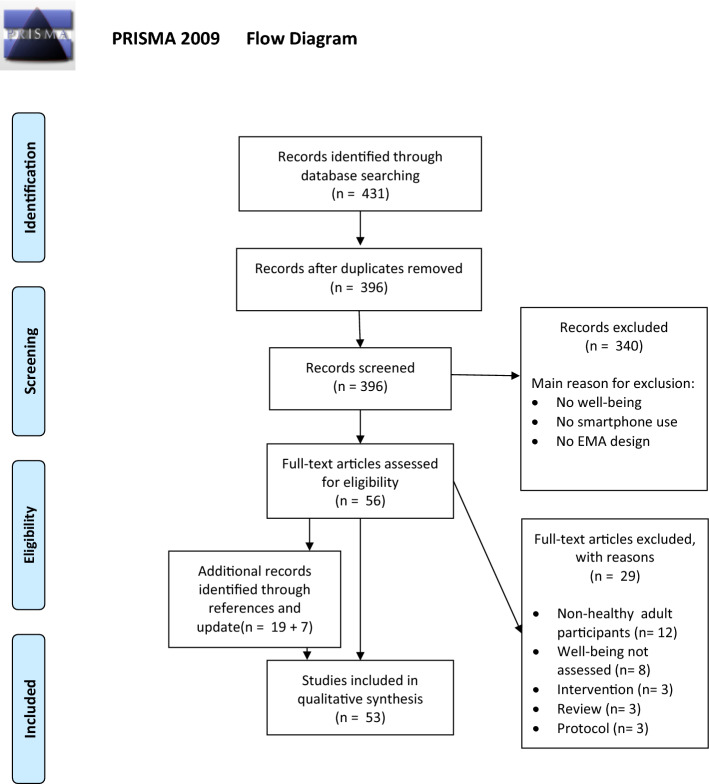
Feelings of well-being and happiness fluctuate over time and contexts. Ecological Momentary Assessment (EMA) studies can capture fluctuations in momentary behavior, and experiences by assessing these multiple times per day. Traditionally, EMA was performed using pen and paper. Recently, due to technological advances EMA studies can be conducted more easily with smartphones, a device ubiquitous in our society. The goal of this review was to evaluate the literature on smartphone-based EMA in well-being research in healthy subjects. The systematic review was conducted according to the Preferred Reporting Items for Systematic Review and Meta-Analysis (PRISMA) guidelines. Searching PubMed and Web of Science, we identified 53 studies using smartphone-based EMA of well-being. Studies were heterogeneous in designs, context, and measures. The average study duration was 12.8 days, with well-being assessed 2-12 times per day. Half of the studies included objective data (e.g. location). Only 47.2% reported compliance, indicating a mean of 71.6%. Well-being fluctuated daily and weekly, with higher well-being in evenings and weekends. These fluctuations disappeared when location and activity were accounted for. On average, being in nature and physical activity relates to higher well-being. Working relates to lower well-being, but workplace and company do influence well-being. The important advantages of using smartphones instead of other devices to collect EMAs are the easier data collection and flexible designs. Smartphone-based EMA reach far larger maximum sample sizes and more easily add objective data to their designs than palm-top/PDA studies. Smartphone-based EMA research is feasible to gain insight in well-being fluctuations and its determinants and offers the opportunity for parallel objective data collection. Most studies currently focus on group comparisons, while studies on individual differences in well-being patterns and fluctuations are lacking. We provide recommendations for future smartphone-based EMA research regarding measures, objective data and analyses.
幸福感和快乐感会随时间和环境而波动。生态瞬时评估(EMA)研究可以通过每天多次评估来捕捉瞬时行为和体验的波动。传统上,EMA是通过纸笔进行的。最近,由于技术进步,使用智能手机进行EMA研究变得更加容易,智能手机在我们的社会中无处不在。本综述的目的是评估在健康受试者幸福感研究中基于智能手机的EMA的文献。系统评价是根据系统评价和Meta分析的首选报告项目(PRISMA)指南进行的。通过检索PubMed和科学网,我们确定了53项使用基于智能手机的EMA进行幸福感研究的文献。这些研究在设计、背景和测量方法上存在异质性。平均研究持续时间为12.8天,每天对幸福感进行2至12次评估。一半的研究纳入了客观数据(如位置)。只有47.2%的研究报告了依从性,平均依从率为71.6%。幸福感每天和每周都会波动,晚上和周末的幸福感更高。当考虑位置和活动因素时,这些波动就会消失。平均而言,身处自然环境和进行体育活动与更高的幸福感相关。工作与较低的幸福感相关,但工作场所和公司确实会影响幸福感。使用智能手机而非其他设备收集EMA的重要优势在于数据收集更容易且设计更灵活。与掌上电脑/个人数字助理(PDA)研究相比,基于智能手机的EMA能够达到更大的最大样本量,并且更容易在设计中添加客观数据。基于智能手机的EMA研究对于深入了解幸福感波动及其决定因素是可行的,并且提供了并行收集客观数据的机会。目前大多数研究集中在组间比较上,而关于幸福感模式和波动的个体差异研究较少。我们为未来基于智能手机的EMA研究在测量方法、客观数据和分析方面提供了建议。