Guo Lingna, Cao Wei, Niu Yuguang, He Shuangba, Chai Renjie, Yang Jianming
State Key Laboratory of Bioelectronics, School of Life Sciences and Technology, Jiangsu Province High-Tech Key Laboratory for Bio-Medical Research, Southeast University, Nanjing, China.
Department of Otolaryngology Head and Neck Surgery, The Second Affiliated Hospital of Anhui Medical University, Hefei, China.
Front Cell Neurosci. 2021 Oct 13;15:760422. doi: 10.3389/fncel.2021.760422. eCollection 2021.
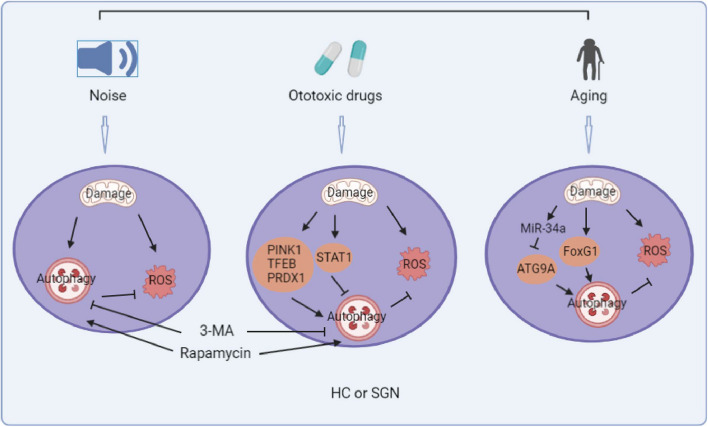
Inner ear hair cells (HCs) and spiral ganglion neurons (SGNs) are the core components of the auditory system. However, they are vulnerable to genetic defects, noise exposure, ototoxic drugs and aging, and loss or damage of HCs and SGNs results in permanent hearing loss due to their limited capacity for spontaneous regeneration in mammals. Many efforts have been made to combat hearing loss including cochlear implants, HC regeneration, gene therapy, and antioxidant drugs. Here we review the role of autophagy in sensorineural hearing loss and the potential targets related to autophagy for the treatment of hearing loss.
内耳毛细胞(HCs)和螺旋神经节神经元(SGNs)是听觉系统的核心组成部分。然而,它们易受遗传缺陷、噪声暴露、耳毒性药物和衰老的影响,并且由于哺乳动物中HCs和SGNs的自发再生能力有限,它们的丧失或损伤会导致永久性听力损失。人们已经做出了许多努力来对抗听力损失,包括人工耳蜗植入、HC再生、基因治疗和抗氧化药物。在这里,我们综述了自噬在感音神经性听力损失中的作用以及与自噬相关的潜在治疗听力损失的靶点。