Division of Allergy and Immunology, Department of Medicine, Northwestern University Feinberg School of Medicine, Chicago, IL, United States.
Front Immunol. 2021 Oct 11;12:737988. doi: 10.3389/fimmu.2021.737988. eCollection 2021.
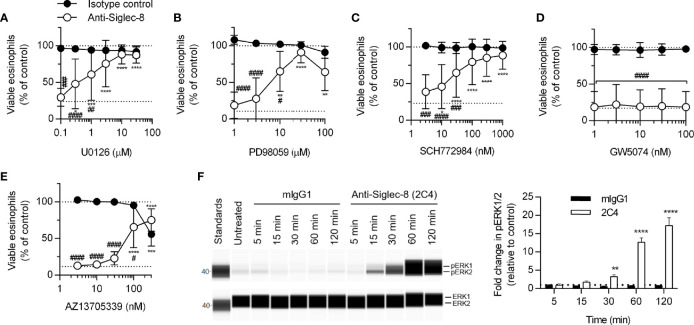
Sialic acid-binding immunoglobulin-like lectin (Siglec)-8 is a glycan-binding receptor bearing immunoreceptor tyrosine-based inhibitory and switch motifs (ITIM and ITSM, respectively) that is selectively expressed on eosinophils, mast cells, and, to a lesser extent, basophils. Previous work has shown that engagement of Siglec-8 on IL-5-primed eosinophils causes cell death CD11b/CD18 integrin-mediated adhesion and NADPH oxidase activity and identified signaling molecules linking adhesion, reactive oxygen species (ROS) production, and cell death. However, the proximal signaling cascade activated directly by Siglec-8 engagement has remained elusive. Most members of the Siglec family possess similar cytoplasmic signaling motifs and recruit the protein tyrosine phosphatases SHP-1/2, consistent with ITIM-mediated signaling, to dampen cellular activation. However, the dependence of Siglec-8 function in eosinophils on these phosphatases has not been studied. Using Siglec-8 antibody engagement and pharmacological inhibition in conjunction with assays to measure cell-surface upregulation and conformational activation of CD11b integrin, ROS production, and cell death, we sought to identify molecules involved in Siglec-8 signaling and determine the stage of the process in which each molecule plays a role. We demonstrate here that the enzymatic activities of Src family kinases (SFKs), Syk, SHIP1, PAK1, MEK1, ERK1/2, PLC, PKC, acid sphingomyelinase/ceramidase, and Btk are all necessary for Siglec-8-induced eosinophil cell death, with no apparent role for SHP-1/2, SHIP2, or c-Raf. While most of these signaling molecules are necessary for Siglec-8-induced upregulation of CD11b integrin at the eosinophil cell surface, Btk is phosphorylated and activated later in the signaling cascade and is instead necessary for CD11b activation. In contrast, SFKs and ERK1/2 are phosphorylated far earlier in the process, consistent with their role in augmenting cell-surface levels of CD11b. In addition, pretreatment of eosinophils with latrunculin B or jasplakinolide revealed that actin filament disassembly is necessary and sufficient for surface CD11b integrin upregulation and that actin polymerization is necessary for downstream ROS production. These results show that Siglec-8 signals through an unanticipated set of signaling molecules in IL-5-primed eosinophils to induce cell death and challenges the expectation that ITIM-bearing Siglecs signal through inhibitory pathways involving protein tyrosine phosphatases to achieve their downstream functions.
唾液酸结合免疫球蛋白样凝集素(Siglec)-8 是一种糖结合受体,具有免疫受体酪氨酸的抑制基序(ITIM)和开关基序(ITSM),选择性地表达于嗜酸性粒细胞、肥大细胞和程度较低的嗜碱性粒细胞上。先前的研究表明,IL-5 诱导的嗜酸性粒细胞上 Siglec-8 的结合会导致细胞死亡、CD11b/CD18 整合素介导的黏附和 NADPH 氧化酶活性,并确定了连接黏附、活性氧(ROS)产生和细胞死亡的信号分子。然而,直接由 Siglec-8 结合激活的近端信号级联仍然难以捉摸。Siglec 家族的大多数成员具有相似的细胞质信号基序,并募集蛋白酪氨酸磷酸酶 SHP-1/2,与 ITIM 介导的信号一致,以抑制细胞激活。然而,Siglec-8 在嗜酸性粒细胞中的功能对这些磷酸酶的依赖性尚未得到研究。我们使用 Siglec-8 抗体结合和药理学抑制,结合测量细胞表面 CD11b 整合素的上调和构象激活、ROS 产生和细胞死亡的测定,旨在鉴定参与 Siglec-8 信号的分子,并确定每个分子在该过程中的作用阶段。我们在这里证明,Src 家族激酶(SFK)、Syk、SHIP1、PAK1、MEK1、ERK1/2、PLC、PKC、酸性鞘磷脂酶/鞘氨醇酶和 Btk 的酶活性对于 Siglec-8 诱导的嗜酸性粒细胞死亡都是必需的,而 SHP-1/2、SHIP2 或 c-Raf 则没有明显作用。虽然这些信号分子大多数对于 Siglec-8 诱导的嗜酸性粒细胞表面 CD11b 整合素的上调是必需的,但 Btk 在信号级联的后期被磷酸化和激活,而是对于 CD11b 的激活是必需的。相比之下,SFK 和 ERK1/2 在该过程中更早地被磷酸化,这与它们增强细胞表面 CD11b 水平的作用一致。此外,用 latrunculin B 或 jasplakinolide 预处理嗜酸性粒细胞表明,肌动蛋白丝解聚是必需的和充分的,以实现表面 CD11b 整合素的上调,并且肌动蛋白聚合对于下游 ROS 的产生是必需的。这些结果表明,Siglec-8 通过一组意想不到的信号分子在 IL-5 诱导的嗜酸性粒细胞中发出信号,导致细胞死亡,并挑战了含有 ITIM 的 Siglecs 通过涉及蛋白酪氨酸磷酸酶的抑制途径发出信号以实现其下游功能的预期。