Outpatient Center of the UKE GmbH, Department of Radiotherapy and Radiation Oncology, University Medical Center Hamburg-Eppendorf, Martinistraße 52, 20246, Hamburg, Germany.
Institute of Medical Biometry and Epidemiology, University Medical Center Hamburg-Eppendorf, Martinistraße 52, 20246, Hamburg, Germany.
Strahlenther Onkol. 2022 Feb;198(2):135-148. doi: 10.1007/s00066-021-01865-3. Epub 2021 Nov 1.
To analyze the impact of nutritional counseling on the development of hypothyroidism after (chemo)radiotherapy in head and neck cancer patients to propose a new normal tissue complication probability (NTCP) model.
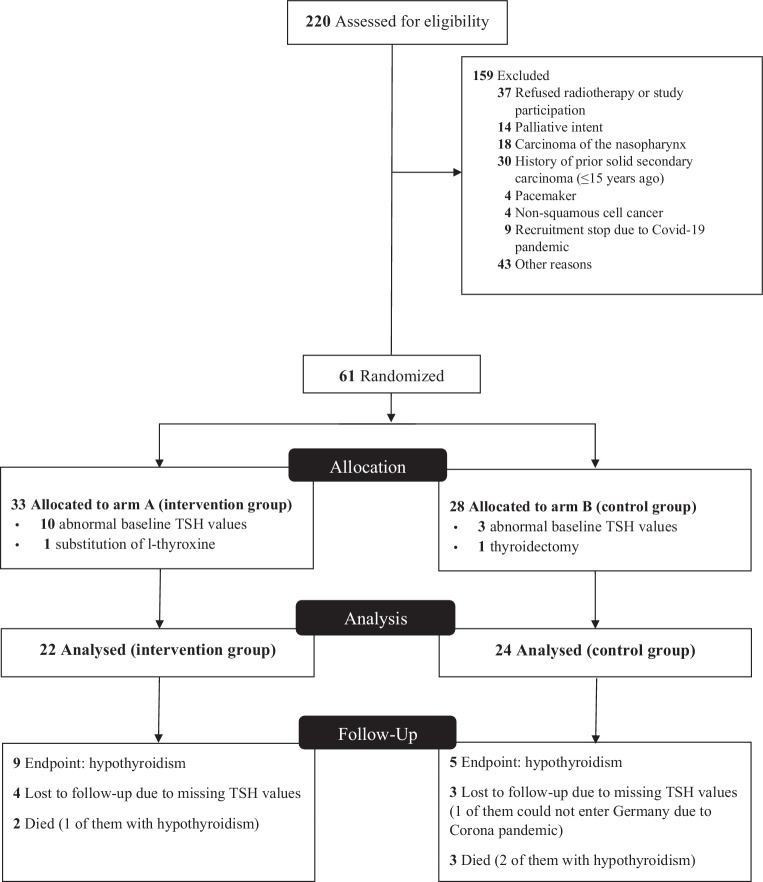
At baseline, at the end of (chemo)radiotherapy, and during follow-up, thyroid-stimulating hormone (TSH) with free thyroxin (fT3 and fT4), nutritional status, and nutrient intake were prospectively analyzed in 46 out of 220 screened patients. Patients received (chemo)radiotherapy within an intervention (individual nutritional counseling every 2 weeks during therapy) and a control group (no nutritional counseling).
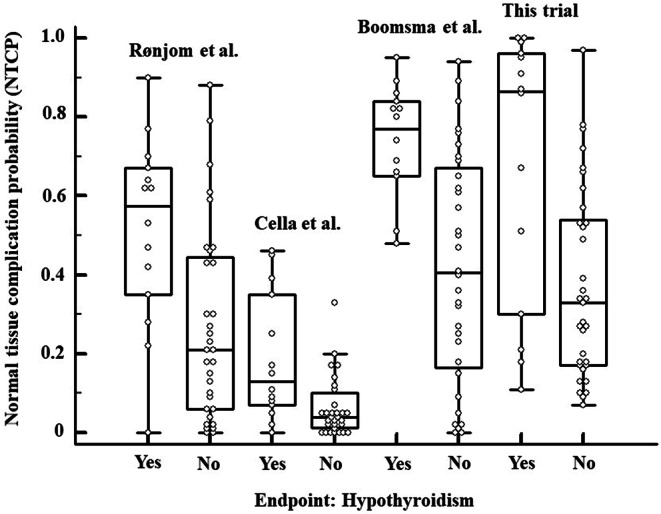
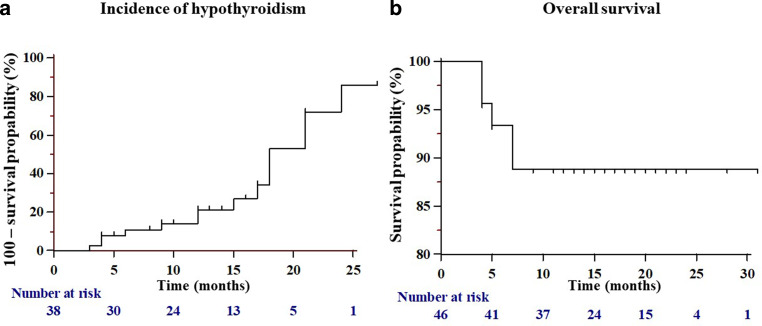
Overall median follow-up was 16.5 [IQR: 12; 22] months. Fourteen patients (30.4%) presented with hypothyroidism after 13.5 [8.8; 17] months. During (chemo)radiotherapy, nutritional status worsened in the entire cohort: body mass index (p < 0.001) and fat-free mass index (p < 0.001) decreased, calorie deficit (p = 0.02) increased, and the baseline protein intake dropped (p = 0.028). The baseline selenium intake (p = 0.002) increased until the end of therapy. Application of the NTCP models by Rønjom, Cella, and Boomsma et al. resulted in good performance of all three models, with an AUC ranging from 0.76 to 0.78. Our newly developed NTCP model was based on baseline TSH and baseline ferritin. Model performance was good, receiving an AUC of 0.76 (95% CI: 0.61-0.87), with a sensitivity of 57.1% and specificity of 96.9% calculated for a Youden index of 0.73 (p = 0.004; area = 0.5).
Baseline TSH and ferritin act as independent predictors for radiotherapy-associated hypothyroidism. The exclusion of such laboratory chemistry parameters in future NTCP models may result in poor model performance.
分析营养咨询对接受头颈部癌症放化疗后甲状腺功能减退症发展的影响,提出一种新的正常组织并发症概率(NTCP)模型。
在 220 名筛查患者中,46 名患者在基线、放化疗结束时和随访期间前瞻性分析了促甲状腺激素(TSH)、游离三碘甲状腺原氨酸(fT3 和 fT4)、营养状况和营养素摄入。患者接受放化疗干预(治疗期间每 2 周进行一次个体化营养咨询)和对照组(无营养咨询)。
总体中位随访时间为 16.5 [IQR:12;22] 个月。14 名患者(30.4%)在 13.5 [8.8;17] 个月后出现甲状腺功能减退症。在放化疗过程中,整个队列的营养状况恶化:体重指数(p<0.001)和去脂体重指数(p<0.001)下降,热量不足(p=0.02)增加,基线蛋白质摄入量下降(p=0.028)。基线硒摄入量(p=0.002)在治疗结束前增加。Rønjom、Cella 和 Boomsma 等人应用 NTCP 模型的结果表明,所有三种模型的性能都很好,AUC 范围为 0.76 至 0.78。我们新开发的 NTCP 模型基于基线 TSH 和基线铁蛋白。模型性能良好,AUC 为 0.76(95%CI:0.61-0.87),灵敏度为 57.1%,特异性为 96.9%,约登指数为 0.73(p=0.004;面积=0.5)。
基线 TSH 和铁蛋白是与放疗相关的甲状腺功能减退症的独立预测因子。在未来的 NTCP 模型中排除这些实验室化学参数可能会导致模型性能不佳。