Department of Endocrinology, The Second Affiliated Hospital of Xi'an Jiaotong University, Xi'an, Shaanxi, P.R. China.
Department of Critical Care Medicine, The Second Affiliated Hospital of Xi'an Jiaotong University, Xi'an, Shaanxi, P.R. China.
Aging (Albany NY). 2021 Nov 1;13(21):23895-23912. doi: 10.18632/aging.203663.
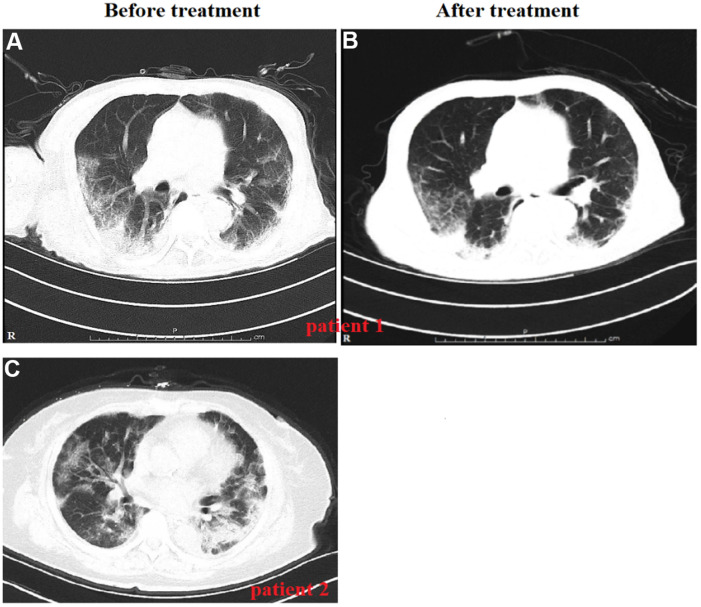
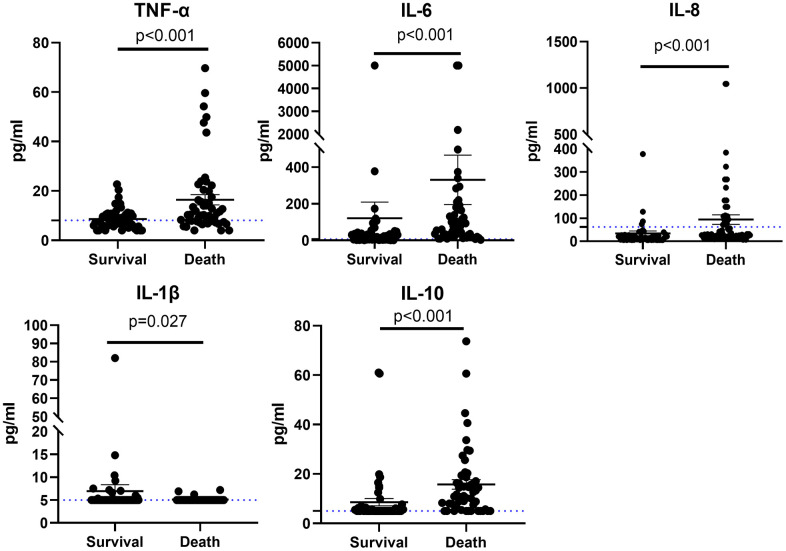
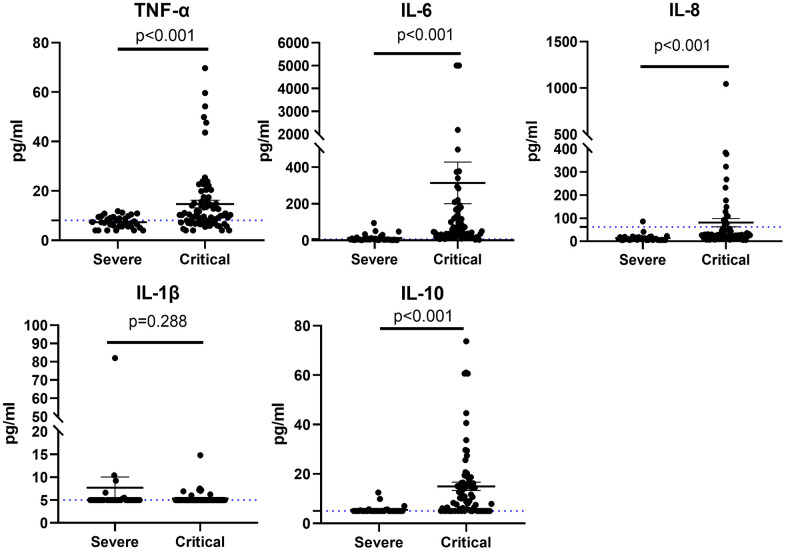
The coronavirus disease 2019 (COVID-19) is presently the most pressing public health concern worldwide. Cytokine storm is an important factor leading to death of patients with COVID-19. This study aims to characterize serum cytokines of patients with severe or critical COVID-19. Clinical records were obtained from 149 patients who were tested at the Sino-French New City Branch of Tongji Hospital from 30 January to 30 March 2020. Data regarding the clinical features of the patients was collected and analyzed. Among the 149, 45 (30.2%) of them had severe conditions and 104 (69.8%) of that presented critical symptoms. In the meantime, 80 (53.7%) of that 149 died during hospitalization. Of all, male patients accounted for 94 (69.1%). Compared with patients in severe COVID-19, those who in critical COVID-19 had significantly higher levels of tumor necrosis factor-α (TNF-α), interleukin-6 (IL-6), IL-8, and IL-10. Moreover, the passed-away patients had considerably higher levels of TNF-α, IL-6, IL-8, and IL-10 than those survived from it. Regression analysis revealed that serum TNF-α level was an independent risk factor for the death of patient with severe conditions. Among the proinflammatory cytokines (IL-1β, TNF-α, IL-8, and IL-6) analyzed herein, TNF-α was seen as a risk factor for the death of patients with severe or critical COVID-19. This study suggests that anti-TNF-α treatment allows patients with severe or critical COVID-19 pneumonia to recover.
新型冠状病毒病(COVID-19)是目前全球最紧迫的公共卫生关注点。细胞因子风暴是导致 COVID-19 患者死亡的重要因素。本研究旨在描述重症或危重症 COVID-19 患者的血清细胞因子特征。临床记录来自于 2020 年 1 月 30 日至 3 月 30 日在同济医院中法学院新城区分院接受检测的 149 名患者。收集并分析了患者的临床特征数据。其中 45 名(30.2%)患者病情严重,104 名(69.8%)患者病情危急。同时,149 名患者中有 80 名(53.7%)在住院期间死亡。其中,男性患者占 94 名(69.1%)。与重症 COVID-19 患者相比,危重症 COVID-19 患者的肿瘤坏死因子-α(TNF-α)、白细胞介素-6(IL-6)、IL-8 和 IL-10 水平明显更高。此外,死亡患者的 TNF-α、IL-6、IL-8 和 IL-10 水平明显高于存活患者。回归分析显示,血清 TNF-α水平是重症患者死亡的独立危险因素。在分析的促炎细胞因子(IL-1β、TNF-α、IL-8 和 IL-6)中,TNF-α被认为是重症或危重症 COVID-19 患者死亡的危险因素。本研究表明,抗 TNF-α 治疗可使重症或危重症 COVID-19 肺炎患者康复。