Department of Veterinary Microbiology and Preventive Medicine, Iowa State University, Ames, IA, USA.
Department of Pharmaceutics, College of Pharmacy, University of Florida, Gainesville, FL, USA.
Sci Rep. 2021 Nov 1;11(1):21358. doi: 10.1038/s41598-021-00765-x.
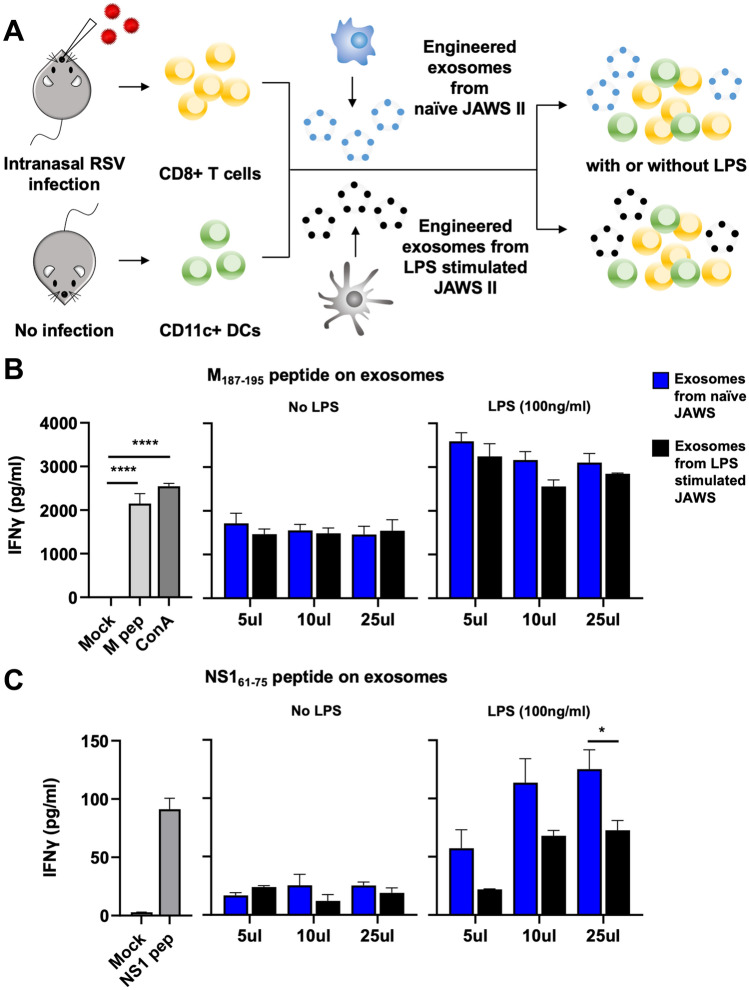
Respiratory syncytial virus (RSV) is one of the main pathogens associated with lower respiratory tract infections in infants and young children worldwide. Exosomes secreted by antigen presenting cells (APCs) can elicit immune responses by carrying major histocompatibility complex (MHC) class I molecules complexed with antigenic peptides and other co-stimulating factors. Therefore, we developed novel immunomagnetic nanographene particles to sequentially isolate, surface engineer, and release intact dendritic cell (DC) exosomes for use as a potential vaccine platform against RSV. The H-2D-restricted, immunodominant peptides from RSV (M and NS1) were introduced to MHC-I on DC-derived exosomes to express peptide/MHC-I (pMHC-I) complexes. A mouse model of RSV infection was used to define the immunogenicity of surface engineered exosomes for activating virus-specific immune responses. Ex vivo assays demonstrated that engineered exosomes carrying RSV-specific peptides can elicit interferon-gamma (IFN-γ) production by virus-specific CD8+ T cells isolated from RSV-infected C57BL/6 mice. In vivo assays demonstrated that subcutaneous administration of both M and NS1 engineered exosomes to mice, with or without additional adjuvant, appeared safe and well tolerated, however, did not prime antigen-specific CD8+ T cell responses. Surface engineered exosomes are immunogenic and promising for further development as a vaccine platform.
呼吸道合胞病毒(RSV)是全球婴幼儿下呼吸道感染的主要病原体之一。抗原提呈细胞(APCs)分泌的外泌体可以通过携带与抗原肽结合的主要组织相容性复合体(MHC)I 类分子和其他共刺激因子来引发免疫反应。因此,我们开发了新型免疫磁性纳米石墨烯颗粒,用于顺序分离、表面工程化和释放完整的树突状细胞(DC)外泌体,作为一种针对 RSV 的潜在疫苗平台。我们将 RSV(M 和 NS1)中的 H-2D 限制性免疫优势肽引入 DC 来源的外泌体上的 MHC-I 中,以表达肽/MHC-I(pMHC-I)复合物。我们使用 RSV 感染的小鼠模型来定义表面工程化外泌体激活病毒特异性免疫反应的免疫原性。体外试验表明,携带 RSV 特异性肽的工程化外泌体可以诱导从 RSV 感染的 C57BL/6 小鼠中分离出的病毒特异性 CD8+T 细胞产生干扰素-γ(IFN-γ)。体内试验表明,在不添加额外佐剂的情况下,皮下给予 M 和 NS1 工程化外泌体对小鼠是安全且耐受良好的,但不能引发抗原特异性 CD8+T 细胞反应。表面工程化的外泌体具有免疫原性,是作为疫苗平台进一步开发的有前途的候选物。