Salido Rodolfo A, Cantú Victor J, Clark Alex E, Leibel Sandra L, Foroughishafiei Anahid, Saha Anushka, Hakim Abbas, Nouri Alhakam, Lastrella Alma L, Castro-Martínez Anelizze, Plascencia Ashley, Kapadia Bhavika K, Xia Bing, Ruiz Christopher A, Marotz Clarisse A, Maunder Daniel, Lawrence Elijah S, Smoot Elizabeth W, Eisner Emily, Crescini Evelyn S, Kohn Laura, Franco Vargas Lizbeth, Chacón Marisol, Betty Maryann, Machnicki Michal, Wu Min Yi, Baer Nathan A, Belda-Ferre Pedro, De Hoff Peter, Seaver Phoebe, Ostrander R Tyler, Tsai Rebecca, Sathe Shashank, Aigner Stefan, Morgan Sydney C, Ngo Toan T, Barber Tom, Cheung Willi, Carlin Aaron F, Yeo Gene W, Laurent Louise C, Fielding-Miller Rebecca, Knight Rob
Department of Bioengineering, University of California San Diego, La Jolla, California, USA.
Division of Infectious Diseases and Global Public Health, Department of Medicine, University of California San Diego School of Medicine, La Jolla, California, USA.
mSystems. 2021 Dec 21;6(6):e0113621. doi: 10.1128/mSystems.01136-21. Epub 2021 Nov 2.
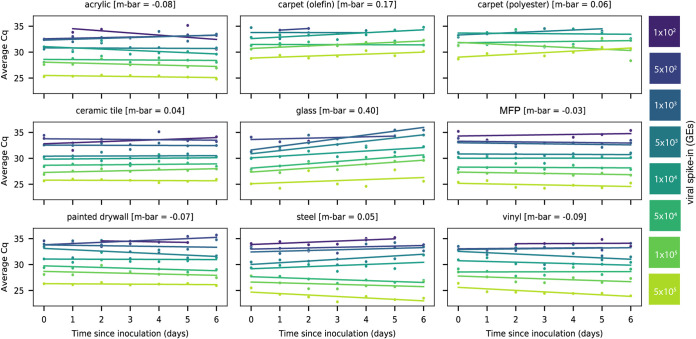
Environmental monitoring in public spaces can be used to identify surfaces contaminated by persons with coronavirus disease 2019 (COVID-19) and inform appropriate infection mitigation responses. Research groups have reported detection of severe acute respiratory syndrome coronavirus 2 (SARS-CoV-2) on surfaces days or weeks after the virus has been deposited, making it difficult to estimate when an infected individual may have shed virus onto a SARS-CoV-2-positive surface, which in turn complicates the process of establishing effective quarantine measures. In this study, we determined that reverse transcription-quantitative PCR (RT-qPCR) detection of viral RNA from heat-inactivated particles experiences minimal decay over 7 days of monitoring on eight out of nine surfaces tested. The properties of the studied surfaces result in RT-qPCR signatures that can be segregated into two material categories, rough and smooth, where smooth surfaces have a lower limit of detection. RT-qPCR signal intensity (average quantification cycle []) can be correlated with surface viral load using only one linear regression model per material category. The same experiment was performed with untreated viral particles on one surface from each category, with essentially identical results. The stability of RT-qPCR viral signal demonstrates the need to clean monitored surfaces after sampling to establish temporal resolution. Additionally, these findings can be used to minimize the number of materials and time points tested and allow for the use of heat-inactivated viral particles when optimizing environmental monitoring methods. Environmental monitoring is an important tool for public health surveillance, particularly in settings with low rates of diagnostic testing. Time between sampling public environments, such as hospitals or schools, and notifying stakeholders of the results should be minimal, allowing decisions to be made toward containing outbreaks of coronavirus disease 2019 (COVID-19). The Safer At School Early Alert program (SASEA) (https://saseasystem.org/), a large-scale environmental monitoring effort in elementary school and child care settings, has processed >13,000 surface samples for SARS-CoV-2, detecting viral signals from 574 samples. However, consecutive detection events necessitated the present study to establish appropriate response practices around persistent viral signals on classroom surfaces. Other research groups and clinical labs developing environmental monitoring methods may need to establish their own correlation between RT-qPCR results and viral load, but this work provides evidence justifying simplified experimental designs, like reduced testing materials and the use of heat-inactivated viral particles.
公共场所的环境监测可用于识别被2019冠状病毒病(COVID-19)患者污染的表面,并为适当的感染缓解措施提供依据。研究小组报告称,在病毒沉积数天或数周后,在表面检测到严重急性呼吸综合征冠状病毒2(SARS-CoV-2),这使得难以估计受感染个体何时可能将病毒 shedding 到SARS-CoV-2阳性表面上,这反过来又使建立有效的检疫措施的过程变得复杂。在本研究中,我们确定,在九种测试表面中的八种表面上,对热灭活颗粒的病毒RNA进行逆转录定量PCR(RT-qPCR)检测,在7天的监测过程中,其衰减最小。所研究表面的特性导致RT-qPCR特征可分为两类材料,粗糙和光滑,其中光滑表面的检测下限较低。RT-qPCR信号强度(平均定量循环[])可以使用每个材料类别仅一个线性回归模型与表面病毒载量相关联。对每个类别中的一个表面上的未处理病毒颗粒进行了相同的实验,结果基本相同。RT-qPCR病毒信号的稳定性表明,在采样后需要清洁监测表面以建立时间分辨率。此外,这些发现可用于尽量减少测试的材料数量和时间点,并在优化环境监测方法时允许使用热灭活病毒颗粒。环境监测是公共卫生监测的重要工具,特别是在诊断检测率较低的环境中。对医院或学校等公共环境进行采样与将结果通知利益相关者之间的时间应尽量缩短,以便做出控制2019冠状病毒病(COVID-19)爆发的决策。“学校更安全早期警报计划”(SASEA)(https://saseasystem.org/)是一项在小学和儿童保育场所进行的大规模环境监测工作,已处理了超过13000份SARS-CoV-2表面样本,从574份样本中检测到病毒信号。然而,连续的检测事件使得本研究有必要围绕教室表面持续的病毒信号建立适当的应对措施。其他开发环境监测方法的研究小组和临床实验室可能需要在RT-qPCR结果与病毒载量之间建立自己的相关性,但这项工作提供了证据,证明了简化实验设计的合理性,如减少测试材料和使用热灭活病毒颗粒。