Public Health England, National Infection Service, Porton Down, Wiltshire, United Kingdom.
Emerging Infections and Zoonoses, National Infection Service, Public Health England, London, United Kingdom.
Appl Environ Microbiol. 2021 Jun 25;87(14):e0052621. doi: 10.1128/AEM.00526-21.
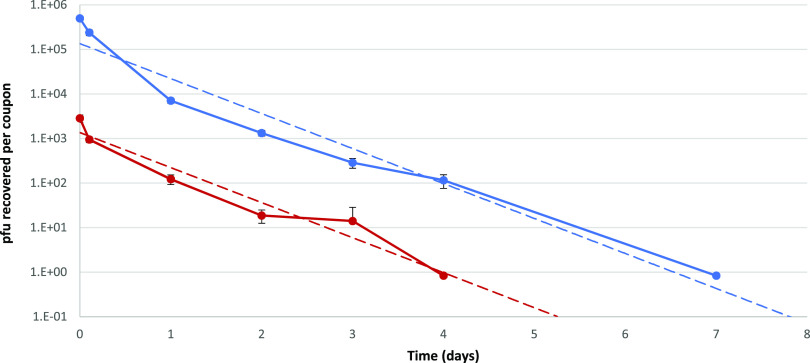
The transmission of SARS-CoV-2 is likely to occur through a number of routes, including contact with contaminated surfaces. Many studies have used reverse transcription-PCR (RT-PCR) analysis to detect SARS-CoV-2 RNA on surfaces, but seldom has viable virus been detected. This paper investigates the viability over time of SARS-CoV-2 dried onto a range of materials and compares viability of the virus to RNA copies recovered and whether virus viability is concentration dependent. Viable virus persisted for the longest time on surgical mask material and stainless steel, with a 99.9% reduction in viability by 122 and 114 h, respectively. Viability of SARS-CoV-2 reduced the fastest on a polyester shirt, with a 99.9% reduction within 2.5 h. Viability on the bank note was reduced second fastest, with 99.9% reduction in 75 h. RNA on all surfaces exhibited a 1-log reduction in genome copy number recovery over 21 days. The findings show that SARS-CoV-2 is most stable on nonporous hydrophobic surfaces. RNA is highly stable when dried on surfaces, with only 1-log reduction in recovery over 3 weeks. In comparison, SARS-CoV-2 viability reduced more rapidly, but this loss in viability was found to be independent of starting concentration. Expected levels of SARS-CoV-2 viable environmental surface contamination would lead to undetectable levels within 2 days. Therefore, when RNA is detected on surfaces, it does not directly indicate the presence of viable virus, even at low cycle threshold values. This study shows the impact of material type on the viability of SARS-CoV-2 on surfaces. It demonstrates that the decay rate of viable SARS-CoV-2 is independent of starting concentration. However, RNA shows high stability on surfaces over extended periods. This has implications for interpretation of surface sampling results using RT-PCR to determine the possibility of viable virus from a surface, where RT-PCR is not an appropriate technique to determine viable virus. Unless sampled immediately after contamination, it is difficult to align RNA copy numbers to quantity of viable virus on a surface.
SARS-CoV-2 的传播途径可能包括接触受污染的表面。许多研究已经使用逆转录聚合酶链反应(RT-PCR)分析来检测表面上的 SARS-CoV-2 RNA,但很少检测到有活力的病毒。本文研究了 SARS-CoV-2 在一系列材料上干燥后的随时间变化的存活能力,并比较了病毒的存活能力与回收的 RNA 拷贝数以及病毒存活能力是否与浓度有关。在外科口罩材料和不锈钢上,病毒存活时间最长,分别在 122 小时和 114 小时后,存活能力降低了 99.9%。在聚酯衬衫上,SARS-CoV-2 的存活能力下降最快,在 2.5 小时内,存活能力降低了 99.9%。纸币上的存活能力次之,在 75 小时内降低了 99.9%。所有表面上的 RNA 在 21 天内基因组拷贝数恢复减少了 1 个对数。研究结果表明,SARS-CoV-2 在非多孔疏水表面上最稳定。当 RNA 在表面上干燥时,其稳定性非常高,在 3 周内仅减少了 1 个对数的回收。相比之下,SARS-CoV-2 的存活能力下降得更快,但这种存活能力的丧失与起始浓度无关。预期水平的 SARS-CoV-2 环境表面污染在 2 天内将无法检测到。因此,当在表面上检测到 RNA 时,即使在低循环阈值值下,也不能直接表明存在有活力的病毒。本研究表明了材料类型对 SARS-CoV-2 在表面上存活能力的影响。它表明,有活力的 SARS-CoV-2 的衰减率与起始浓度无关。然而,RNA 在表面上的稳定性很高,可以持续很长时间。这对使用 RT-PCR 从表面确定有活力的病毒的可能性来解释表面采样结果具有重要意义,在这种情况下,RT-PCR 不是确定有活力病毒的合适技术。除非在污染后立即采样,否则很难将 RNA 拷贝数与表面上有活力的病毒数量对齐。