Erasmus School of Health Policy and Management, Erasmus University Rotterdam, PO Box 1738, 3000 DR, Rotterdam, The Netherlands.
Department of Psychiatry, Erasmus Medical Center, Rotterdam, The Netherlands.
Health Qual Life Outcomes. 2021 Nov 2;19(1):249. doi: 10.1186/s12955-021-01883-w.
The importance of economic evaluations of mental healthcare interventions is increasingly recognized. Despite the multitude of available quality of life instruments, concerns have been raised regarding the content validity of these instruments, and hence suitability for use in mental health. The aim of this paper, therefore, was to assess the content validity and the suitability of existing quality of life instruments for use in economic evaluations in mental health problems.
In order to identify available quality of life instruments used in people with mental health problems, a systematic review was performed using the Embase, Medline and PsycINFO databases (time period January 2012 to January 2018). Two reviewers independently assessed study eligibility and executed data extraction. The evaluation framework of Connell and colleagues was used to assess whether the identified quality of life instruments cover the dimensions valued highly by people with mental health problems. Two reviewers independently mapped the content of each identified instrument onto the evaluation framework and indicated the extent to which the instrument covered each of the dimensions of the evaluation framework.
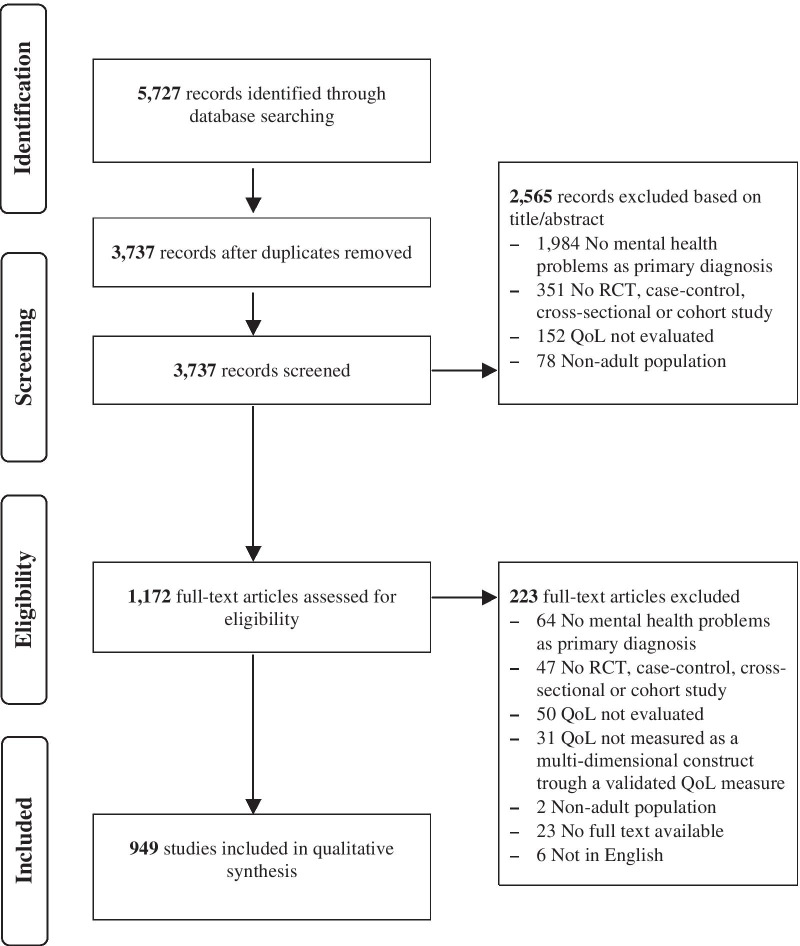
Searches of databases yielded a total of 5727 references. Following duplicate removal and double-independent screening, 949 studies were included in the qualitative synthesis. A total of 44 unique quality of life instruments were identified, of which 12 were adapted versions of original instruments. The best coverage of the dimensions of the evaluation framework of Connell and colleagues was by the WHOQOL-100, S-QoL, SQLS, EDQoL, QLI and the IMHQOL, but none fully covered all dimensions of the evaluation framework.
The results of this study highlight the multitude of available quality of life instruments used in people with mental health problems and indicate that none of the available quality of life instruments fully cover the dimensions previously found to be important in people with mental health problems. Future research should explore the possibilities of refining or expanding existing instruments as well as the development and testing of new quality of life instruments to ensure that all relevant quality of life dimensions for people with mental health problems are covered in evaluations.
精神卫生保健干预措施的经济评估的重要性日益受到重视。尽管有许多可用的生活质量工具,但人们对这些工具的内容效度提出了担忧,因此对其在精神卫生中的适用性提出了质疑。因此,本文的目的是评估现有的生活质量工具在精神卫生问题的经济评估中的内容效度和适用性。
为了确定用于精神健康问题人群的现有生活质量工具,我们使用 Embase、Medline 和 PsycINFO 数据库进行了系统综述(时间范围为 2012 年 1 月至 2018 年 1 月)。两名审查员独立评估研究的合格性并执行数据提取。Connell 及其同事的评估框架用于评估所确定的生活质量工具是否涵盖精神健康问题人群高度重视的维度。两名审查员独立地将每个确定的工具的内容映射到评估框架上,并指出该工具涵盖评估框架的每个维度的程度。
数据库检索共产生了 5727 条参考文献。经过重复去除和双重独立筛选,949 项研究被纳入定性综合分析。共确定了 44 种独特的生活质量工具,其中 12 种是原始工具的改编版本。Connell 及其同事的评估框架的维度得到最佳覆盖的是 WHOQOL-100、S-QoL、SQLS、EDQoL、QLI 和 IMHQOL,但没有一种工具完全涵盖评估框架的所有维度。
本研究的结果突出了用于精神健康问题人群的大量现有生活质量工具,并表明现有的生活质量工具中没有一种完全涵盖先前在精神健康问题人群中发现的重要维度。未来的研究应探索改进或扩展现有工具以及开发和测试新的生活质量工具的可能性,以确保评估涵盖所有与精神健康问题人群相关的生活质量维度。