Ehrlich Rodney, Barker Stephen, Tsang Vivian W L, Kistnasamy Barry, Yassi Annalee
Faculty of Health Sciences, School of Public Health and Family Medicine, University of Cape Town, South Africa.
School of Population and Public Health, Vancouver, Canada.
J Migr Health. 2021 Oct 6;4:100065. doi: 10.1016/j.jmh.2021.100065. eCollection 2021.
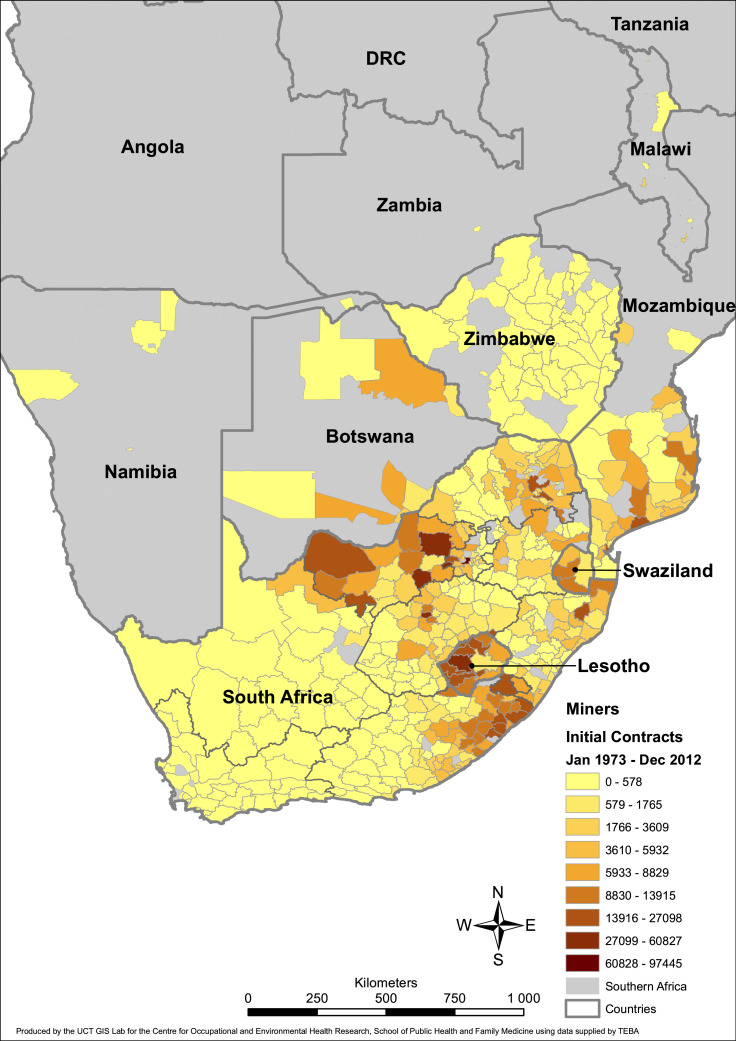
A legacy of the South African gold mining industry, now in decline, is a large burden of silicosis and tuberculosis among former migrant miners from rural South Africa and surrounding countries, particularly Lesotho and Mozambique. This neglected population faces significant barriers in filing claims for compensation for occupational lung disease. The objective of the study was to gain insight into the extent of such barriers, particularly for former miners and cross-border migrants.
The database of a large gold mining company and the statutory compensation authority were analyzed for the period 1973-2018 by country of origin, age, and employment status at the time of claim filing. Proportions and odds ratios (ORs) for each of the compensable diseases were calculated by the above variables. Processing delays of claims were also calculated.
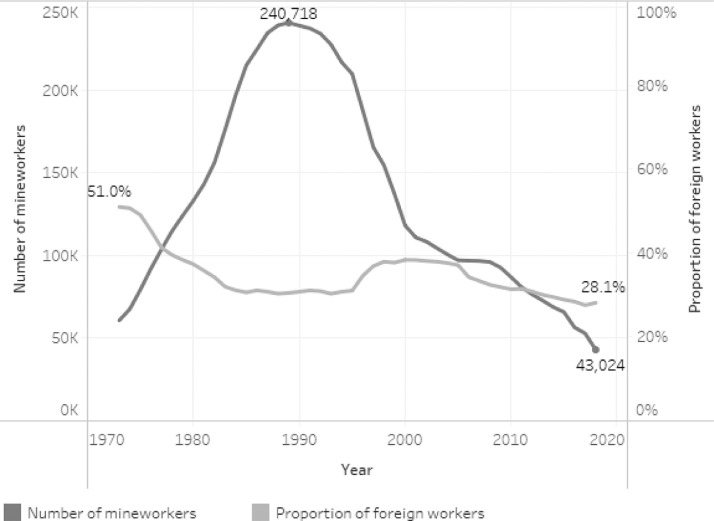
Annual company employment declined from 240,718 in 1989 to 43,024 in 2018 and the proportion of cross-border migrants within the workforce from 51.0 to 28.1%. The compensation database contained 68,612 claims. The majority of compensable claims in all diagnostic categories were from active miners. The odds of cross-border miners relative to South African miners filing a claim depended on employment status. For example, the OR for Lesotho miners filing while in active employment was 1.86 (95% CI 1.81, 1.91), falling to 0.94 (95% CI 0.91, 0.98) among former miners. The equivalent findings for Mozambiquan miners were 0.95 (95% CI 0.91, 1.00), falling to 0.44 (95% CI 0.41, 0.47). Median processing delays over the whole period were from 1.1 years from filing to adjudication, and 3.8 years from filing to payment.
The findings provide a quantitative view of differential access to occupational lung disease compensation, including long processing delays, among groups of migrant miners from the South African gold mines. There is a deficit of compensable claims for silicosis and silico-tuberculosis among former miners irrespective of country of origin. While cross-border miner groups appear to file more claims while active, this is reversed once they leave employment. Current large-scale efforts to provide medical examinations and compensation justice to this migrant miner population need political and public support and scrutiny of progress.
南非金矿开采业如今已走向衰落,其遗留问题是,来自南非农村及周边国家(尤其是莱索托和莫桑比克)的前流动矿工中,矽肺病和肺结核负担沉重。这一被忽视的群体在申请职业性肺病赔偿时面临重大障碍。本研究的目的是深入了解此类障碍的程度,尤其是针对前矿工和跨境移民。
对一家大型金矿公司的数据库以及法定赔偿机构在1973 - 2018年期间的数据,按原籍国、年龄和索赔时的就业状况进行分析。通过上述变量计算每种可赔偿疾病的比例和比值比(OR)。还计算了索赔的处理延迟时间。
公司年度就业人数从1989年的240,718人降至2018年的43,024人,劳动力中跨境移民的比例从51.0%降至28.1%。赔偿数据库包含68,612份索赔申请。所有诊断类别的可赔偿索赔中,大多数来自在职矿工。跨境矿工相对于南非矿工提出索赔的几率取决于就业状况。例如,莱索托在职矿工提出索赔的OR为1.86(95%可信区间1.81, 1.91),在前矿工中降至0.94(95%可信区间0.91, 0.98)。莫桑比克矿工的相应结果为0.95(95%可信区间为0.91, 1.00),在前矿工中降至0.44(95%可信区间0.41, 0.47)。整个期间索赔处理的中位延迟时间为从提交到裁决需1.1年,从提交到付款需3.8年。
研究结果提供了一个定量视角,展示了南非金矿的流动矿工群体在获得职业性肺病赔偿方面的差异,包括处理延迟时间长。无论原籍国如何,前矿工中矽肺病和矽肺合并结核的可赔偿索赔存在不足。虽然跨境矿工群体在职时似乎提出的索赔更多,但一旦离职情况就相反。当前为这一流动矿工群体提供医学检查和赔偿公正的大规模努力需要政治和公众的支持以及对进展情况的审查。