Department of Epidemiology and Biostatistics School of Public Health Imperial College London London United Kingdom.
Research Unit of Mathematical Sciences University of Oulu Finland.
J Am Heart Assoc. 2021 Nov 16;10(22):e022277. doi: 10.1161/JAHA.121.022277. Epub 2021 Nov 3.
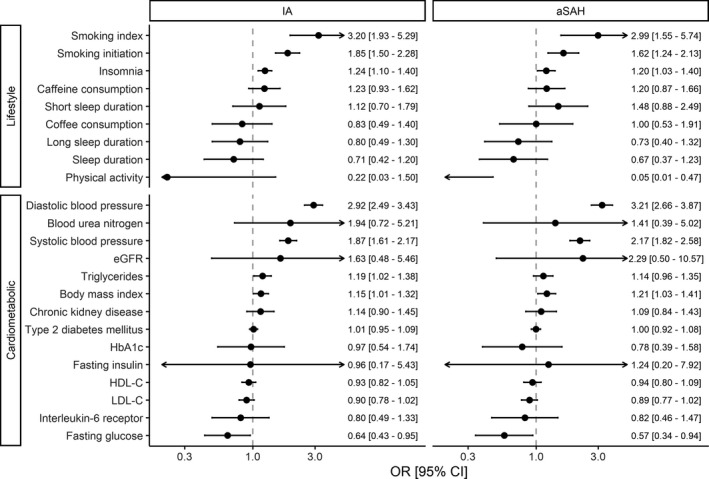
Background The aim of this study was to assess the associations of modifiable lifestyle factors (smoking, coffee consumption, sleep, and physical activity) and cardiometabolic factors (body mass index, glycemic traits, type 2 diabetes, systolic and diastolic blood pressure, lipids, and inflammation and kidney function markers) with risks of any (ruptured or unruptured) intracranial aneurysm and aneurysmal subarachnoid hemorrhage using Mendelian randomization. Methods and Results Summary statistical data for the genetic associations with the modifiable risk factors and the outcomes were obtained from meta-analyses of genome-wide association studies. The inverse-variance weighted method was used as the main Mendelian randomization analysis, with additional sensitivity analyses conducted using methods more robust to horizontal pleiotropy. Genetic predisposition to smoking, insomnia, and higher blood pressure was associated with an increased risk of both intracranial aneurysm and aneurysmal subarachnoid hemorrhage. For intracranial aneurysm, the odds ratios were 3.20 (95% CI, 1.93-5.29) per SD increase in smoking index, 1.24 (95% CI, 1.10-1.40) per unit increase in log-odds of insomnia, and 2.92 (95% CI, 2.49-3.43) per 10 mm Hg increase in diastolic blood pressure. In addition, there was weak evidence for associations of genetically predicted decreased physical activity, higher triglyceride levels, higher body mass index, and lower low-density lipoprotein cholesterol levels with higher risk of intracranial aneurysm and aneurysmal subarachnoid hemorrhage, with 95% CI overlapping the null for at least 1 of the outcomes. All results were consistent in sensitivity analyses. Conclusions This Mendelian randomization study suggests that smoking, insomnia, and high blood pressure are major risk factors for intracranial aneurysm and aneurysmal subarachnoid hemorrhage.
本研究旨在评估可改变的生活方式因素(吸烟、咖啡饮用、睡眠和体力活动)和心血管代谢因素(体重指数、血糖特征、2 型糖尿病、收缩压和舒张压、血脂以及炎症和肾功能标志物)与任何(破裂或未破裂)颅内动脉瘤和蛛网膜下腔出血风险之间的关联,使用孟德尔随机化方法。
从全基因组关联研究的荟萃分析中获得了与可改变的风险因素和结局相关的遗传关联的汇总统计数据。使用逆方差加权法作为主要的孟德尔随机化分析,并用更能抵抗水平多效性的方法进行额外的敏感性分析。遗传易感性与吸烟、失眠和更高的血压与颅内动脉瘤和蛛网膜下腔出血的风险增加相关。对于颅内动脉瘤,吸烟指数每增加 1 个标准差,优势比为 3.20(95%CI,1.93-5.29);对数odds 增加 1 个单位的失眠,优势比为 1.24(95%CI,1.10-1.40);舒张压每增加 10mmHg,优势比为 2.92(95%CI,2.49-3.43)。此外,遗传预测的体力活动减少、甘油三酯水平升高、体重指数升高和低密度脂蛋白胆固醇水平降低与颅内动脉瘤和蛛网膜下腔出血风险升高之间存在微弱的关联,至少有 1 个结局的 95%CI 与零重叠。所有结果在敏感性分析中均一致。
本孟德尔随机化研究表明,吸烟、失眠和高血压是颅内动脉瘤和蛛网膜下腔出血的主要危险因素。