
人类血液代谢物与颅内动脉瘤及动脉瘤性蛛网膜下腔出血之间的因果关系:一项孟德尔随机化研究。
Causal relationships between human blood metabolites and intracranial aneurysm and aneurysmal subarachnoid hemorrhage: a Mendelian randomization study.
作者信息
Jiang Jia, Gui Siming, Wei Dachao, Chen Xiheng, Tang Yudi, Lv Jian, You Wei, Chen Ting, Yang Shu, Ge Huijian, Li Youxiang
机构信息
Department of Neurosurgery, Beijing Neurosurgical Institute and Beijing Tiantan Hospital, Capital Medical University, Beijing, China.
Department of Neurosurgery, Beijing Chaoyang Hospital, Capital Medical University, Beijing, China.
出版信息
Front Neurol. 2023 Dec 14;14:1268138. doi: 10.3389/fneur.2023.1268138. eCollection 2023.
OBJECTIVE
The aim of this study was to assess the causal relationships between blood metabolites and intracranial aneurysm, aneurysmal subarachnoid hemorrhage, and unruptured intracranial aneurysm.
METHODS
Our exposure sample consisted of 7,824 individuals from a genome-wide association study of human blood metabolites. Our outcome sample consisted of 79,429 individuals (7,495 cases and 71,934 controls) from the International Stroke Genetics Consortium, which conducted a genome-wide association study of intracranial aneurysm, aneurysmal subarachnoid hemorrhage, and unruptured intracranial aneurysm. We identified blood metabolites with a potential causal effect on intracranial aneurysms and conducted sensitivity analyses to validate our findings.
RESULTS
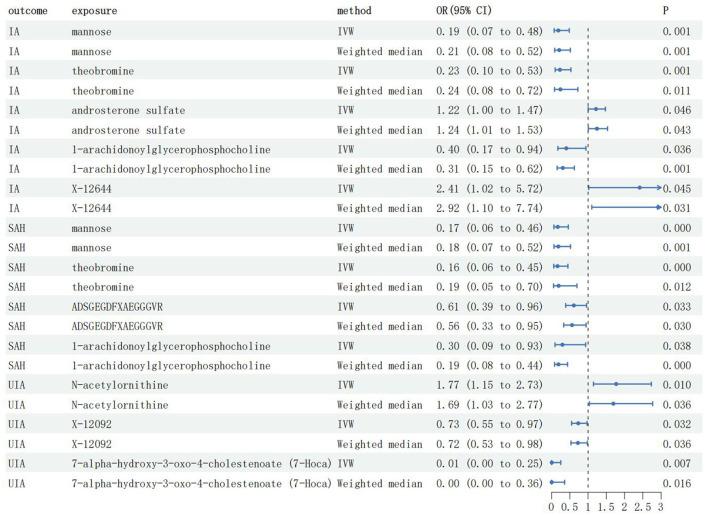
After rigorous screening and Mendelian randomization tests, we found four, two, and three serum metabolites causally associated with intracranial aneurysm, aneurysmal subarachnoid hemorrhage, and unruptured intracranial aneurysm, respectively (all < 0.05). Sensitivity analyses confirmed the robustness of these associations.
CONCLUSIONS
Our Mendelian randomization analysis demonstrated causal relationships between human blood metabolites and intracranial aneurysm, aneurysmal subarachnoid hemorrhage, and unruptured intracranial aneurysm. Further research is required to explore the potential of targeting these metabolites in the management of intracranial aneurysm.
目的
本研究旨在评估血液代谢物与颅内动脉瘤、动脉瘤性蛛网膜下腔出血及未破裂颅内动脉瘤之间的因果关系。
方法
我们的暴露样本包括来自一项人类血液代谢物全基因组关联研究的7824名个体。我们的结局样本包括来自国际卒中遗传学联盟的79429名个体(7495例病例和71934例对照),该联盟对颅内动脉瘤、动脉瘤性蛛网膜下腔出血及未破裂颅内动脉瘤进行了全基因组关联研究。我们确定了对颅内动脉瘤有潜在因果效应的血液代谢物,并进行了敏感性分析以验证我们的发现。
结果
经过严格筛选和孟德尔随机化检验,我们分别发现了四种、两种和三种与颅内动脉瘤、动脉瘤性蛛网膜下腔出血及未破裂颅内动脉瘤有因果关联的血清代谢物(均P<0.05)。敏感性分析证实了这些关联的稳健性。
结论
我们的孟德尔随机化分析证明了人类血液代谢物与颅内动脉瘤、动脉瘤性蛛网膜下腔出血及未破裂颅内动脉瘤之间的因果关系。需要进一步研究以探索靶向这些代谢物在颅内动脉瘤管理中的潜力。

 Zotero 插件