Barbosa Ana, Brito João, Figueiredo Pedro, Seabra André, Mendes Romeu
EPIUnit - Instituto de Saúde Pública, Universidade do Porto, Porto, Portugal.
Portugal Football School, Portuguese Football Federation, Oeiras, Portugal.
JMIR Res Protoc. 2021 Nov 3;10(11):e28554. doi: 10.2196/28554.
Studies on walking football have found positive effects on health; however, there are still several research gaps when applying walking football programs for patients with type 2 diabetes.
This study aims to test the effectiveness of a walking football exercise program on glycemic control and cardiovascular risk factors in middle-aged and older men with type 2 diabetes.
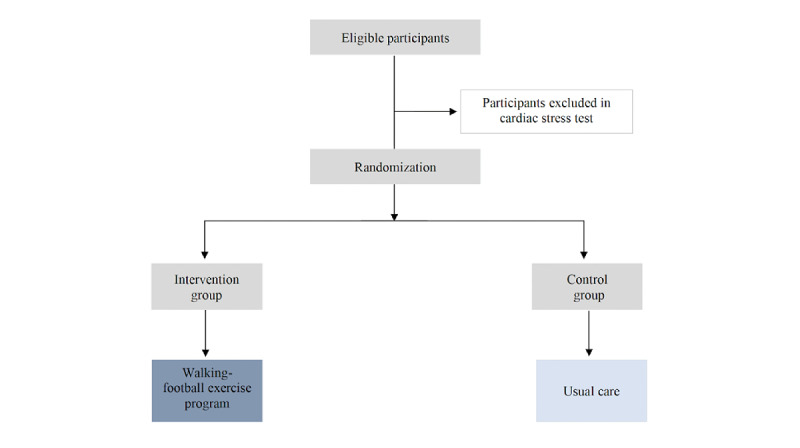
The study will be run as a randomized controlled trial with a 6-month duration in Portugal. Eligible participants will be randomized using a 1:1 ratio for intervention or control groups and compared using an intention-to-treat analysis. The intervention will consist of a walking football exercise program. The control group will continue with usual care in primary health care units. The primary outcome will be the mean difference in glycated hemoglobin between intervention and control groups after 6 months. Secondary outcomes include the mean differences in fasting blood glucose, total cholesterol, low-density lipoprotein cholesterol, high-density lipoprotein cholesterol, triglycerides, systolic and diastolic blood pressure, body mass index, waist circumference, fat-free mass, and fat mass. Additionally, secondary outcomes include the incidence of exercise-related injuries and adverse events and the walking football exercise program's cost-utility.
The study protocol is being prepared to be submitted to the Health Ethics Committee of the Northern Regional Health Administration, Portugal. After approval, participant recruitment will start in primary health care units in Porto's metropolitan area by family medicine doctors.
Walking football might have the potential to be effective in improving glycemic control and cardiovascular risk factors, with a low rate of exercise-related injuries and adverse events and a good cost-utility ratio. Therefore, walking football may be a sustainable intervention strategy for type 2 diabetes management.
INTERNATIONAL REGISTERED REPORT IDENTIFIER (IRRID): PRR1-10.2196/28554.
关于步行足球的研究已发现其对健康有积极影响;然而,在将步行足球项目应用于2型糖尿病患者时仍存在若干研究空白。
本研究旨在测试步行足球锻炼项目对中年及老年2型糖尿病男性患者血糖控制和心血管危险因素的效果。
该研究将在葡萄牙作为一项为期6个月的随机对照试验开展。符合条件的参与者将以1:1的比例随机分为干预组或对照组,并采用意向性分析进行比较。干预将包括一个步行足球锻炼项目。对照组将继续在初级卫生保健单位接受常规护理。主要结局将是6个月后干预组和对照组之间糖化血红蛋白的平均差异。次要结局包括空腹血糖、总胆固醇、低密度脂蛋白胆固醇、高密度脂蛋白胆固醇、甘油三酯、收缩压和舒张压、体重指数、腰围、去脂体重和脂肪量的平均差异。此外,次要结局还包括与运动相关的损伤和不良事件的发生率以及步行足球锻炼项目的成本效益。
研究方案正在准备提交给葡萄牙北部地区卫生管理局的健康伦理委员会。获批后,波尔图大都市区的初级卫生保健单位将由家庭医生开始招募参与者。
步行足球可能有潜力有效改善血糖控制和心血管危险因素,运动相关损伤和不良事件发生率低,成本效益比良好。因此,步行足球可能是2型糖尿病管理的一种可持续干预策略。
国际注册报告识别号(IRRID):PRR1-10.2196/28554