Amarela Lukić-Grlić, Department of Laboratory Diagnostics, Laboratory of Clinical Microbiology, Zagreb Children's Hospital, Klaićeva 16, 10000 Zagreb, Croatia,
Croat Med J. 2021 Oct 31;62(5):495-503. doi: 10.3325/cmj.2021.62.495.
To investigate whether three-month oral vitamin D supplementation (800 IU in drops) reduces the risk of influenza infection in elderly nursing home residents vaccinated against influenza.
This cross-sectional observational study enrolled 97 participants (73.2% women) who received one dose of seasonal trivalent 2016-2017 influenza vaccine. The patients were randomized into an experimental group, which received vitamin D supplementation for three months starting on the day of vaccination, and a control group, which did not receive vitamin D supplementation. The primary outcome was the number of influenza infections laboratory-confirmed using a rapid point-of-care test based on nasal swabs collected during vitamin D supplementation. The secondary outcome was serum 25-hydroxyvitamin D level at the end of the study.
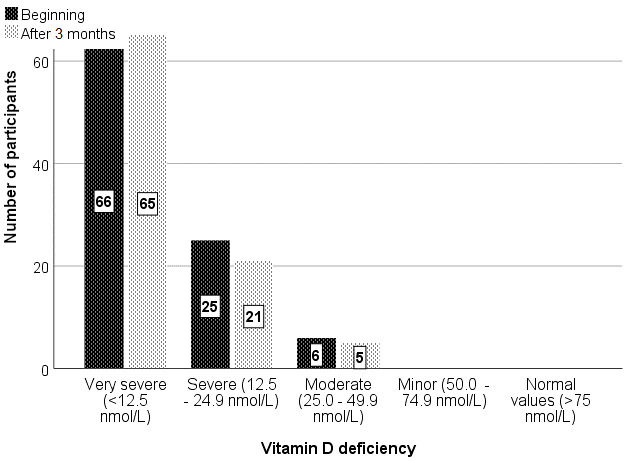
The mean age ±standard deviation was 78.5± 8.8 years. All participants had vitamin D deficiency at baseline. Twenty-three participants who developed signs of respiratory infections during the study were tested for influenza virus. Although the number of influenza-positive participants was lower in the group receiving vitamin D supplementation as compared with the control group (5 vs 12), this difference was not significant. Vitamin D supplementation failed to increase 25(OH)D levels after three months of supplementation.
Elderly nursing home residents in Zagreb County have a significant vitamin D deficiency. The recommended national supplementation of 800 IU daily failed to lead to vitamin D sufficiency and did not reduce the risk of influenza infection among the vaccinated elderly.
探讨在接种流感疫苗的老年疗养院居民中,口服补充三个月维生素 D(滴剂 800IU)是否能降低流感感染风险。
本横断面观察性研究纳入了 97 名参与者(73.2%为女性),他们均接受了一剂 2016-2017 年季节性三价流感疫苗。患者被随机分为实验组和对照组,实验组在接种疫苗当天开始口服补充维生素 D 三个月,对照组不补充维生素 D。主要结局是通过基于鼻拭子的快速即时检测(POCT)检测到的实验室确诊流感感染人数。次要结局是研究结束时的血清 25-羟维生素 D 水平。
参与者的平均年龄为 78.5±8.8 岁。所有参与者在基线时均有维生素 D 缺乏。在研究期间出现呼吸道感染迹象的 23 名参与者检测了流感病毒。尽管补充维生素 D 组的流感阳性参与者人数(5 名)少于对照组(12 名),但差异无统计学意义。补充三个月后,维生素 D 补充未能增加 25(OH)D 水平。
萨格勒布县的老年疗养院居民存在严重的维生素 D 缺乏。建议的每日 800IU 国家补充量未能使维生素 D 充足,也未能降低接种疫苗的老年人流感感染风险。