Department of Health Management, Navy military medical university, Shanghai, China.
Medical Department, Shanghai Changzheng Hospital, Shanghai, China.
BMC Geriatr. 2021 Nov 3;21(1):626. doi: 10.1186/s12877-021-02590-3.
This study aimed to explore the association between diabetes mellitus and health-related quality of life (HRQoL) of older people in Shanghai, China, especially regarding the differences in each aspect of the EQ-5D and how large the score gaps are between older people with and without diabetes.
A total of 11,103 people of either sex older than 60 years were enrolled from 17 districts of Shanghai. The EQ-5D-3L was used to assess the HRQoL of older people. The Wilcoxon rank sum test and t-test were used to compare the difference in HRQoL between people with or without diabetes. After univariate regression, multiple linear regression and ordinal logistic regression were conducted to evaluate the influence of diabetes mellitus and other confounding variables on the EQ VAS scores and on the five dimensions of the EQ-5D.
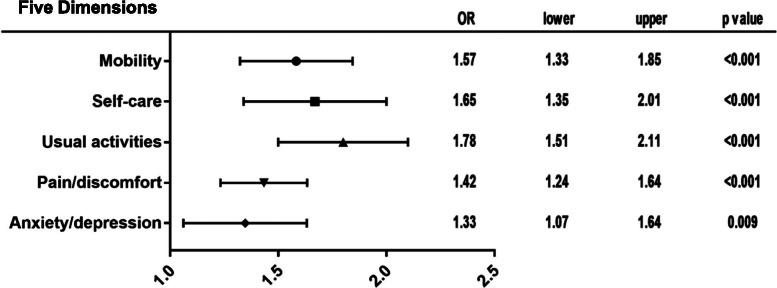
Twelve percent of all participants had diabetes mellitus, and the proportion was almost the same between men and women. The EQ VAS scores of people with diabetes mellitus were approximately 3.70 points lower than those of people without diabetes (95% CI = -4.40, -2.99, p < 0.001) after adjusting for confounding variables. People with diabetes mellitus had increased problems with mobility (OR = 1.57, 95% CI = 1.33, 1.85), self-care (OR = 1.65, 95% CI = 1.35, 2.01), usual activities (OR = 1.78, 95% CI = 1.51, 2.11), pain/discomfort (OR = 1.42, 95% CI = 1.24, 1.64), and anxiety/depression (OR = 1.33, 95% CI = 1.07, 1.64).
This study showed that diabetes mellitus was associated with the HRQoL of older people and that older people with diabetes had poorer performance in every aspect of EQ-5D measurements.
本研究旨在探讨中国上海老年人糖尿病与健康相关生活质量(HRQoL)之间的关系,特别是在 EQ-5D 的各个方面的差异,以及患有和不患有糖尿病的老年人之间的评分差距有多大。
共纳入上海市 17 个区的 11103 名 60 岁以上的男女老年人。采用 EQ-5D-3L 评估老年人的 HRQoL。采用 Wilcoxon 秩和检验和 t 检验比较有和无糖尿病老年人之间 HRQoL 的差异。进行单因素回归、多元线性回归和有序逻辑回归,以评估糖尿病和其他混杂因素对 EQ VAS 评分和 EQ-5D 五个维度的影响。
所有参与者中,有 12%患有糖尿病,且男女比例几乎相同。在调整混杂因素后,患有糖尿病的老年人的 EQ VAS 评分比无糖尿病的老年人低约 3.70 分(95%CI:-4.40,-2.99,p<0.001)。患有糖尿病的老年人在移动(OR=1.57,95%CI:1.33,1.85)、自理(OR=1.65,95%CI:1.35,2.01)、日常活动(OR=1.78,95%CI:1.51,2.11)、疼痛/不适(OR=1.42,95%CI:1.24,1.64)和焦虑/抑郁(OR=1.33,95%CI:1.07,1.64)方面存在更多问题。
本研究表明,糖尿病与老年人的 HRQoL 相关,患有糖尿病的老年人在 EQ-5D 测量的各个方面表现更差。