University of Guam, School of Health, University Drive, Mangilao, GU, 96923, USA.
University of Guam, College of Natural & Applied Sciences, Biology Program, University Drive, Mangilao, GU, 96923, USA.
BMC Public Health. 2021 Nov 3;21(1):1994. doi: 10.1186/s12889-021-12078-9.
The non-communicable disease (NCD) epidemic among Pacific Islanders prompted the declaration of a regional state of NCD emergency throughout the United States-Affiliated Pacific Islands (USAPIs) in 2010. Subsequently, the University of Guam Health Science Program launched a pilot study on NCD research in its undergraduate curriculum modeled after the Pacific Data for Decision Making (DDM) framework - a field epidemiology training program employed in the USAPIs. The primary objective of the research is to conduct annual assessments of student health indicators with plans for longitudinal follow-up. Here, development and evaluation of the undergraduate research curriculum are described.
The Pacific DDM framework covering knowledge and skills in resourcing, types of data and indicators, data sources, data management, information products, and data dissemination and use were incorporated in undergraduate core courses of the Health Science Program. During the data collection pilot years, 2013 and 2014, a survey containing questions predominantly on NCD risk factors was launched at the university. The survey was administered by upperclassmen in the Health Science Program and evolved into the Pacific Islands Cohort of College Students (PICCS) research study. The initial years were spent developing the infrastructure. Program outputs were tracked annually to measure program success.
Students in the Health Science Program obtained research knowledge and skills through various courses while enrolled in the program. The PICCS data collection continued annually as a cross-sectional survey from 2015 to current. Numerous successes have resulted including student abstracts and publications, acceptances to summer programs and fellowships, a sustained annual health fair for college students, a grant award, and other program-related impacts.
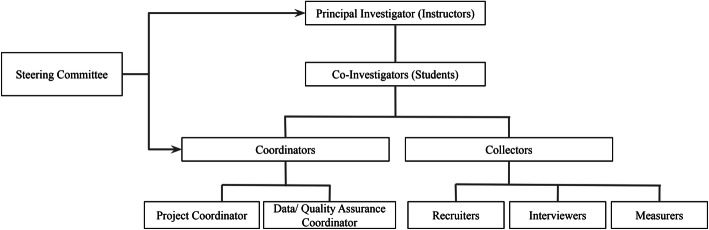
The PICCS framework provided the organizational structure and documented tools, protocols, roles, and responsibilities to enhance consistency and reproducibility. Undergraduate students applied their knowledge and skills to an ongoing study focused on NCD risk factor surveillance of college students. Additionally, multiple research successes have been achieved through the PICCS curriculum. Plans are underway to begin the longitudinal design of the PICCS research study and sustain it through the curriculum, with room for adaptation as courses are updated over time.
太平洋岛民中的非传染性疾病(NCD)疫情促使 2010 年在美国附属太平洋群岛(USAPIs)范围内宣布 NCD 紧急状态。随后,关岛大学健康科学项目启动了一项 NCD 研究试点计划,该计划以太平洋数据决策(DDM)框架为蓝本,该框架是在 USAPIs 中采用的现场流行病学培训计划。该研究的主要目的是对学生的健康指标进行年度评估,并计划进行纵向随访。在此,描述了本科研究课程的开发和评估。
将涵盖资源、数据和指标类型、数据源、数据管理、信息产品以及数据传播和使用方面知识和技能的太平洋 DDM 框架纳入健康科学计划的本科核心课程中。在数据收集试点年(2013 年和 2014 年),在大学开展了一项包含 NCD 风险因素主要问题的调查。该调查由健康科学计划中的高年级学生管理,并演变为太平洋岛屿大学生队列(PICCS)研究。最初几年用于开发基础设施。每年跟踪计划产出以衡量计划成功情况。
健康科学计划的学生通过各种课程获得了研究知识和技能。PICCS 数据收集从 2015 年至今一直持续进行,作为一项横断面调查。取得了许多成功,包括学生摘要和出版物、暑期项目和奖学金的录取、为大学生举办的年度健康博览会、获得赠款以及其他与计划相关的影响。
PICCS 框架提供了组织结构和记录工具、协议、角色和职责,以增强一致性和可重复性。本科学生将他们的知识和技能应用于一项针对大学生 NCD 风险因素监测的正在进行的研究中。此外,通过 PICCS 课程取得了多项研究成功。计划开始启动 PICCS 研究的纵向设计,并通过课程维持该研究,随着课程的更新,为适应课程留出空间。