Agrawal Adesh Kumar, Gowda Mahesh, Achary Umesh, Gowda Guru S, Harbishettar Vijaykumar
National Institute of Mental Health and Neurosciences, Bengaluru, Karnataka, India.
Spandana Nursing Home (Postgraduate Institute, DNB Psychiatry), Bengaluru, Karnataka, India.
Indian J Psychol Med. 2021 Sep;43(5 Suppl):S53-S59. doi: 10.1177/02537176211030979. Epub 2021 Sep 21.
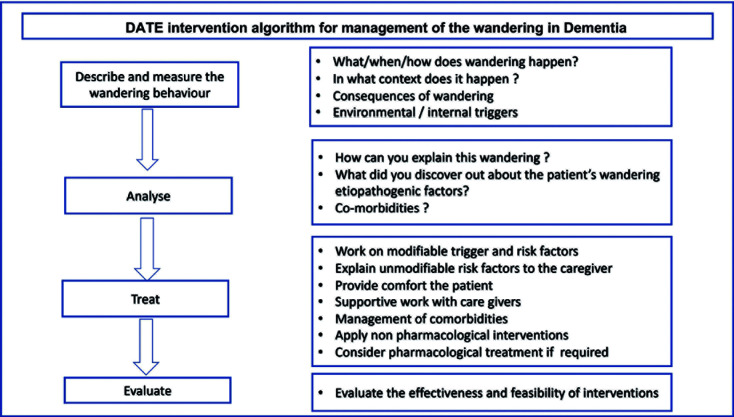
Wandering behavior is one of the most important and challenging management aspects in persons with dementia. Wandering behavior in people with dementia (PwD) is associated with an increased risk of falls, injuries, and fractures, as well as going missing or being lost from a facility. This causes increased distress in caregivers at home and in healthcare facilities. The approach to the comprehensive evaluation of the risk assessment, prevention, and treatment needs more strengthening and effective measures as the prevalence of wandering remains high in the community. Both the caregiver and clinicians need a clear understanding and responsibility of ethical and legal issues while managing and restraining the PwD. Ethical and legal issues especially in the light of the new Indian Mental Healthcare Act of 2017, related to confinement by family members in their homes by family caregivers, seclusion, physical or chemical restraints, other pharmacological and behavioral treatment, highlighting their effectiveness as well as adverse consequences are discussed. This article attempts to address an approach in managing wandering behavior in PwD in light of MHCA, 2017.
徘徊行为是痴呆症患者管理中最重要且最具挑战性的方面之一。痴呆症患者的徘徊行为与跌倒、受伤和骨折风险增加相关,还与从机构走失或迷路有关。这会导致家庭和医疗机构中的照料者更加苦恼。由于社区中徘徊行为的患病率仍然很高,对风险评估、预防和治疗进行综合评估的方法需要进一步加强并采取有效措施。在管理和约束痴呆症患者时,照料者和临床医生都需要清楚地了解并负责伦理和法律问题。本文讨论了伦理和法律问题,特别是根据2017年新的印度精神卫生保健法,涉及家庭照料者将家庭成员限制在家中、隔离、身体或化学约束、其他药物和行为治疗,强调了它们的有效性以及不良后果。本文试图根据2017年《精神卫生保健法》探讨一种管理痴呆症患者徘徊行为的方法。