Barazi Nour, Polidovitch Nazari, Debi Ryan, Yakobov Simona, Lakin Robert, Backx Peter H
Department of Biology, York University, Toronto, ON, Canada.
Front Physiol. 2021 Oct 18;12:692247. doi: 10.3389/fphys.2021.692247. eCollection 2021.
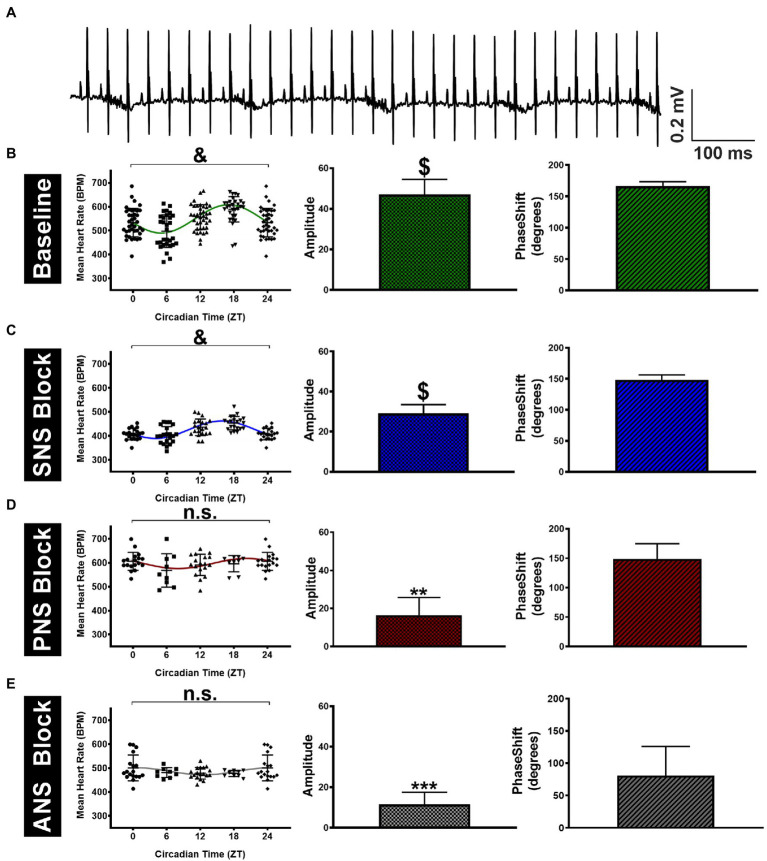
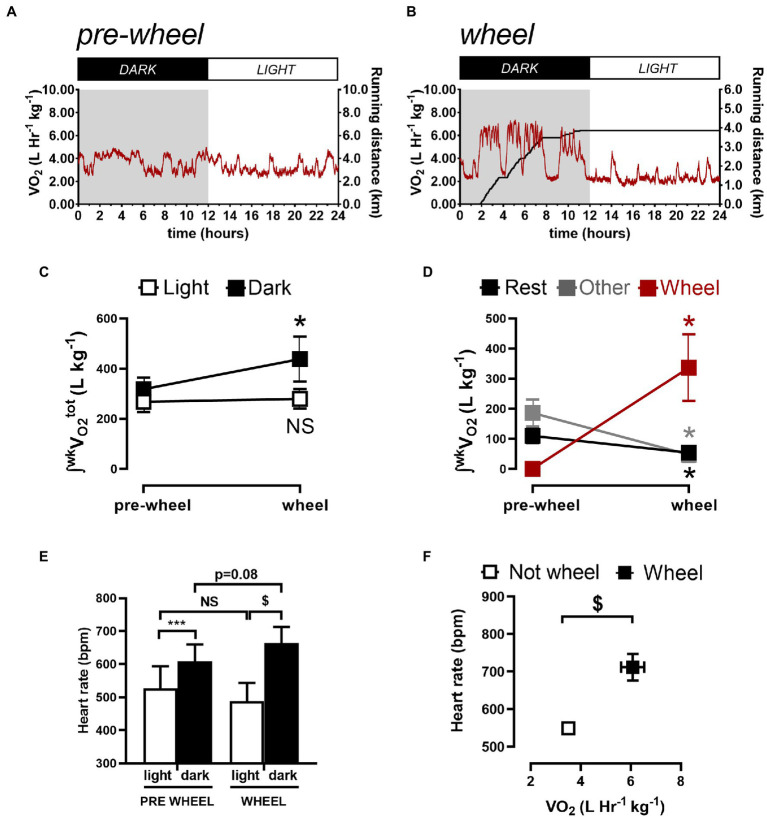
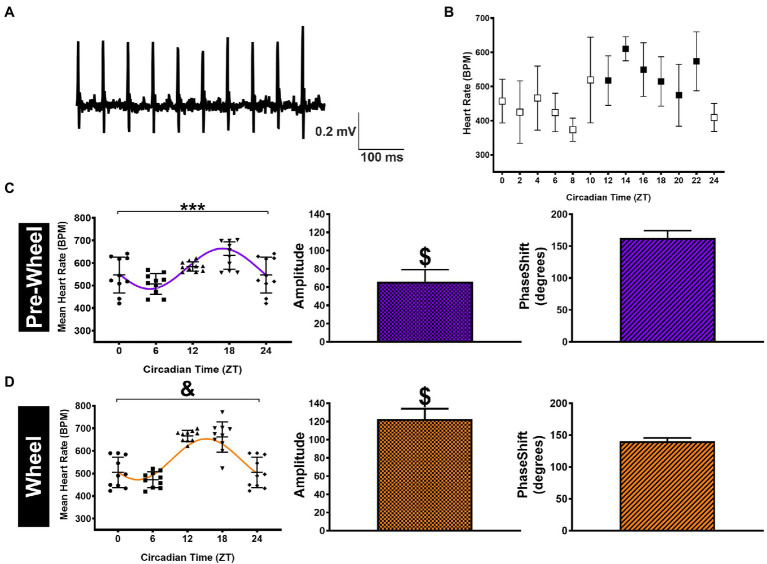
Heart rate (HR) and blood pressure as well as adverse cardiovascular events show clear circadian patterns, which are linked to interdependent daily variations in physical activity and cardiac autonomic nerve system (ANS) activity. We set out to assess the relative contributions of the ANS (alone) and physical activity to circadian HR fluctuations. To do so, we measured HR (beats per minute, bpm) in mice that were either immobilized using isoflurane anesthesia or free-moving. Nonlinear fits of HR data to sine functions revealed that anesthetized mice display brisk circadian HR fluctuations with amplitudes of 47.1±7.4bpm with the highest HRs in middle of the dark (active) period (ZT 18: 589±46bpm) and lowest HRs in the middle of the light (rest) period (ZT 6: 497±54bpm). The circadian HR fluctuations were reduced by ~70% following blockade of cardiac parasympathetic nervous activity (PNA) with atropine while declining by <15% following cardiac sympathetic nerve activity (SNA) blockade with propranolol. Small HR fluctuation amplitudes (11.6±5.9bpm) remained after complete cardiac ANS blockade. Remarkably, circadian HR fluctuation amplitudes in freely moving, telemetrized mice were only ~32% larger than in anesthetized mice. However, after gaining access to running wheels for 1week, circadian HR fluctuations increase to 102.9±12.1bpm and this is linked directly to increased O consumption during running. We conclude that, independent of physical activity, the ANS is a major determinant of circadian HR variations with PNA playing a dominant role compared to SNA. The effects of physical activity to the daily HR variations are remarkably small unless mice get access to running wheels.
心率(HR)、血压以及不良心血管事件呈现出明显的昼夜节律模式,这与身体活动和心脏自主神经系统(ANS)活动中相互依存的每日变化有关。我们着手评估ANS(单独作用)和身体活动对昼夜HR波动的相对贡献。为此,我们在使用异氟烷麻醉固定或自由活动的小鼠中测量了HR(每分钟心跳次数,bpm)。将HR数据与正弦函数进行非线性拟合后发现,麻醉小鼠表现出明显的昼夜HR波动,振幅为47.1±7.4bpm,在黑暗(活动)期中间(ZT 18:589±46bpm)时HR最高,在光照(休息)期中间(ZT 6:497±54bpm)时HR最低。在用阿托品阻断心脏副交感神经活动(PNA)后,昼夜HR波动减少了约70%,而在用普萘洛尔阻断心脏交感神经活动(SNA)后,昼夜HR波动下降幅度小于15%。在完全阻断心脏ANS后,仍存在小幅度的HR波动(11.6±5.9bpm)。值得注意的是,自由活动、植入遥测设备的小鼠的昼夜HR波动幅度仅比麻醉小鼠大~32%。然而,在能够使用转轮1周后,昼夜HR波动增加到102.9±12.1bpm,这直接与跑步期间氧气消耗量增加有关。我们得出结论,与身体活动无关,ANS是昼夜HR变化的主要决定因素,与SNA相比,PNA起主导作用。除非小鼠能够使用转轮,否则身体活动对每日HR变化的影响非常小。